How Much Does It Cost to Repair Foundation Issues? 2026 Analysis
Discover how much it costs to repair foundation issues in 2026. A structural engineer's breakdown of underpinning, lateral bracing, and soil heave.
The Structural Reality: Why Foundation Repair Costs Vary Wildly
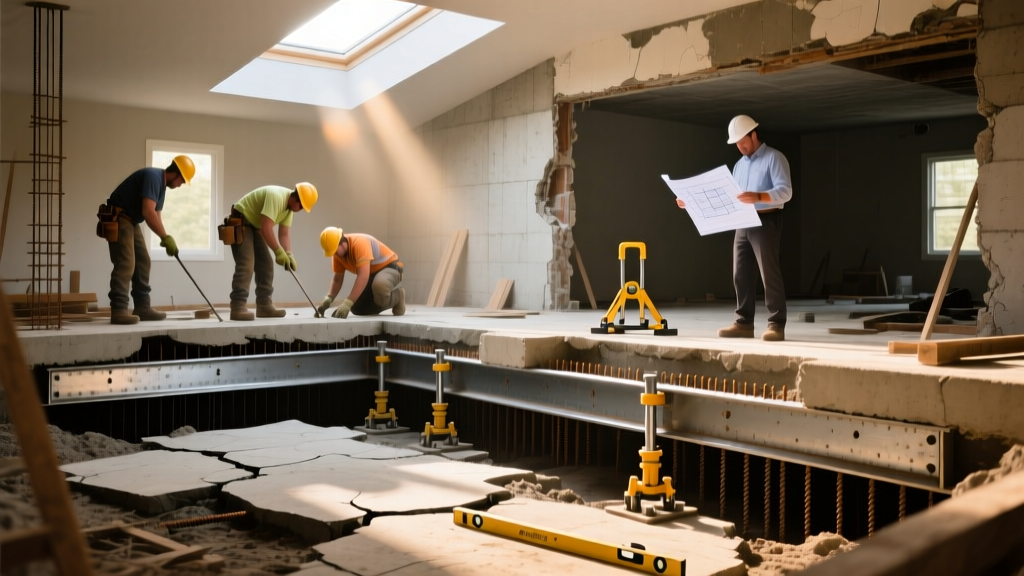
Asking how much does it cost to repair foundation issues is structurally equivalent to asking how much it costs to fix a failing bridge. The answer depends entirely on the load path, the failure mechanism, and the geotechnical conditions driving the movement. In 2026, foundation repair costs range from $500 for non-structural epoxy crack injections to over $45,000 for comprehensive deep underpinning and structural stabilization.
From a structural analysis perspective, foundation failures are not random; they are predictable responses to exceeded material limits or soil bearing capacities. Homeowners who treat structural shear cracks as mere cosmetic blemishes often face catastrophic load redistribution, leading to roof framing separation and masonry veneer collapse. Accurate costing requires first identifying whether the issue stems from differential settlement, hydrostatic lateral pressure, or expansive soil heave.
Cost Breakdown by Structural Failure Mode
To accurately budget for a repair, you must align the cost with the specific structural defect. The following matrix details 2026 market rates for primary foundation repair methodologies, categorized by their underlying geotechnical or structural trigger.
| Failure Mechanism | Structural Symptom | Primary Repair Method | 2026 Cost Range |
|---|---|---|---|
| Differential Settlement | Diagonal drywall cracks, sticking doors, slab sloping > 1% | Deep Underpinning (Helical/Push Piers) | $1,900 - $3,200 per pier |
| Hydrostatic Lateral Pressure | Horizontal cracking, inward bowing of basement walls | Carbon Fiber Straps or Steel I-Beams | $1,200 - $2,500 per wall |
| Expansive Soil Heave | Center-lift of slab-on-grade, perimeter compression cracks | Moisture Control & Mudjacking/Polyjacking | $12 - $25 per sq. ft. |
| Concrete Shrinkage | Vertical hairline cracks (< 1/8 inch), no vertical displacement | Epoxy / Polyurethane Injection | $500 - $1,200 per crack |
Deep Dive: Underpinning Costs and Load Transfer Mechanics
When a structure experiences differential settlement, the soil in the active zone (typically the top 5 to 8 feet) has failed to support the dead and live loads of the structure. According to geotechnical research on expansive soils and foundation movement, bypassing this active zone to transfer loads to stable, load-bearing strata or bedrock is the only permanent structural fix. This is achieved via underpinning, but the method dictates the cost and engineering viability.
Push Piers vs. Helical Piers: A Structural Comparison
- Push Piers (Resistance Piers): These utilize the actual weight of the structure to hydraulically drive steel pipe sections into the ground. Cost: $1,900 - $2,700 per pier. Push piers are highly cost-effective for heavy masonry or multi-story structures but can fail to drive properly on lighter wood-framed buildings due to insufficient reactionary weight.
- Helical Piers: These feature helical bearing plates welded to a central steel shaft and are torqued into the soil like a screw. Cost: $2,400 - $3,200 per pier. Helical piers do not rely on the structure's weight for installation, making them the mandatory choice for lightweight structures, new construction pre-stabilization, or situations where bedrock is exceptionally deep (50+ feet). Installation torque is directly correlated to load capacity, providing real-time structural verification.
Evaluating Lateral Load Failures in Basement Walls
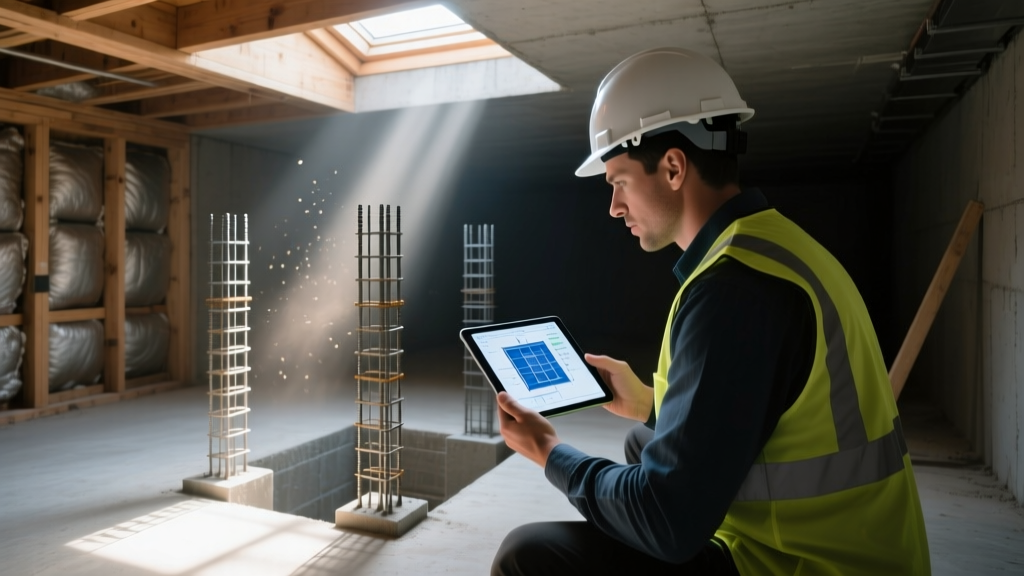
Basement walls act as retaining walls. When exterior drainage fails, the soil becomes saturated, increasing the lateral earth pressure exponentially. As documented in standard foundation defect analysis protocols, horizontal cracking near the mid-height of a poured concrete or CMU (Concrete Masonry Unit) wall is a critical indicator of shear failure.
Bracing Methodologies and Cost Thresholds
The repair cost for a bowing basement wall depends entirely on the measured deflection (inward movement):
- Deflection < 2 Inches (Carbon Fiber Straps): High-tensile carbon fiber grids bonded with structural epoxy can halt further movement. Cost: $1,200 - $1,800 per wall. This relies on the wall's remaining compressive strength and is only viable if the wall has not yielded past its elastic limit.
- Deflection > 2 Inches (Steel I-Beams / Wall Anchors): At this stage, the masonry has undergone plastic deformation. Carbon fiber will delaminate under the continued hydrostatic load. You must install vertical steel I-beams anchored to the floor slab and top floor joists, or excavate the exterior and install tie-back earth anchors. Cost: $2,500 - $5,500 per wall.
The Hidden Upfront Cost: Structural Engineering Analysis
The most critical line item in your budget is not the repair itself, but the diagnostic phase. Many foundation repair companies offer 'free inspections.' From a structural standpoint, these are sales presentations, not engineering analyses. A contractor's incentive is to sell piers; an engineer's incentive is to solve the load path anomaly.
Budget $800 to $1,500 for an independent Structural Engineer (PE) to conduct a differential elevation survey, analyze the superstructure framing, and write a stamped repair specification. Furthermore, if your region features highly plastic clays (PI > 30), budget an additional $1,500 to $3,000 for a geotechnical soil boring to determine the exact depth of the load-bearing strata before accepting an underpinning bid. For comprehensive guidelines on residential structural resilience and foundation load paths, refer to the FEMA Building Science foundation publications.
Diagnostic Decision Matrix: Is Your Crack a Structural Threat?
Use this framework to determine if a foundation crack requires immediate structural intervention or standard maintenance:
- Vertical, < 1/8 inch, uniform width: Concrete shrinkage. Non-structural. Seal with polyurethane to prevent moisture ingress. Cost: < $800.
- Diagonal, tapering (wider at top/bottom): Differential settlement. Structural. Requires elevation survey and potential underpinning. Cost: $15,000+.
- Horizontal, mid-wall, accompanied by efflorescence: Hydrostatic shear failure. Critical structural threat. Requires immediate lateral bracing and exterior drainage correction. Cost: $3,000+.
- Stair-step in CMU blocks, > 1/4 inch width: Shear displacement due to localized settlement or lateral thrust. Structural. Requires engineering assessment. Cost: Varies based on root cause.
Actionable Framework: Evaluating a Contractor's Bid
When reviewing proposals to repair foundation issues, do not simply select the lowest bidder. Foundation repair involves altering the primary load path of your home. Demand the following documentation in your contract:
- Factor of Safety (FoS): The proposed pier system must have a minimum FoS of 2.0 against the calculated dead and live loads of the structure.
- Maximum Lift Limits: Specify that the contractor will lift the structure in increments no greater than 1/8 inch per day to prevent sudden stress fractures in the superstructure framing and drywall.
- Warranty Transferability: Ensure the warranty covers not just the steel materials, but the structural performance (i.e., a guarantee against future settlement exceeding 1/4 inch), and that it is backed by a third-party insurance trust, not just the local LLC which may dissolve.
By treating foundation repair as a structural engineering project rather than a simple landscaping or concrete patching job, you ensure the capital invested permanently stabilizes the structure, protecting both the building's integrity and its long-term market valuation.
Written by
Elena RodriguezElena Rodriguez is a civil engineer and technical writer specializing in concrete technology, masonry systems, and ASTM/ACI compliance. She earned her B.S. in Civil Engineering from Texas A&M University and spent a decade at a materials testing laboratory, performing over 2,000 concrete compressive strength tests and masonry prism evaluations. Elena is an ACI-certified Field Testing Technician (Grade I) and a member of ASTM Committee C12 on Natural Building Stone. She currently consults on forensic engineering cases involving concrete failures and moisture intrusion. Based in San Antonio, TX, Elena is a proud member of the Society of Women Engineers (SWE) and coaches her daughter's FIRST Robotics team.
More from Elena Rodriguez
View all
Walls & Panels
Cost Analysis: Light Gauge Steel Framing Advantages and Disadvantages
Evaluate light gauge steel framing advantages and disadvantages through a strict cost analysis lens, comparing material, labor, and lifecycle expenses.
Aug 4, 2026

Walls & Panels
Gypsum Board Types: Exact Specifications, Thickness & Dimensions
Compare standard, Type X, and moisture-resistant gypsum board types. Get exact specifications, thicknesses, dimensions, and ASTM standards for your project.
Aug 4, 2026

Fire Resistance
Best Fire-Resistant Outdoor Decking Materials: 2026 Buyer Guide
Discover the best fire-resistant outdoor decking materials for 2026. Compare Class A PVC, aluminum, and hardwood options for WUI compliance and safety.
Aug 4, 2026