6 Types of Foundation Repair: Methods, Costs, and Use Cases
Compare 6 types of foundation repair, including steel piers, helical piers, and slabjacking. Learn costs, use cases, and how to fix structural settlement.

Foundation failure is rarely a single structural disease; it is a complex symptom of soil-structure interaction, hydrostatic pressure, or subgrade erosion. In 2026, structural engineers and geotechnical specialists categorize foundation repairs not just by the hardware used, but by the specific failure mode of the soil. Applying a slabjacking solution to a differential settlement problem, or using carbon fiber on a wall experiencing shear stress, will result in catastrophic secondary failures.
This guide breaks down the six primary types of foundation repair, detailing the exact engineering specifications, 2026 market pricing, and the specific geotechnical edge cases where each method succeeds or fails.
Diagnostic Matrix: Matching the Failure Mode to the Repair
Before selecting a repair method, you must identify the vector of failure. Use this diagnostic matrix to map your structural symptoms to the correct engineering intervention.
| Visible Symptom | Underlying Geotechnical Cause | Primary Repair Method |
|---|---|---|
| Stair-step cracking in masonry/brick | Differential settlement (expansive clay or washout) | Steel Push Piers or Helical Piers |
| Interior slab sloping or sinking | Subgrade erosion, plumbing leaks, or poor compaction | Polyurethane Foam Jacking |
| Basement walls bowing inward | Lateral earth pressure, hydrostatic load | Carbon Fiber Straps or Deadman Anchors |
| Seasonal cracking (opens in summer, closes in winter) | Moisture fluctuation in expansive soils | Moisture Control Systems & Root Barriers |
1. Steel Push Piers (Resistance Piers)
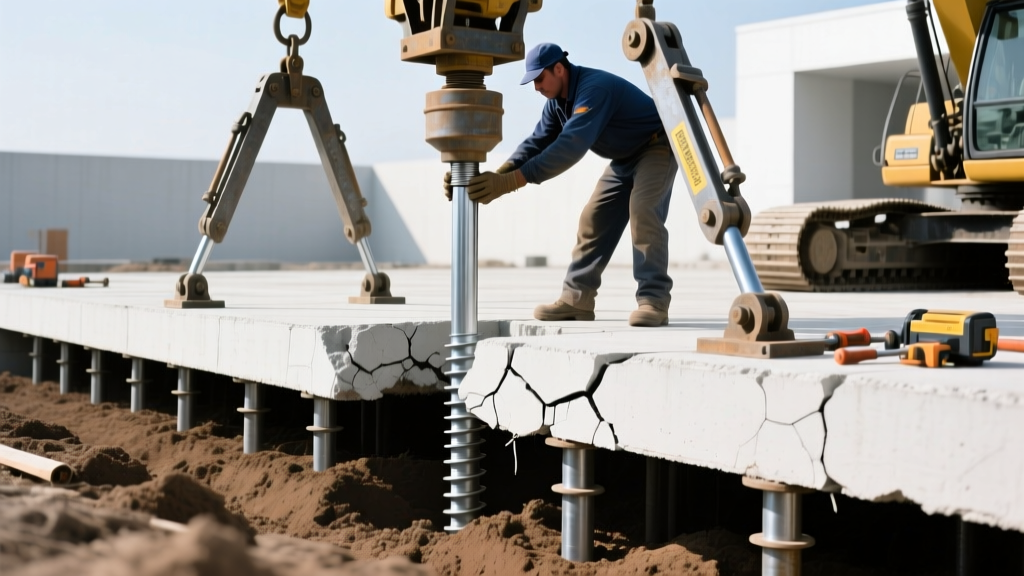
Push piers are the industry standard for stabilizing foundations experiencing differential settlement due to unstable upper soil strata. They rely on the weight of the structure itself to drive steel tubing down to load-bearing bedrock.
Engineering Specifications
- Material: High-strength, hot-dipped galvanized steel tubing (typically 2.875-inch or 3.5-inch outer diameter).
- Load Capacity: Modern systems like the ECP (Earth Contact Products) Model 400 can support up to 70,000 lbs per pier, with a safety factor of 2.0.
- Installation Depth: Driven hydraulically until 'refusal' (bedrock) is reached, typically 20 to 60 feet deep.
Edge Cases & Limitations
Push piers require the structure to be heavy enough to provide the resistance needed to drive the pier. They are not suitable for lightweight structures (like small porches or single-story wood-frame additions) because the structure will lift before the pier reaches bedrock. Furthermore, if bedrock is deeper than 100 feet, skin friction on the steel shaft can exceed the hydraulic ram's capacity, causing the pier to buckle.
2. Helical Piers
When bedrock is too deep for push piers, or the structure is too light to provide driving resistance, helical piers are the mandated solution. These act like massive steel screws, threading into the soil until the torque applied correlates to a specific load-bearing capacity.
Engineering Specifications
- Material: Square shaft (e.g., Chance SS5, 1.5-inch square) or round shaft with welded helical plates.
- Torque-to-Capacity Correlation: Installers use the formula: Capacity = Torque x K-factor. Achieving 5,000 ft-lbs of torque on a standard SS5 shaft yields roughly 50,000 lbs of axial capacity.
- Use Case: Ideal for new construction tie-downs, lightweight sunrooms, and deep-soil regions like the Gulf Coast where bedrock is hundreds of feet down.
3. Polyurethane Foam Jacking (Polyjacking)
For sunken concrete slab-on-grade foundations, driveways, and warehouse floors, polyjacking has entirely replaced traditional mudjacking (slabjacking) in professional applications. It involves injecting a two-part high-density polymer beneath the slab.
The Injection Process
- Drilling: 5/8-inch holes are drilled through the slab in a precise grid pattern.
- Injection: A heated, plural-component pump injects liquid resin. The chemical reaction causes the foam to expand 20 to 30 times its liquid volume.
- Lifting: The expansion creates controlled hydraulic pressure, lifting the slab back to grade within 15 minutes.
- Curing: The foam cures to 90% of its ultimate strength in under 15 minutes, allowing immediate heavy traffic.
Material Specs
Industry-leading resins like Alchemy Polymers AP-Lift 4.0 yield a cured density of 4.0 lbs per cubic foot and a compressive strength exceeding 6,000 PSF. Unlike cementitious mudjack slurry, which weighs 120 lbs/cu ft and can cause secondary soil subsidence, polyurethane is practically weightless (approx. 2-4 lbs/cu ft) and is impervious to water erosion.
4. Carbon Fiber Wall Straps
Bowing basement walls are caused by lateral earth pressure. Carbon fiber straps provide an incredibly high tensile strength solution that requires zero excavation and preserves interior square footage.
Engineering Specifications
- Material: Aerospace-grade Kevlar and carbon fiber weave, bonded to the concrete with structural, high-modulus epoxy.
- Yield Strength: Systems like Fortress Stabilization offer tensile strengths exceeding 100,000 PSI, making them stronger than steel I-beams of the same footprint.
- Spacing: Typically installed every 48 inches on center, anchored to the floor joist system at the top and the slab at the bottom.
The 2-Inch Rule
Carbon fiber is strictly a tensile restraint. It cannot push a wall back into plumb. According to structural engineering standards, carbon fiber straps are only viable if the wall is bowing less than 2 inches inward. If deflection exceeds 2 inches, the wall must be excavated and pushed back with hydraulic jacks before straps are applied, or deadman anchors must be used instead.
5. Deadman Wall Anchors (Tiebacks)
When a basement wall has deflected beyond the 2-inch limit, or when the wall is constructed of hollow cinderblock lacking the tensile integrity to hold epoxy, deadman anchors are required.
A steel rod is driven through the failing wall and out into the yard, where it is attached to a galvanized steel earth anchor buried in stable, undisturbed soil. By tightening the nut on the interior wall plate, the wall is physically winched back toward plumb over several weeks. This method requires exterior excavation to bury the anchor plate, making it more invasive and expensive than interior-only solutions.
6. Moisture Control & Root Barriers
Hardware repairs are useless if the soil moisture profile continues to fluctuate. Expansive clay soils (common in Texas, Colorado, and the Dakotas) swell when wet and shrink when dry, causing seasonal foundation heave and settlement.
As detailed by researchers at the Texas A&M AgriLife Extension, maintaining a constant soil moisture level around the perimeter is critical. This involves:
- Root Barriers: Installing 24-inch deep HDPE plastic trenches between the foundation and large trees to prevent roots from extracting subgrade moisture.
- Automated Drip Systems: Subsurface soaker hoses tied to rain sensors to maintain the 'active zone' (top 5 feet of soil) at a constant moisture content.
- French Drains: Perforated pipe wrapped in filter fabric, buried in washed gravel, to intercept groundwater before it creates hydrostatic pressure against the footing.
2026 Foundation Repair Cost Matrix
Pricing varies based on regional labor rates, soil conditions, and access limitations. The following matrix reflects national average costs for 2026.
| Repair Method | Pricing Metric | Average 2026 Cost | Lifespan / Warranty |
|---|---|---|---|
| Steel Push Piers | Per Pier (approx. 7-10 ft depth) | $1,800 - $2,600 | Lifetime (Transferable) |
| Helical Piers | Per Pier (approx. 15-20 ft depth) | $1,500 - $2,300 | Lifetime (Transferable) |
| Polyurethane Jacking | Per Square Foot | $12 - $18 | 10 - 20 Years |
| Carbon Fiber Straps | Per Strap (Vertical) | $650 - $950 | Lifetime (Material) |
| Deadman Anchors | Per Anchor (Includes excavation) | $900 - $1,400 | 25+ Years |
| Root Barriers | Per Linear Foot | $65 - $95 | 50+ Years |
Making the Final Decision
Choosing the correct foundation repair type requires looking past the symptoms and addressing the geotechnical root cause. If your home is experiencing differential settlement on expansive clay, steel piers combined with moisture control barriers offer the only permanent stabilization. If your issue is isolated to a sunken garage slab, polyurethane foam provides a rapid, minimally invasive fix. Always demand torque logs for helical piers, refusal depth charts for push piers, and independent engineering sign-off before finalizing any structural intervention.
Written by
Elena RodriguezElena Rodriguez is a civil engineer and technical writer specializing in concrete technology, masonry systems, and ASTM/ACI compliance. She earned her B.S. in Civil Engineering from Texas A&M University and spent a decade at a materials testing laboratory, performing over 2,000 concrete compressive strength tests and masonry prism evaluations. Elena is an ACI-certified Field Testing Technician (Grade I) and a member of ASTM Committee C12 on Natural Building Stone. She currently consults on forensic engineering cases involving concrete failures and moisture intrusion. Based in San Antonio, TX, Elena is a proud member of the Society of Women Engineers (SWE) and coaches her daughter's FIRST Robotics team.
More from Elena Rodriguez
View all
Walls & Panels
Cost Analysis: Light Gauge Steel Framing Advantages and Disadvantages
Evaluate light gauge steel framing advantages and disadvantages through a strict cost analysis lens, comparing material, labor, and lifecycle expenses.
Aug 4, 2026

Walls & Panels
Gypsum Board Types: Exact Specifications, Thickness & Dimensions
Compare standard, Type X, and moisture-resistant gypsum board types. Get exact specifications, thicknesses, dimensions, and ASTM standards for your project.
Aug 4, 2026

Fire Resistance
Best Fire-Resistant Outdoor Decking Materials: 2026 Buyer Guide
Discover the best fire-resistant outdoor decking materials for 2026. Compare Class A PVC, aluminum, and hardwood options for WUI compliance and safety.
Aug 4, 2026