Dallas TX Foundation Repair Cost Guide: 2026 Pricing & Methods
Discover the true foundation repair cost in Dallas, TX for 2026. Compare steel vs. concrete piers, soil factors, and permit requirements for your home.
The Dallas Soil Factor: Why North Texas Foundations Fail
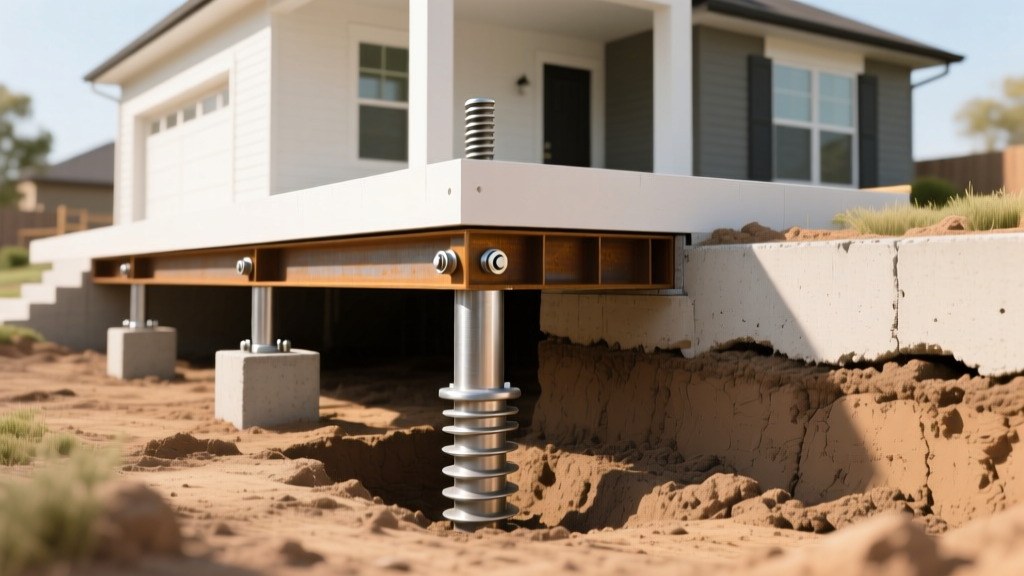
When evaluating the foundation repair cost in Dallas, TX, homeowners must first understand the geological adversary beneath their feet. The majority of the Dallas-Fort Worth metroplex sits atop the Blackland Prairie, characterized by highly expansive clay soils. According to the Foundation Performance Association, these soils possess a Plasticity Index (PI) frequently exceeding 45, meaning they undergo drastic volumetric changes based on moisture content.
During prolonged North Texas droughts, the clay desiccates and shrinks, causing the foundation to settle. When heavy seasonal rains return, the soil swells unevenly, leading to differential heaving. This constant cycle of shrink-swell fatigue is the primary driver of structural distress in the region, necessitating deep foundation underpinning rather than superficial patching.
Properties in eastern Dallas County often transition into the Austin Chalk formation. While chalk is more stable than Blackland clay, it features extensive fracturing and subsurface voids. Foundations built over fractured chalk require specialized drilled bell piers that bypass the fractured zone entirely, which significantly alters the baseline repair budget.
2026 Foundation Repair Cost Breakdown in Dallas
The average foundation repair cost in Dallas, TX ranges from $6,500 to $14,500 for a standard 2,500-square-foot slab-on-grade home requiring 15 to 25 piers. However, pricing fluctuates heavily based on the underpinning method selected. Below is the current 2026 pricing matrix for North Texas repair methods.
| Repair Method | Average Cost (Per Pier / Sq Ft) | Depth to Refusal | Best Application |
|---|---|---|---|
| Pressed Concrete Piers | $160 - $240 per pier | 12 - 18 feet | Standard slab settlement in stable clay zones |
| Pressed Steel Piers | $260 - $380 per pier | 15 - 25+ feet | Heavy structural loads, reaching deep stable strata |
| Drilled Bell Piers | $650 - $950 per pier | 20 - 30+ feet | New construction, severe Austin Chalk voids |
| Polyurethane Foam Jacking | $18 - $28 per sq ft | N/A (Surface) | Lifting interior slab floors, void filling |
| Helical Piers | $300 - $450 per pier | 15 - 30 feet | Lightweight structures, tie-downs for uplift |
Method Deep-Dive: Steel vs. Concrete Piers
In the Dallas market, the debate between pressed concrete and pressed steel piers dominates contractor estimates. Pressed concrete cylinders are cost-effective but rely on skin friction in the clay. If the clay dries out deeply during a severe drought, concrete piers can experience 'negative skin friction,' dragging the pier down with the soil. Pressed steel piers, featuring a 2-7/8 inch outer diameter, cut through the active clay zone to bear directly on load-bearing strata or bedrock. While steel piers increase the initial project cost by roughly 40%, they offer superior long-term stability in North Texas climates.
Hidden Costs: Engineering, Permits, and Restoration
Contractor estimates rarely represent the final out-of-pocket expense. To accurately budget your Dallas foundation repair, you must account for the following mandatory and ancillary costs:
- Independent Structural Engineer (PE) Report: $600 - $1,200. Never rely solely on a contractor's free assessment. The American Society of Civil Engineers recommends hiring an independent PE to design the repair plan and dictate the exact number and depth of piers required.
- City of Dallas Permits: $250 - $450. The Dallas Development Services Department requires building permits for structural foundation repairs. Your contractor must pull this permit and schedule municipal inspections.
- Plumbing Testing & Repairs: $350 - $1,500. Lifting a slab stresses underground PVC and cast-iron waste lines. A hydrostatic pressure test is mandatory before and after the lift. If a line breaks during the lift, trenching and repair will add to the total.
- Landscaping & Hardscape Restoration: $1,000 - $4,000+. Excavating access trenches for piers destroys flowerbeds, sidewalks, and patios. Budget for concrete saw-cutting, removal, and post-repair landscaping.
Slab-on-Grade vs. Pier and Beam: Regional Variances
The architectural era of your Dallas home dictates the foundation type and subsequent repair methodology.
Slab-on-Grade (Post-1970s Construction)
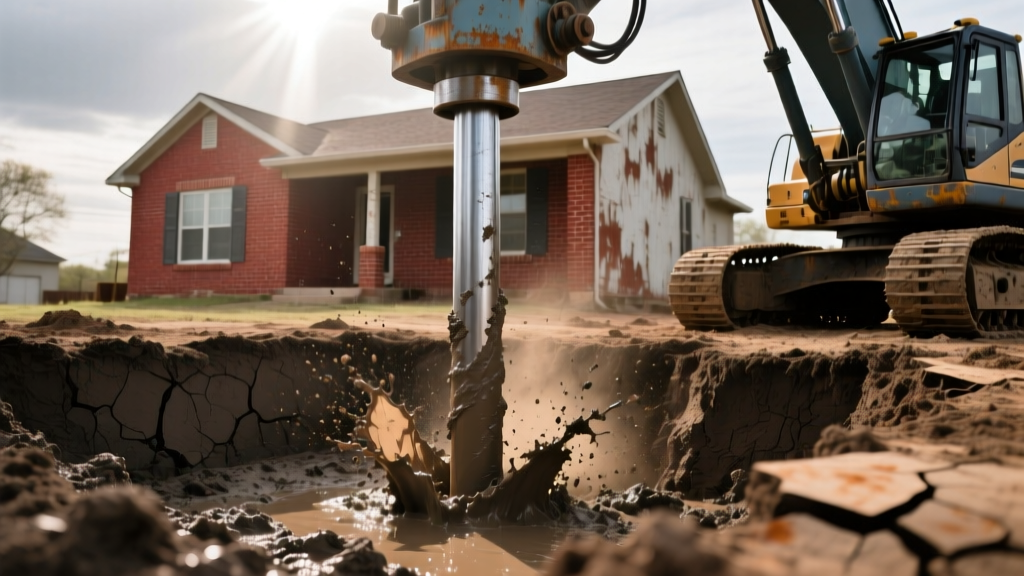
Most modern Dallas homes utilize post-tensioned or conventionally reinforced concrete slabs. Repairs involve exterior excavation, driving piers along the grade beam, and utilizing hydraulic jacks to lift the perimeter. Interior slab settlement is addressed via polyurethane foam injection, which requires drilling 5/8-inch holes through the interior flooring.
Pier and Beam (Pre-1960s Construction)
Neighborhoods like Lakewood, Munger Place, and Highland Park feature historic pier and beam homes. Repair costs here are generally lower per point of contact but require more labor. Contractors must access the crawl space to replace rotted wooden shims, install new concrete pad-and-block supports, or replace compromised wooden joists. Crawl space encapsulation and vapor barrier installation ($3 - $6 per sq ft) are often required concurrently to manage the high humidity trapped beneath Dallas historic homes.
The Texas A&M AgriLife Extension strongly advocates for consistent foundation watering in expansive soil regions. Installing an automated soaker hose system or a subsurface drip irrigation loop around your home's perimeter costs between $800 and $1,500. This is a fraction of the cost of structural underpinning and is often required by foundation repair companies to keep their lifetime warranties valid.
Navigating Dallas Root Barriers and Tree Influence
Dallas is heavily canopied with Live Oaks, Cedar Elms, and Bois d'Arc trees. While beautiful, these species possess aggressive, moisture-seeking root systems that desiccate the soil directly beneath foundation grade beams. If a large tree is located within 15 feet of a settling foundation, installing a high-density polyethylene (HDPE) root barrier is mandatory before underpinning.
Root barriers cost between $60 and $95 per linear foot. Failing to install a root barrier allows the tree to continue extracting moisture from the newly stabilized soil, leading to a secondary settlement event that will void your structural warranty.
Dallas Foundation Repair FAQ
Will my homeowners insurance cover foundation repair in Dallas?
Standard HO-3 policies in Texas explicitly exclude earth movement, soil expansion, and settling. Insurance will only cover foundation damage if it is the direct, sudden result of a covered peril, such as a burst underground plumbing line washing away the supporting soil. Always request a hydrostatic test if you suspect a plumbing leak is causing sudden, localized settlement.
How long does a typical Dallas foundation repair project take?
The physical underpinning of an average 20-pier slab project takes 3 to 5 days. However, the total timeline from initial engineering assessment to final municipal inspection and landscaping restoration typically spans 4 to 6 weeks. Delays often occur during the Dallas summer months when municipal permit offices experience high volumes of structural repair applications due to drought-induced settlement.
Should I repair the foundation before or after remodeling?
Always complete structural underpinning before interior remodeling. Lifting a foundation will inevitably cause drywall cracks, door frame shifts, and tile pop-ups. If you remodel first, the subsequent foundation lift will destroy your new finishes, resulting in thousands of dollars in wasted renovation capital.
Written by
Marcus ChenMarcus Chen is a licensed structural engineer (PE) and building materials analyst with over 12 years of experience across residential, commercial, and industrial construction. He holds a Master of Science in Civil Engineering from UC Berkeley and spent six years at Thornton Tomasetti before transitioning to independent consulting and technical writing. Marcus specializes in material selection for seismic-prone regions, concrete reinforcement strategies, and lifecycle cost analysis. His work has been cited by the American Concrete Institute (ACI) and the Structural Engineers Association of California (SEAOC). When he is not on a job site or at his desk, you will find him hiking the Sierra Nevada or restoring a 1920s craftsman bungalow in Oakland, CA.
More from Marcus Chen
View all
Construction Cost
How Much Did the Eiffel Tower Cost to Build?
How much did the Eiffel Tower cost to build in 1889? We adjust for inflation and compare its budget to modern skyscraper construction.
Aug 4, 2026

Fire Resistance
What Is a Fire Resistant Material? Testing & Certification Guide
Discover what is a fire resistant material through ASTM and UL testing. Learn how fire ratings, certifications, and assemblies work in construction.
Aug 4, 2026

Construction Cost
How Much Did the Burj Khalifa Cost to Build?
How much did the Burj Khalifa cost to build? We break down the $1.5B project and extract 5 money-saving strategies for your next build.
Jul 30, 2026