Types of Makeup Foundation Assemblies: Cost Analysis
Analyze the material costs and structural layers of slab, crawlspace, and basement foundation makeup assemblies for residential construction.

Defining Foundation Makeup in Structural Engineering
While the phrase might trigger thoughts of cosmetics in retail search algorithms, in construction terminology, the types of makeup foundation assemblies refer to the precise cross-sectional stratigraphy—the layered material composition—of a structural foundation system. A foundation is rarely just a monolithic block of concrete; it is a carefully engineered stack of materials designed to manage structural loads, capillary water, thermal transfer, and soil gases. Understanding the specific makeup of these layers is critical for accurate cost estimation, code compliance, and long-term structural durability.
According to the U.S. Department of Energy, the thermal and moisture performance of a building is heavily dictated by its foundation assembly. In 2026, with updated International Energy Conservation Code (IECC) requirements mandating stricter continuous insulation and radon mitigation protocols, the material costs associated with foundation stratigraphy have shifted significantly. Below is a detailed cost analysis and technical breakdown of the three primary foundation makeup types: slab-on-grade, sealed crawlspace, and full basement assemblies.
Slab-on-Grade Foundation Makeup: Layer Costs & Specifications
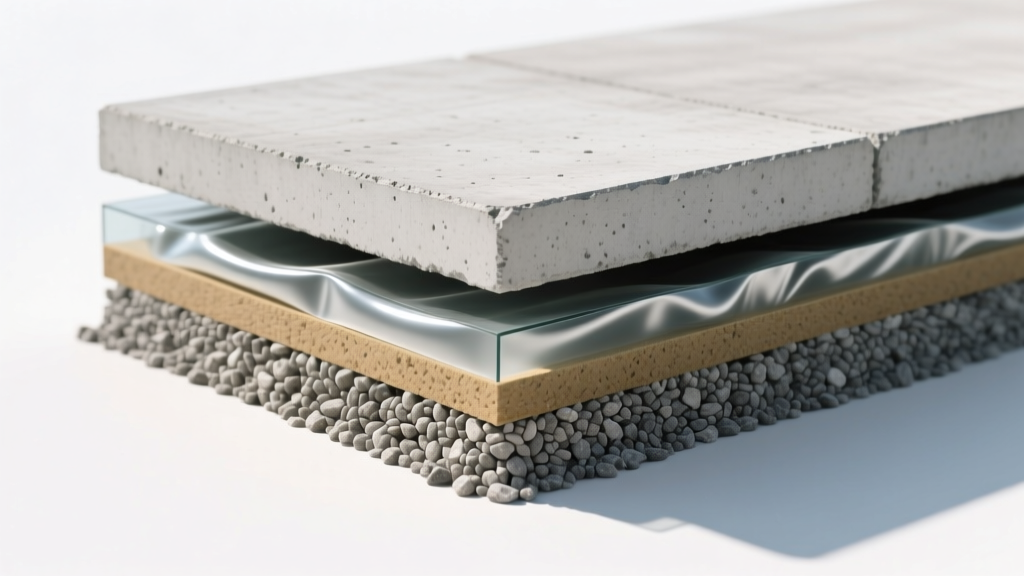
The slab-on-grade assembly is the most common foundation type in temperate and warm climates. The 'makeup' of a high-performance slab extends from the undisturbed subgrade up to the finished floor surface. Cutting corners on the intermediate layers leads to slab curling, moisture vapor emission, and thermal bridging.
Standard High-Performance Slab Stratigraphy
- Compacted Subgrade: Native soil compacted to 95% Proctor density to prevent differential settlement.
- Capillary Break: 4 inches of washed, angular 3/4-inch crushed stone (ASTM D448). This layer breaks capillary suction from the water table and serves as a passive radon ventilation plenum.
- Vapor Retarder: A 15-mil polyolefin membrane (ASTM E1745 Class A), such as Stego Wrap. Standard 6-mil polyethylene is no longer considered best practice due to high puncture rates during rebar placement.
- Thermal Insulation: 2 inches of EPS (ASTM C578 Type II) or XPS rigid foam, yielding R-10 to R-12. Under-slab insulation is now mandatory in most IECC climate zones 4 and higher.
- Concrete Slab: 4-inch thick, 4000 PSI mix design with a low water-cement ratio (0.45) and fiber mesh reinforcement to minimize plastic shrinkage cracking.
- Subgrade Prep & Capillary Break: $1.15 - $1.40
- 15-mil Vapor Barrier: $0.35 - $0.50
- R-10 Rigid Insulation: $1.20 - $1.60
- 4-inch Concrete Slab (Material & Finish Labor): $3.50 - $4.50
- Total Slab Makeup Cost: $6.20 - $8.00 per sq. ft.
Crawlspace Assembly: Sealed vs. Vented Makeup Costs
Crawlspace foundations elevate the wood-framed superstructure above the ground, providing access to plumbing and HVAC systems. The 'makeup' of the crawlspace ground and perimeter walls dictates whether the space acts as a vented buffer zone or a sealed, conditioned plenum. The industry standard has aggressively shifted toward sealed crawlspaces to mitigate mold, wood rot, and energy loss.
Sealed Crawlspace Ground Makeup
A sealed crawlspace requires a robust ground vapor barrier that is sealed to the foundation walls and piers. The assembly typically includes a 20-mil reinforced polyethylene liner (often with a polyester scrim for tear resistance). Seams are overlapped by 6 inches and sealed with compatible mastic tape. Additionally, the perimeter foundation walls must be insulated with rigid foam or closed-cell spray foam rather than insulating the floor joists above.
While traditional vented crawlspaces with 6-mil ground poly and fiberglass batt insulation between joists remain legal in some jurisdictions, building science experts at the Building Science Corporation strongly advise against them in humid climates. The cost difference to upgrade to a sealed makeup assembly is marginal compared to the long-term risk of floor joist decay and elevated indoor humidity levels.
Crawlspace Assembly Cost Matrix
| Assembly Component | Vented Makeup Cost (per sq. ft.) | Sealed Makeup Cost (per sq. ft.) |
|---|---|---|
| Ground Vapor Barrier | $0.15 (6-mil Poly) | $1.85 (20-mil Reinforced) |
| Wall Insulation | $0.00 (N/A) | $1.40 (2-inch Rigid Foam) |
| Floor Joist Insulation | $1.60 (R-19 Fiberglass Batt) | $0.00 (N/A) |
| Dehumidification / Venting | $0.40 (Foundation Vents) | $1.10 (Dedicated Dehumidifier) |
| Total Estimated Cost | $2.15 | $4.35 |
Full Basement Foundation Makeup: Waterproofing and Thermal Layers
Basement foundations represent the most complex and expensive makeup assembly. Because the habitable space is situated below grade, the stratigraphy must manage hydrostatic pressure, bulk water intrusion, and significant thermal differentials. The makeup of a basement is divided into the exterior envelope and the interior slab assembly.
Exterior Wall Makeup Stratigraphy
The exterior face of a poured concrete or CMU basement wall requires a multi-stage waterproofing and drainage makeup. Damp-proofing (a simple asphalt spray) is insufficient for habitable spaces and is prohibited by code in areas with expansive soils or high water tables. A proper waterproofing makeup includes:
- Surface Prep: Parging or grinding the concrete to remove form lines and honeycombs.
- Fluid-Applied Membrane: A thick, elastomeric asphalt-polyurethane coating (e.g., Tremco Paraseal) applied at 60-90 wet mils to bridge hairline cracks.
- Protection/Drainage Board: A high-density polyethylene (HDPE) dimple mat that relieves hydrostatic pressure and channels water down to the footing drain.
- Footing Drain: A 4-inch perforated PVC pipe surrounded by washed gravel, wrapped in filter fabric to prevent siltation.
Interior Basement Slab Makeup
The interior slab makeup mirrors the slab-on-grade assembly but often requires thicker sub-slab insulation (R-15 to R-20) and a mandatory sub-slab depressurization system for radon mitigation. The inclusion of a 4-inch crushed stone layer beneath the 15-mil vapor barrier is non-negotiable to ensure the radon vent system functions correctly.
Comparative Cost Matrix: Foundation Types (2026 Estimates)
The following table synthesizes the total material and specialized labor costs for the foundation makeup assemblies. Note that these figures represent the makeup layers only and exclude bulk excavation, forming, and the structural concrete pouring of footings and stem walls. Data aligns with regional averages reported by the National Association of Home Builders (NAHB) construction cost surveys.
| Foundation Type | Primary Cost Driver | Estimated Makeup Cost | Best Climate Application |
|---|---|---|---|
| Slab-on-Grade | Sub-slab insulation & vapor barrier | $6.20 - $8.00 / sq. ft. (floor area) | Warm, flat terrains, expansive clays |
| Sealed Crawlspace | Heavy-duty liner & wall insulation | $4.35 / sq. ft. (ground footprint) | Humid, coastal, flood-prone zones |
| Full Basement | Exterior waterproofing & drainage mat | $9.50 - $14.00 / lin. ft. (wall) + slab costs | Cold climates, sloped lots, frost lines > 32" |
| FPSF (Frost-Protected Shallow) | Wing insulation & perimeter rigid foam | $7.50 - $9.50 / lin. ft. (perimeter) | Extreme cold, shallow bedrock sites |
Code Compliance and IECC Requirements
When specifying the types of makeup foundation assemblies for new construction, adherence to the latest IECC standards is mandatory. The code strictly dictates the minimum R-values for continuous foundation insulation based on climate zone. For example, in Climate Zone 5, slab-on-grade foundations require R-10 continuous insulation extending 2 feet down from the top of the slab, or R-10 under the entire slab area. Furthermore, the integration of sub-slab radon ventilation layers is now a baseline requirement in over 35 states, making the 4-inch capillary break layer a critical, code-enforced component of the foundation makeup rather than an optional upgrade.
Ultimately, selecting the right foundation makeup assembly requires balancing initial material costs against the long-term thermodynamics of the structure. Investing in high-quality vapor retarders and rigid insulation during the stratigraphy phase prevents catastrophic moisture failures and ensures the structural longevity of the entire building envelope.
Written by
Sarah WhitfieldSarah Whitfield is a chartered quantity surveyor (MRICS) and construction cost analyst with 15 years of experience in material pricing, procurement strategy, and project budgeting. She earned her degree in Construction Management from the University of Reading (UK) and has worked on projects ranging from $2M custom homes to $180M mixed-use developments across North America and Europe. Sarah currently leads cost estimating for BuildMat Insight, maintaining a proprietary database of 4,000+ material price points updated quarterly. She is a frequent contributor to RSMeans cost data panels and has presented at the International Cost Engineering Council (ICEC) congress. Based in Denver, CO, Sarah is an avid trail runner and volunteer mentor for Women in Construction.
More from Sarah Whitfield
View all
Wood & Lumber
What Are the Different Types of Wood? A Builder's Guide
Compare structural softwoods, finish hardwoods, and engineered lumber. Analyze Janka ratings, MOE values, and 2026 pricing for construction.
Aug 4, 2026

Walls & Panels
Steel Framing vs Wood Framing: Corrosion and Moisture Defense
Compare steel framing vs wood framing for moisture resistance. Learn about galvanized coatings, condensation risks, and corrosion protection strategies.
Jul 21, 2026

Stone & Masonry
How to Cut Stone Veneer: Wet Saw vs Grinder Comparison
Compare the best tools for cutting stone veneer. We review wet saws, angle grinders, and chop saws to help you achieve clean, chip-free cuts.
Jul 21, 2026