Slab Foundation Repair Cost: Structural Analysis & Pricing Guide
Analyze slab foundation repair costs through a structural engineering lens. Discover pricing for piers, foam, and soil stabilization.

The Structural Mechanics of Slab Failure
Slab-on-grade foundations transfer structural loads directly to the underlying soil matrix. When the soil's bearing capacity fluctuates due to moisture variance or load overstress, the slab experiences differential settlement. From a structural engineering perspective, a concrete slab is essentially a rigid plate resting on an elastic foundation. When the support yields unevenly, bending moments and tensile stresses develop within the concrete. Standard residential slabs possess a modulus of rupture between 500 and 700 psi; once tensile stresses exceed this threshold, structural cracking initiates.
Understanding the precise failure mode is the first step in determining the accurate slab foundation repair cost. Contractors often apply a one-size-fits-all approach, but structural remediation must be matched to the specific geotechnical and mechanical failure.
Critical Distinction: Edge Drop vs. Center Lift
Edge Drop: Occurs when perimeter soils lose moisture and shrink, causing the exterior walls to drop while the interior remains supported. This induces negative bending moments, resulting in tension cracks on the top surface of the slab near the perimeter.
Center Lift: Occurs when moisture accumulates under the slab's center (often due to plumbing leaks or poor surface drainage), causing the middle to heave upward. This creates positive bending moments, leading to tension cracks on the bottom surface that propagate upward, often visible as diagonal cracks at interior door frames.
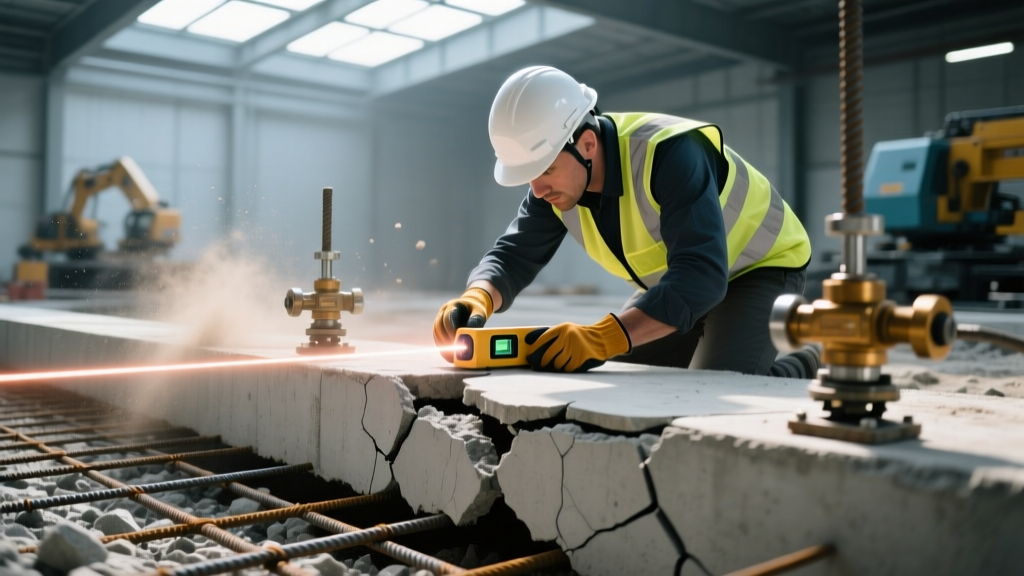
Diagnostic Matrix: Failure Mode to Repair Protocol
Before calculating costs, an independent structural engineer must map the physical symptoms to their geotechnical root causes. The following matrix outlines how specific structural failures dictate the required intervention.
| Structural Symptom | Geotechnical Cause | Engineered Repair Method |
|---|---|---|
| Perimeter settlement (>1.5 inches) | Expansive clay desiccation; edge drop | Steel push piers or helical piers driven to refusal |
| Interior slab voids & minor sinking | Soil erosion; poorly compacted fill dirt | Polyurethane deep injection (void filling) |
| Central heaving & interior drywall cracks | Moisture accumulation under slab center | Drainage correction, moisture barriers, selective mudjacking |
| Severe shear cracking; slab fragmentation | Active soil shear failure; load overstress | Complete foundation replacement or structural grade beam retrofit |
Slab Foundation Repair Cost by Structural Intervention
The cost of stabilizing a slab foundation is rarely a flat fee. It is a function of the linear footage affected, the depth to load-bearing strata, and the specific materials engineered for the soil profile. Below is the 2026 pricing matrix for primary structural interventions.
Deep Foundation Underpinning (Piers)
When a slab has experienced significant differential settlement due to unstable upper soil layers, the load must be transferred past the active zone to a stable stratum or bedrock.
- Steel Push Piers: $1,200 to $1,800 per pier. These are hydraulically driven using the weight of the structure as resistance. They require 25 to 30 tons of driving force and are ideal for heavy masonry or multi-story loads resting on the slab.
- Helical Piers: $1,500 to $2,500 per pier. Screwed into the ground, their load capacity is torque-correlated during installation. Helical piers are mandatory for lighter structures (where the building weight cannot provide sufficient reaction force for push piers) or for new construction retrofits.
- Drilled Concrete Piers (Bell-bottom): $800 to $1,400 per pier. Common in regions with shallow bedrock (e.g., parts of Texas). Requires heavy drilling equipment and significant curing time before loading.
Shallow Soil Stabilization & Void Filling
For slabs suffering from minor settlement (less than 1 inch) or sub-slab erosion where the structural integrity of the concrete remains intact, shallow interventions are appropriate.
- Polyurethane Foam Injection: $15 to $30 per square foot. High-density, closed-cell structural foam is injected through 5/8-inch ports. It expands to fill voids, compacts loose soils, and provides immediate lifting force. Cures in 15 minutes and adds negligible weight to the underlying soil.
- Cementitious Mudjacking (Slabjacking): $6 to $12 per square foot. Involves pumping a slurry of Portland cement, sand, and water. While cheaper, the slurry weighs up to 100 lbs per cubic foot, which can exacerbate settlement in highly compressible expansive clays. According to guidelines from the American Concrete Institute (ACI), mudjacking should be restricted to non-structural flatwork or slabs with verified high bearing-capacity subgrades.
Geotechnical Variables That Inflate Repair Costs
A structural engineer's assessment will often reveal secondary variables that drastically alter the final invoice. Homeowners must budget for these ancillary geotechnical corrections:
Hidden Cost Multipliers
- Depth to Refusal: Standard pier pricing assumes a depth of 15 to 25 feet. If soil borings reveal that stable strata lies at 50 feet, expect an additional $150 to $250 per 10-foot extension per pier.
- Interior Access Restrictions: Installing piers inside a home requires cutting the slab with a concrete saw, excavating manually, and patching the concrete. This adds $300 to $500 per interior pier location compared to exterior installations.
- Root Barriers: If large vegetation is causing localized soil desiccation, installing a high-density polyethylene (HDPE) root barrier costs $65 to $95 per linear foot, excavated to a minimum depth of 36 inches.
- Geotechnical Soil Testing: Before designing a pier layout, an engineer may require standard penetration tests (ASTM D1586). Soil boring reports typically cost $1,500 to $3,000 but prevent catastrophic under-design.
The Engineering Hierarchy of Foundation Assessment
To avoid unnecessary expenditures or inadequate repairs, follow this strict diagnostic hierarchy before signing any repair contract:
- Topographic Elevation Survey: A licensed engineer uses a digital manometer or optical level to map the slab's contour at 5-foot grid intervals. This identifies the exact vector and magnitude of settlement.
- Geotechnical Evaluation: Utilizing tools like the USDA NRCS Web Soil Survey, the engineer identifies the soil taxonomy (e.g., Montmorillonite clays with high plasticity indices) to predict future moisture-driven movement.
- Structural Load Calculation: Calculating the dead and live loads of the structure to determine the required factor of safety (typically 2.0 for helical piers) for the underpinning system.
Warning: The "Free Inspection" Conflict of Interest
Foundation repair companies employ sales representatives, not licensed structural engineers. A "free inspection" often results in a standardized, over-engineered pier layout designed to maximize revenue. Always invest $500 to $1,200 for an independent structural engineering report from a licensed Professional Engineer (PE). A PE has no financial stake in the repair method and will design a solution based strictly on structural necessity. You can verify engineering credentials through the National Society of Professional Engineers (NSPE) or your state licensing board.
When Repair is Not Economically Viable
Not all slab foundations can or should be saved. From a structural analysis standpoint, total foundation replacement becomes the mandated protocol under specific failure conditions:
- Severe Slab Fragmentation: If the concrete has shattered into multiple independent blocks with differential movement exceeding 4 inches between adjacent segments, the slab has lost its structural diaphragm action. Piering will only lift individual fragments, tearing the superstructure apart.
- Post-Tension Cable Failure: In post-tensioned slabs, if the internal steel tendons have corroded and snapped (often visible as rust stains blowing out the concrete cover), the slab lacks the tensile capacity to span across the new pier supports without snapping under its own weight.
- Chemical Degradation: Slabs poured with high-chloride aggregates or those exposed to severe sulfate soils may suffer from delayed ettringite formation or sulfate attack, reducing the concrete's compressive strength below 2,000 psi. In these cases, the material itself is failing, regardless of soil stability.
Accurately assessing the slab foundation repair cost requires moving beyond superficial crack measurements. By demanding a structural analysis that correlates soil mechanics, concrete tensile limits, and specific underpinning capacities, property owners can ensure their capital is deployed toward a permanent, engineered solution rather than a temporary cosmetic patch.
Written by
Marcus ChenMarcus Chen is a licensed structural engineer (PE) and building materials analyst with over 12 years of experience across residential, commercial, and industrial construction. He holds a Master of Science in Civil Engineering from UC Berkeley and spent six years at Thornton Tomasetti before transitioning to independent consulting and technical writing. Marcus specializes in material selection for seismic-prone regions, concrete reinforcement strategies, and lifecycle cost analysis. His work has been cited by the American Concrete Institute (ACI) and the Structural Engineers Association of California (SEAOC). When he is not on a job site or at his desk, you will find him hiking the Sierra Nevada or restoring a 1920s craftsman bungalow in Oakland, CA.
More from Marcus Chen
View all
Construction Cost
How Much Did the Eiffel Tower Cost to Build?
How much did the Eiffel Tower cost to build in 1889? We adjust for inflation and compare its budget to modern skyscraper construction.
Aug 4, 2026

Fire Resistance
What Is a Fire Resistant Material? Testing & Certification Guide
Discover what is a fire resistant material through ASTM and UL testing. Learn how fire ratings, certifications, and assemblies work in construction.
Aug 4, 2026

Construction Cost
How Much Did the Burj Khalifa Cost to Build?
How much did the Burj Khalifa cost to build? We break down the $1.5B project and extract 5 money-saving strategies for your next build.
Jul 30, 2026