Foundation Building Materials Revenue: 2026 Type Comparison
Analyze 2026 foundation building materials revenue across poured concrete, ICF, CMU, and precast systems to maximize contractor margins and ROI.
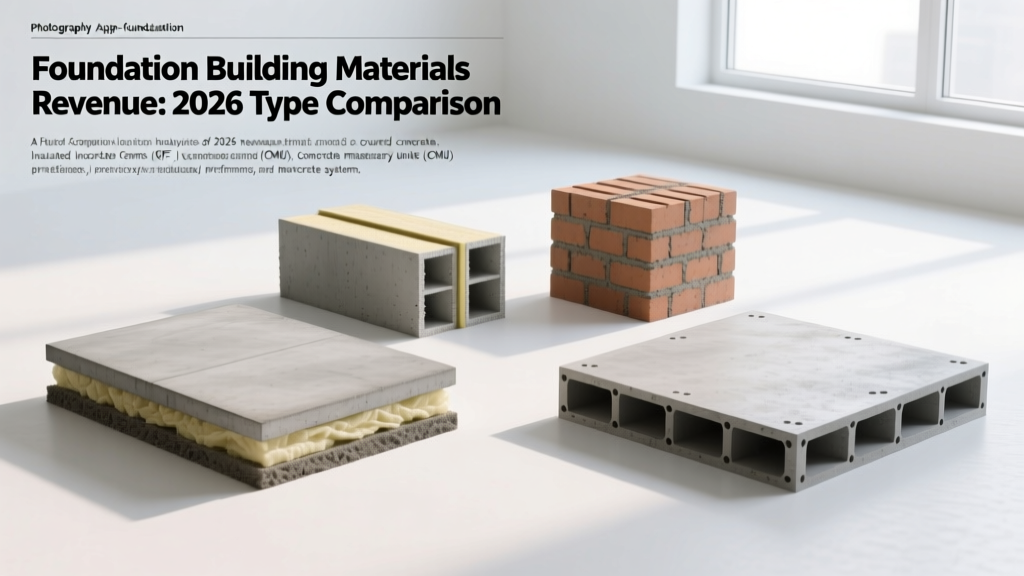
2026 Foundation System Revenue Matrix
The economics of substructural construction have shifted dramatically. While total construction spending continues to track upward according to the U.S. Census Bureau construction data, the profit margins for foundation contractors are no longer dictated solely by volume. Instead, foundation building materials revenue is now heavily dependent on the intersection of material procurement costs, specialized labor availability, and system installation speed. In 2026, contractors who default to traditional methods without analyzing the net revenue yield of alternative systems are leaving 15% to 22% in gross margin on the table.
Below is a comparative matrix of the four dominant foundation systems, analyzing their current market share, baseline material costs, and realistic contractor gross margins for residential and light-commercial applications.
| Foundation System | 2026 Market Share | Avg. Material Cost (per sq ft of wall) | Avg. Labor Cost (per sq ft) | Contractor Gross Margin |
|---|---|---|---|---|
| Poured Concrete (Formed) | 62% | $3.80 - $4.50 | $6.50 - $8.00 | 18% - 22% |
| CMU (Concrete Masonry Unit) | 14% | $2.50 - $3.20 | $11.00 - $14.50 | 10% - 14% |
| ICF (Insulated Concrete Forms) | 16% | $5.50 - $6.80 | $3.50 - $4.50 | 26% - 32% |
| Precast Concrete Panels | 8% | $12.00 - $16.00 | $2.00 - $3.00 (Crane ops) | 20% - 25% |
The Margin Divergence: ICF vs. Traditional Poured Concrete
When evaluating foundation building materials revenue, Insulated Concrete Forms (ICF) represent the most significant margin-expansion opportunity for modern contractors. Brands like Fox Blocks, Nudura, and Logix have optimized their interlocking web designs to reduce assembly time by up to 40% compared to traditional aluminum or plywood forming systems.
The Material Premium vs. Labor Savings
ICF blocks carry an 18% to 25% material premium over the combined cost of ready-mix concrete, rebar, and traditional forming lumber. However, the Insulating Concrete Form Association (ICFA) notes that the elimination of separate framing, insulating, and stripping phases compresses the total labor timeline by nearly half. For a standard 2,500 sq ft basement, the labor savings typically range from $4,200 to $6,500. Because labor is the most volatile variable in 2026 construction economics, capturing this savings directly inflates the contractor's net revenue yield.
The Poured Concrete CapEx Trap
Traditional poured concrete remains the volume leader, but its revenue profile requires heavy capital expenditure. Maintaining a fleet of Symons or Peri forming systems requires ongoing maintenance, release agents, and specialized form-setters. While the per-square-foot material cost of ready-mix (averaging $155 to $175 per cubic yard in 2026, per Portland Cement Association market intelligence) is predictable, the revenue is frequently eroded by form-stripping labor and crane rental delays.
CMU Block: The Labor-Driven Revenue Squeeze
Concrete Masonry Units (CMU) are experiencing a severe margin compression. The material itself is inexpensive—standard 8x8x16 blocks cost roughly $1.85 to $2.30 each in 2026. However, the skilled masonry labor shortage has driven hourly rates for experienced blocklayers to $45 to $65 per hour. Furthermore, CMU foundations require secondary waterproofing membranes, parge coats, and rigid insulation installation to meet modern energy codes. These secondary trades dilute the foundation contractor's revenue share, often reducing the net margin on CMU projects to single digits unless the contractor self-performs all trades.
Precast Panels: High Revenue, High Barrier to Entry
Precast foundation systems, such as the Superior Walls Xi series, offer a unique revenue model. The panels are manufactured off-site with integrated insulation, stud facings, and concrete mix designs exceeding 5,000 PSI. A complete basement can be craned into place and secured in under six hours. The revenue advantage here is velocity: a contractor can cycle through three precast foundation installs in the time it takes to form, pour, and strip one traditional basement. The trade-off is the high upfront material cost and the mandatory use of a 50-ton mobile crane, which limits this system's viability to sites with adequate overhead clearance and stable soil bearing capacities for crane outriggers.
High-Margin Repair Materials: The Hidden Revenue Drivers
Foundation building materials revenue is not exclusive to new construction. The repair and retrofit sector utilizes specialized materials that yield exceptionally high gross margins due to their proprietary nature and the technical expertise required for application.
- Polyurethane Lifting Foams: Products like Alchemy-Spetec AP Lift 43 are used for slab jacking and void filling. The material cost averages $14 to $18 per board foot, but contractors routinely charge $55 to $75 per board foot for the installed service, yielding 65%+ gross margins.
- Carbon Fiber Reinforcement: Systems like Fortress Stabilization's carbon fiber straps are used to arrest bowing CMU or poured walls. A single strap kit costs the contractor roughly $120 to $150, but the installed market rate is $450 to $600 per strap. A standard 40-foot wall requiring 12 straps generates over $4,000 in high-margin revenue in a single day.
- Geopolymer Grouts: Used for deep soil stabilization and underpinning, these materials offer higher compressive strength and lower carbon footprints than traditional Portland cement grouts, allowing contractors to bid on LEED-certified commercial retrofits at a premium.
Regional Pricing and Revenue Optimization
Geography dictates the optimal material mix for maximum revenue. In the Sunbelt, where slab-on-grade and post-tensioned foundations dominate, revenue is driven by high-volume, low-margin concrete pours. Contractors here maximize profit by utilizing automated laser-screeds and power trowels to minimize finishing labor.
Conversely, in the Northeast and Midwest, deep frost walls and full basements are mandatory. This is where ICF and precast systems generate the highest revenue. By marketing the integrated R-22 to R-24 insulation value of ICF directly to custom home buyers, contractors can justify a 10% to 15% premium on the overall foundation bid, capturing that margin as pure profit rather than passing it to a secondary insulation subcontractor.
Procurement Warning: Monitor regional fly ash and slag cement availability. In 2026, supply chain bottlenecks for Class F fly ash have caused localized price spikes. If your concrete supplier substitutes higher-cost Type I/II Portland cement to maintain mix designs, your ready-mix ticket price will increase by 8% to 12%. Always lock in mix-design pricing with your batch plant 90 days prior to breaking ground to protect your projected revenue.

Actionable Framework for Margin Maximization
To optimize foundation building materials revenue in the current market, contractors must transition from being mere installers to system integrators. Evaluate every project against three criteria: site accessibility, local labor availability, and the client's energy-performance requirements. If skilled carpenters for form-setting are scarce in your region, pivot immediately to ICF or precast. By aligning your material procurement strategy with the specific labor constraints of your local market, you insulate your bottom line from the volatility that continues to compress margins across the broader construction industry.
Written by
Elena RodriguezElena Rodriguez is a civil engineer and technical writer specializing in concrete technology, masonry systems, and ASTM/ACI compliance. She earned her B.S. in Civil Engineering from Texas A&M University and spent a decade at a materials testing laboratory, performing over 2,000 concrete compressive strength tests and masonry prism evaluations. Elena is an ACI-certified Field Testing Technician (Grade I) and a member of ASTM Committee C12 on Natural Building Stone. She currently consults on forensic engineering cases involving concrete failures and moisture intrusion. Based in San Antonio, TX, Elena is a proud member of the Society of Women Engineers (SWE) and coaches her daughter's FIRST Robotics team.
More from Elena Rodriguez
View all
Walls & Panels
Cost Analysis: Light Gauge Steel Framing Advantages and Disadvantages
Evaluate light gauge steel framing advantages and disadvantages through a strict cost analysis lens, comparing material, labor, and lifecycle expenses.
Aug 4, 2026

Walls & Panels
Gypsum Board Types: Exact Specifications, Thickness & Dimensions
Compare standard, Type X, and moisture-resistant gypsum board types. Get exact specifications, thicknesses, dimensions, and ASTM standards for your project.
Aug 4, 2026

Fire Resistance
Best Fire-Resistant Outdoor Decking Materials: 2026 Buyer Guide
Discover the best fire-resistant outdoor decking materials for 2026. Compare Class A PVC, aluminum, and hardwood options for WUI compliance and safety.
Aug 4, 2026