Repairing Different Types of Footings and Foundations: A Structural Guide
Diagnose settlement and structural failure across slab, pier, and basement systems. Expert repair methods, costs, and underpinning specs for 2026.

Differential settlement compromises the structural integrity of any building, but the mechanical response and required remediation depend entirely on the specific substructure configuration. When evaluating the various types of footings and foundations, structural engineers must match the failure mode—whether it is expansive clay heave, soil consolidation, or hydrostatic pressure—to the correct underpinning or stabilization technique. Misdiagnosing the soil-structure interaction often leads to recurring damage and wasted capital.
Diagnostic Framework: Matching Symptoms to Foundation Types
Before selecting a repair methodology, it is critical to identify the exact footing system and its primary load-transfer mechanism. The symptoms of failure vary distinctly across different types of footings and foundations:
- Slab-on-Grade: Diagonal drywall cracks originating from door frames, sticking windows, and separations at the ceiling-to-wall joints. Indicates shallow soil moisture fluctuation.
- Continuous Strip & T-Shaped Footings (Basements/Crawlspaces): Horizontal cracking in foundation walls, inward bowing, and stair-step cracking in masonry. Indicates lateral earth pressure or deep frost heave.
- Pier and Beam: Bouncy or sloping floors, gaps between baseboards and flooring, and misaligned cabinet doors. Indicates localized point-load failure or timber deterioration.
Slab-on-Grade Footing Failures and Polyurethane Lifts
Slab-on-grade foundations rely on the direct bearing capacity of the upper soil strata. In regions with high-plasticity clays (Plasticity Index > 25), seasonal moisture variations cause the soil to swell and shrink, leading to slab deflection. Traditional mudjacking (slabjacking) using a cementitious slurry is increasingly being replaced by high-density polyurethane foam injection due to its precision and lower weight.
Polyurethane Injection Specifications and Costs
Modern structural lifting utilizes closed-cell, two-part polyurethane resins, such as NCFI TerraThane or Alchemy Polymers structural foams. These materials expand to 20 to 30 times their liquid volume, curing in approximately 15 seconds with a compressive strength ranging from 50 to 80 psi and a density of 2.5 to 4.0 lbs per cubic foot.
Technical Insight: Unlike cementitious mudjacking slurry, which weighs roughly 120 lbs per cubic foot and can exacerbate settlement by adding dead load to weak subgrades, structural polyurethane adds less than 4 lbs per cubic foot. This makes it the superior choice for lifting heavily loaded interior footings without risking secondary consolidation.
2026 Cost Data: Polyurethane slab lifting averages $12 to $28 per square foot, depending on the depth of the void and the required lift height (typically 1 to 3 inches). Mudjacking remains cheaper at $6 to $10 per square foot but requires larger injection holes (1.5 inches vs. 5/8 inches for poly) and carries a higher risk of future washout.
Repairing Continuous Strip and T-Shaped Footings
Basements and deep crawlspaces utilize continuous strip or T-shaped footings that transfer structural loads below the frost line. When these footings settle due to poor soil bearing capacity or when the retaining walls bow inward due to hydrostatic pressure, deep underpinning or lateral reinforcement is required. Guidelines published by the Foundation Performance Association emphasize that underpinning must bypass the active soil zone and bear on stable strata or bedrock.
Helical Piers vs. Resistance Push Piers
For footing settlement, engineers typically specify either helical piers or resistance push piers. The choice depends on the structure's weight and the soil profile.
- Helical Piers: These feature helical bearing plates welded to a central steel shaft (e.g., Chance Type SS 150 with a 1.5-inch square shaft). They are mechanically torqued into the ground. The installation torque directly correlates to the load capacity (using a K-factor of 8 to 10). A torque of 7,000 ft-lbs translates to an ultimate capacity of roughly 56,000 to 70,000 lbs. Helical piers are ideal for lighter structures or new construction retrofits where the dead load is insufficient to drive push piers.
- Resistance Push Piers: These utilize the weight of the structure itself to hydraulically drive steel pipe sections through unstable soil to a load-bearing stratum. They are best suited for heavy, multi-story masonry buildings where the dead load exceeds 40,000 lbs per linear foot.
2026 Cost Data: Installed underpinning piers cost between $1,800 and $3,200 per pier. A standard residential corner settlement repair requiring 4 to 6 piers will typically range from $9,000 to $18,000, including excavation, hydraulic lifting, and backfilling.
Pier and Beam Foundation Shimming and Re-piering
Pier and beam systems elevate the structure, creating a crawlspace. Failures here usually stem from moisture intrusion causing wooden girders and joists to rot, or from the concrete pads supporting the wooden piers sinking into soft soil. Repairing these systems requires addressing both the superstructure timber and the substructure footings.
Crawlspace Encapsulation and SmartJack Systems
Simply shimming a sagging floor with wooden blocks is a temporary fix that ignores the root cause. Modern remediation involves installing adjustable, galvanized steel crawl space support posts, such as the Foundation Supportworks SmartJack system. These posts feature a 60,000+ lb load capacity and are anchored to a pre-cast concrete base or a newly poured engineered footing. When combined with a 20-mil polyethylene crawlspace encapsulation barrier and a commercial dehumidifier, this system halts wood rot and provides permanent, adjustable floor leveling. According to building science standards referenced by the U.S. Department of Housing and Urban Development, controlling crawlspace moisture is mandatory to preserve the structural capacity of timber framing.
Underpinning and Lift Methods Matrix
Selecting the correct intervention requires comparing the mechanical properties, ideal use cases, and limitations of available repair technologies. The American Concrete Institute (ACI) provides rigorous standards for the materials used in these structural repairs.
| Method | Primary Use Case | Load Capacity / Specs | Limitations |
|---|---|---|---|
| Helical Piers | Deep underpinning for light to medium structures; new construction tie-backs. | Up to 100,000+ lbs; Torque-correlated capacity. | Cannot penetrate dense gravel or bedrock without specialized rock augers. |
| Push Piers | Heavy structural lifting; multi-story masonry; deep bedrock bearing. | 60,000 to 90,000 lbs; relies on structure dead load. | Requires massive structural weight to drive; ineffective on light wood-frame builds. |
| Polyurethane Foam | Slab-on-grade lifting; void filling; shallow soil stabilization. | 50-80 psi compressive; 2.5-4.0 lb/cu ft density. | Not suitable for deep continuous footing underpinning or heavy point loads. |
| Carbon Fiber Straps | Lateral reinforcement for bowing basement retaining walls. | Up to 10,000 lbs tensile strength per strap. | Only arrests inward movement; does not lift settled footings or correct vertical shear. |
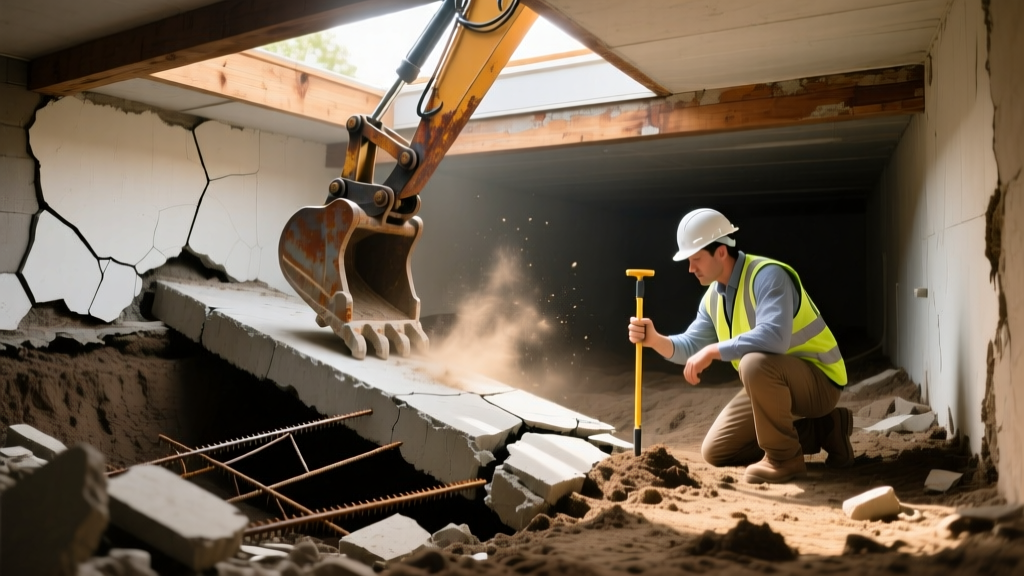
Soil Stabilization: The Root Cause Intervention
Repairing the physical types of footings and foundations without addressing the underlying soil mechanics is a temporary measure. When expansive clays or highly porous sandy soils are the root cause, chemical soil stabilization is required.
Permeation Grouting and Ionic Soil Modifiers
Permeation grouting involves injecting low-viscosity chemical grouts, such as sodium silicate or acrylate polymers, into the soil matrix. This process fills the soil pores and cures into a sandstone-like mass, dramatically increasing the bearing capacity and reducing permeability. This is highly effective beneath continuous strip footings where water infiltration is washing away fine soil particles (piping).
Alternatively, for shallow expansive clay issues beneath slabs, ionic soil modifiers (like RoadPak or similar enzymatic stabilizers) can be injected to alter the clay's electrical charge. This collapses the double-layer water film around clay particles, rendering the soil non-reactive to moisture changes and preventing future seasonal heave.
Critical Warning: Hydrostatic Pressure and Interior Drains
When repairing basement foundations, many contractors suggest installing interior French drains and sump pumps to manage hydrostatic pressure. While this manages the water, it does not relieve the lateral pressure pushing against the exterior of the foundation wall. If the wall is already bowing or exhibiting horizontal shear cracks, interior drainage must be paired with exterior waterproofing membranes, yielding wall anchors, or carbon fiber reinforcement to prevent catastrophic structural failure. Never rely solely on interior water management to solve a lateral load problem.
Successfully repairing structural settlement requires a precise understanding of the specific types of footings and foundations involved. By matching the exact failure mechanism to engineered underpinning, polyurethane lifting, or chemical soil stabilization, property owners can achieve permanent structural remediation rather than relying on cyclical, temporary patches.
Written by
Elena RodriguezElena Rodriguez is a civil engineer and technical writer specializing in concrete technology, masonry systems, and ASTM/ACI compliance. She earned her B.S. in Civil Engineering from Texas A&M University and spent a decade at a materials testing laboratory, performing over 2,000 concrete compressive strength tests and masonry prism evaluations. Elena is an ACI-certified Field Testing Technician (Grade I) and a member of ASTM Committee C12 on Natural Building Stone. She currently consults on forensic engineering cases involving concrete failures and moisture intrusion. Based in San Antonio, TX, Elena is a proud member of the Society of Women Engineers (SWE) and coaches her daughter's FIRST Robotics team.
More from Elena Rodriguez
View all
Walls & Panels
Cost Analysis: Light Gauge Steel Framing Advantages and Disadvantages
Evaluate light gauge steel framing advantages and disadvantages through a strict cost analysis lens, comparing material, labor, and lifecycle expenses.
Aug 4, 2026

Walls & Panels
Gypsum Board Types: Exact Specifications, Thickness & Dimensions
Compare standard, Type X, and moisture-resistant gypsum board types. Get exact specifications, thicknesses, dimensions, and ASTM standards for your project.
Aug 4, 2026

Fire Resistance
Best Fire-Resistant Outdoor Decking Materials: 2026 Buyer Guide
Discover the best fire-resistant outdoor decking materials for 2026. Compare Class A PVC, aluminum, and hardwood options for WUI compliance and safety.
Aug 4, 2026