Average Foundation Repair Cost in Texas: 2026 Pricing Breakdown
Discover the average foundation repair cost in Texas for 2026. Compare pressed concrete, steel piers, and polyjacking prices for slab and pier-beam homes.

The Expansive Soil Factor in Texas Settlement
Calculating the average foundation repair cost in Texas requires an understanding of the state's unique geology. Over 80% of structural settlement issues in regions like Dallas-Fort Worth, Houston, Austin, and San Antonio are driven by highly expansive clay soils. According to data cross-referenced with the USDA NRCS Web Soil Survey, soil series such as Beaumont clay and Houston Black possess a Plasticity Index (PI) exceeding 35. This means the soil can swell up to 6% in volume during heavy rainfall and shrink drastically during drought cycles, snapping concrete grade beams and causing severe differential settlement.
Average Foundation Repair Cost in Texas: 2026 Pricing Matrix
The total cost to stabilize and lift a settling foundation varies wildly based on the linear footage of the affected perimeter, the weight of the structure, and the depth required to reach load-bearing strata. Below is the 2026 pricing matrix for the most common repair methods utilized by contractors affiliated with the Foundation Performance Association (FPA).
| Repair Method | Best Application | 2026 Average Cost | Expected Lifespan |
|---|---|---|---|
| Polyurethane Foam Jacking | Interior slab lifting, pool decks, minor voids | $5.00 - $9.00 per sq. ft. | 15 - 20+ years |
| Pressed Concrete Piers | Exterior perimeter, moderate clay depths | $600 - $850 per pier | 20 - 30 years |
| Steel Push Piers | Heavy masonry, deep bedrock refusal (Austin Chalk) | $1,400 - $2,200 per pier | 75 - 100+ years |
| Helical Piers | New construction, sandy loam soils, light loads | $1,800 - $2,800 per pier | 100+ years |
For a standard 2,500-square-foot Texas ranch home requiring exterior perimeter stabilization on two sides (approximately 20 to 25 piers), homeowners should budget between $14,000 and $22,000 for a mid-tier pressed concrete solution, or $30,000 to $45,000 for a heavy-duty steel push pier system.
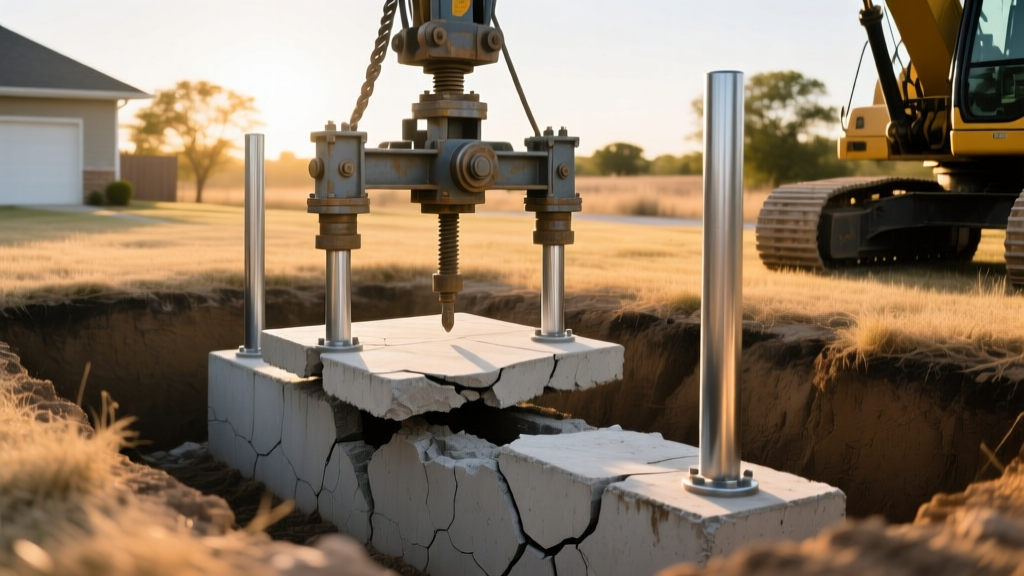
Piering Methods Compared: Pressed Concrete vs. Steel Push Piers
The most debated topic in Texas foundation repair is the choice between pressed concrete cylinders and steel push piers. Both methods utilize hydraulic jacks to lift the grade beam, but their long-term performance in expansive soils differs significantly.
Pressed Concrete Cylinders
This method involves using a hydraulic cylinder to press 6-inch diameter, high-density concrete segments (typically rated for 6,000 PSI compressive strength) into the soil one by one. The friction of the soil against the concrete holds the pier in place.
- The Advantage: Lower upfront cost and wider availability of contractors across the DFW and Houston metros.
- The Failure Mode: In areas with deep, highly plastic clay or sandy loam transitions, the soil can lose its friction grip during severe droughts. The concrete cylinders can 'drift' or tilt laterally, leading to a loss of support within 5 to 10 years.
Steel Push Piers (e.g., ECP, Foundation Supportworks)
Steel push piers consist of 2-foot interlocking galvanized or epoxy-coated steel pipe sections driven hydraulically through the unstable clay until they hit a load-bearing stratum, such as the Austin Chalk formation or the Brazos River sandstone, often at depths of 25 to 45 feet.
- The Advantage: Bypasses the active moisture zone entirely. Because the pier rests on bedrock or dense, non-expansive strata, seasonal soil shrinkage does not affect the load-bearing capacity.
- The Failure Mode: If driven into soils with large subsurface boulders or debris, the steel pipe can deflect or bend. Proper pre-installation soil boring is mandatory to avoid this.
The Hidden Cost Variables in Texas Foundation Projects
Contractor estimates often exclude critical ancillary work required to complete a code-compliant and structurally sound repair. When budgeting, factor in these mandatory secondary costs:
Never rely solely on a contractor's 'free inspection.' Hire an independent Professional Engineer (PE) to draft a repair plan specifying the exact number, depth, and placement of piers. This prevents contractors from overselling unnecessary piers to inflate the invoice.
Lifting a slab foundation alters the pitch of the embedded PVC and cast-iron sewer lines. Texas municipal codes require a hydrostatic pressure test after the lift is complete to ensure no pipes were fractured during the leveling process. If a leak is found, tunneling and pipe repair will add $2,000 to $5,000 to the project.
Large oak and mesquite trees extract thousands of gallons of water from the soil, causing localized subsidence. Installing a 3-foot-deep HDPE root barrier and regrading the perimeter to achieve a 5% slope away from the foundation is often required to validate the contractor's warranty.
Step-by-Step: Securing a Reliable Repair Contract
Navigating the Texas foundation repair market requires strict due diligence. Follow this sequence to protect your investment:
- Procure the PE Plan: Hire a licensed structural engineer to evaluate the property and issue a stamped repair schematic.
- Bid the Plan: Send the exact same engineer's plan to three different repair companies. Do not allow them to alter the pier count without written approval from the engineer.
- Verify Warranty Transferability: Ensure the contract includes a lifetime warranty that is backed by a third-party insurance trust, not just the company itself. If the company goes out of business, a self-backed warranty is worthless.
- Schedule the Municipal Permit: Verify that the contractor is pulling the required municipal permit. In cities like Austin and Plano, unpermitted foundation work will trigger a stop-work order and complicate future real estate transactions.
- Execute the Lift and Test: Oversee the hydraulic lift, ensuring the contractor uses a unified jacking manifold to lift the slab evenly at a rate of no more than 1/8th of an inch per day to prevent drywall and brick veneer blowouts.
For further reading on how foundation issues impact property valuations in the state, consult the housing market reports published by the Texas Real Estate Research Center. Understanding the intersection of structural integrity and real estate disclosures is vital for any Texas homeowner managing a repair project.
Written by
Sarah WhitfieldSarah Whitfield is a chartered quantity surveyor (MRICS) and construction cost analyst with 15 years of experience in material pricing, procurement strategy, and project budgeting. She earned her degree in Construction Management from the University of Reading (UK) and has worked on projects ranging from $2M custom homes to $180M mixed-use developments across North America and Europe. Sarah currently leads cost estimating for BuildMat Insight, maintaining a proprietary database of 4,000+ material price points updated quarterly. She is a frequent contributor to RSMeans cost data panels and has presented at the International Cost Engineering Council (ICEC) congress. Based in Denver, CO, Sarah is an avid trail runner and volunteer mentor for Women in Construction.
More from Sarah Whitfield
View all
Wood & Lumber
What Are the Different Types of Wood? A Builder's Guide
Compare structural softwoods, finish hardwoods, and engineered lumber. Analyze Janka ratings, MOE values, and 2026 pricing for construction.
Aug 4, 2026

Walls & Panels
Steel Framing vs Wood Framing: Corrosion and Moisture Defense
Compare steel framing vs wood framing for moisture resistance. Learn about galvanized coatings, condensation risks, and corrosion protection strategies.
Jul 21, 2026

Stone & Masonry
How to Cut Stone Veneer: Wet Saw vs Grinder Comparison
Compare the best tools for cutting stone veneer. We review wet saws, angle grinders, and chop saws to help you achieve clean, chip-free cuts.
Jul 21, 2026