Foundation Building Materials Montebello: 2026 Selection Framework
Navigate the 2026 selection framework for foundation building materials in Montebello, addressing local seismic codes, expansive soils, and concrete specs.
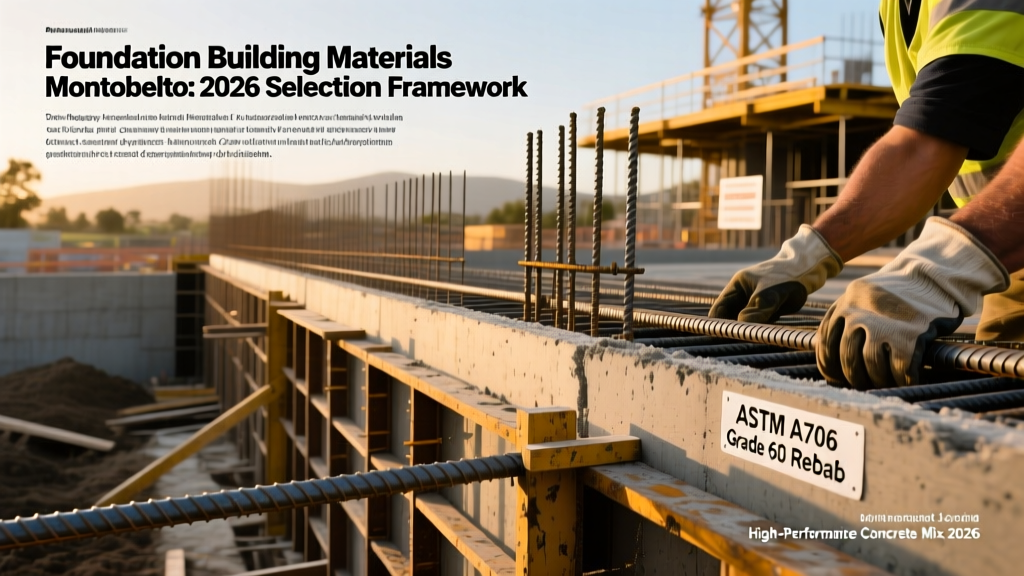
The Montebello Foundation Challenge: Seismic and Soil Realities
Selecting the correct foundation building materials in Montebello requires navigating a complex intersection of high seismic risk, variable soil profiles, and stringent California Building Code (CBC) mandates. Situated in the western San Gabriel Valley, Montebello’s geology is dominated by alluvial fan deposits from the San Gabriel Mountains and basin sediments. Proximity to the Whittier Fault zone dictates rigorous lateral force-resisting design, while localized pockets of expansive Adobe clay and sulfate-rich groundwater demand highly specific material chemistries.
A generic approach to foundation material selection will result in premature concrete degradation, differential settlement, or catastrophic failure during a seismic event. The 2026 selection framework outlined below transitions contractors and structural engineers from reactive code-compliance to proactive material optimization, utilizing data from the USGS Seismic Design Maps and localized geotechnical baselines.
Core Selection Framework: Matching Materials to Micro-Zones
Before specifying concrete mix designs or reinforcement schedules, the project’s geotechnical report must dictate the material pathway. Montebello sites generally fall into three primary micro-zones. Use the following decision matrix to align your foundation system with the correct material specifications.
| Soil Profile / Hazard | Optimal Foundation System | Primary Material Specification | Critical Edge Case / Gotcha |
|---|---|---|---|
| Expansive Clay (High Plasticity) | Post-Tensioned Slab-on-Grade or Raised Floor | ASTM C150 Type V Cement, 5000 PSI, w/c < 0.40 | Moisture barriers (15-mil poly) must lap 12 inches; edge beams require 24-inch minimum depth. |
| Liquefiable Alluvium / Fill | Drilled Cast-in-Drilled-Hole (CIDH) Piers | Grade 60 Epoxy-Coated Rebar, Tremie Concrete (Slump 8-10") | Casing must remain in place during concrete placement if soil caves; never pull casing prematurely. |
| Competent Bearing Strata (Bedrock) | Continuous Spread Footings / Grade Beams | ASTM C150 Type II Cement, 4000 PSI, Standard Rebar | Rock anchors may be required if lateral sliding resistance is insufficient per CBC Chapter 18. |

Concrete Mix Designs for Southern California Soils
The chemical composition of Montebello’s groundwater and soil frequently contains moderate to severe concentrations of water-soluble sulfates. According to guidelines published by the Portland Cement Association (PCA), sulfate attack leads to the formation of ettringite, which expands and causes severe concrete cracking and spalling.
Ordering a standard 3000 PSI or 4000 PSI mix with ordinary Portland cement (Type I/II) for a site with severe sulfate exposure (water-soluble sulfate between 0.20% and 2.00% by weight) violates CBC Table 1904.2.1. Inspectors will reject the pour if the batch ticket does not explicitly show the correct cement type and maximum water-cementitious ratio.
Specifying the Mix: The 2026 Standard
- Cement Type: Mandate ASTM C150 Type V (Sulfate Resisting) for severe exposure, or a blended Type II cement supplemented with Class F fly ash (minimum 25% replacement) or slag cement (minimum 50% replacement) to reduce permeability and mitigate sulfate ingress.
- Compressive Strength (f'c): Minimum 4,000 PSI for shallow footings; 5,000 PSI for drilled piers and retaining walls subject to hydrostatic pressure.
- Water-Cementitious Ratio (w/c): Strictly limit to 0.45 or lower. Lower w/c ratios drastically reduce the capillary pore network, preventing sulfate-laden groundwater from penetrating the concrete matrix.
- Admixtures: Utilize polycarboxylate-based high-range water reducers (HRWR/superplasticizers) to achieve an 8-inch slump for pumped CIDH piers without adding excess water. In Montebello’s summer heat, specify hydration stabilizers (retarders) to extend initial set times by 1.5 to 2 hours, accommodating transit delays on the 60 Freeway.
Reinforcement and Anchoring: Meeting CBC Seismic Standards
Montebello falls within Seismic Design Category D or E, depending on the exact site classification (typically Site Class D for stiff soil). The California Building Code (CBC) mandates rigorous detailing for foundation reinforcement to ensure ductility during seismic ground acceleration.
Rebar Selection and Detailing
For standard continuous footings and grade beams, ASTM A615 Grade 60 rebar is the baseline. However, in areas where the geotechnical report identifies high chloride or sulfate concentrations, specify ASTM A775 epoxy-coated reinforcement. When tying epoxy-coated rebar, contractors must use plastic-coated tie wire and patch any coating chips with an approved two-part epoxy mastic prior to the inspection.
Transverse reinforcement (stirrups and ties) in foundation beams and piers must utilize seismic hooks (135-degree bends with a 6-inch extension) to confine the concrete core and prevent brittle shear failure. Standard 90-degree hooks are strictly prohibited in Seismic Design Category D/E structural elements.
Anchor Bolts and Holdowns
The connection between the concrete foundation and the wood or steel superstructure is the most frequent point of failure in older Montebello homes. For new construction and major retrofits:
- Anchor Bolts: Use 5/8-inch diameter ASTM F1554 Grade 36 or Grade 55 anchor bolts. While code minimum spacing is often 48 inches on center, structural engineers in the Whittier Narrows area frequently specify 36 inches on center with a minimum 12-inch embedment depth to resist higher overturning moments.
- Holdowns: Continuous tie-down systems (e.g., Simpson Strong-Tie SSTB straps) or discrete heavy-duty holdowns (e.g., Simpson HDU series) are required at shear wall boundaries. Ensure the holdown embedment depth clears the bottom mat of foundation rebar by at least 2 inches to prevent concrete breakout failure.
Deep Foundation Alternatives: When Shallow Slabs Fail
When near-surface soils exhibit excessive settlement potential or liquefaction, shallow foundations are unviable. Drilled piers (caissons) transfer structural loads to competent bearing strata deep underground. The material selection for deep foundations shifts from surface durability to placement logistics.
When pouring drilled piers with groundwater present, a tremie pipe must be used. The concrete mix must be highly flowable (8" to 10" slump) and cohesive to prevent segregation as it falls through the water. Never discharge concrete directly into standing water from a truck chute; this washes the cement paste away, leaving a weak, gravel-filled void at the toe of the pier.
If the drilled shaft passes through unstable, caving soils (common in loose alluvial sands near the San Gabriel River channel), a temporary steel casing or a slurry (bentonite or synthetic polymer) must be used to maintain the hole's integrity. If using casing, the concrete must be placed inside the casing, and the casing extracted slowly while maintaining a minimum 10-foot head of concrete above the casing toe to prevent soil intrusion.
Sourcing and Logistics: Navigating Montebello Supply Chains
Material selection is only half the battle; logistical execution ensures the materials perform as designed. Montebello’s dense urban environment and proximity to major freight corridors (I-5, I-710, and SR-60) impact ready-mix delivery and steel fabrication timelines.
- Batching Proximity: Source ready-mix from plants in Commerce, Pico Rivera, or Santa Fe Springs to minimize transit time. In 2026, with ongoing supply chain fluctuations for supplementary cementitious materials (SCMs) like fly ash, secure mix design approvals from the local building department at least three weeks before the scheduled pour.
- Rebar Fabrication: Complex seismic detailing (tight bend radii, bundled bars) requires precise fabrication. Partner with regional fabricators who utilize automated bending equipment to ensure ASTM A615 bend diameter requirements are strictly met, preventing micro-fractures at the bends.
- Vapor Barriers: For post-tensioned slabs, source 15-mil or 20-mil cross-laminated polyethylene vapor barriers (e.g., Stego Wrap). Standard 6-mil poly is inadequate for expansive soil zones and easily punctured during rebar placement.
Quick-Reference Checklist for Montebello Contractors
- Verify Geotech Report: Confirm soil sulfate levels, expansive index (EI), and allowable bearing capacity before ordering materials.
- Audit Batch Tickets: Ensure Type V cement (or approved SCM blend), max w/c ratio, and design PSI are explicitly printed on every truck ticket.
- Inspect Seismic Hooks: Verify 135-degree bends and 6-inch extensions on all transverse foundation reinforcement.
- Measure Embedments: Check anchor bolt and holdown embedment depths relative to the bottom rebar mat prior to the pour.
- Manage Slump on Site: Reject trucks adding water on-site. Use approved HRWR admixtures to restore workability if the mix stiffens during transit.
By treating foundation material selection as a localized, data-driven framework rather than a commodity purchasing exercise, builders in Montebello can ensure structural longevity, pass stringent municipal inspections on the first attempt, and deliver resilient infrastructure capable of withstanding Southern California’s unique geological hazards.
Written by
Priya KapoorPriya Kapoor is a real estate market analyst and construction economics researcher with expertise in housing affordability, development feasibility, and infrastructure investment. She holds a Master of Regional Planning from Cornell University and previously worked as a senior analyst at CBRE's Investment Properties group, where she modeled returns for $4B in mixed-use development pipelines. Priya now runs an independent research practice advising developers, municipalities, and REITs on construction cost forecasting and market timing. She publishes the quarterly "BuildMat Market Pulse" report tracking material price indices across 12 commodity categories. Based in Austin, TX, Priya serves on the board of Habitat for Humanity Austin and is a marathon runner.
More from Priya Kapoor
View all
Construction Cost
Cost to Build a 1600 Sq Ft Home in 2026: Full Breakdown
Accurate 2026 cost to build a 1600 sq ft home—material, labor, and regional pricing breakdowns included. Plan your budget with real-time estimates.
Aug 11, 2026

Wood & Lumber
Name the Types of Wood for Pressure Treatment and Preservation
Learn how to name the types of wood best suited for pressure treatment. Compare species treatability, chemical retention levels, and 2026 preservation costs.
Aug 4, 2026

Stone & Masonry
Stone Veneer Suppliers Lindenhurst: 2026 Cost Analysis
Analyze 2026 stone veneer costs in Lindenhurst, NY. Compare local supplier pricing, delivery fees, and Suffolk County installation labor rates.
Aug 4, 2026