2026 Regional Guide to Foundation Injection Repair Cost & Soil Factors
Discover the true foundation injection repair cost by region in 2026. Compare polyurethane, epoxy, and mudjacking pricing based on local soil factors.

The Geotechnical Reality of Foundation Injection Repair Cost
The foundation injection repair cost for a residential slab in Houston, Texas, operates on an entirely different economic and structural model than a comparable repair in Minneapolis, Minnesota. While national averages often cite a flat rate of $10 to $20 per square foot for slab lifting, this metric is virtually useless for accurate budgeting. Injection repair pricing is dictated by regional soil mechanics—specifically the Plasticity Index (PI) of expansive clays, the frost susceptibility of northern loams, and the hydrostatic pressure variations in coastal water tables.
In 2026, advanced two-part polyurethane resins and low-viscosity epoxies have largely replaced traditional cementitious mudjacking for precision structural work. However, the volume of material required, the depth of the injection matrix, and the necessary prep work fluctuate wildly based on your geographic location. Understanding these regional variables is the only way to accurately evaluate a contractor's quote and avoid catastrophic under-engineering.
Material Matrix: Polyurethane vs. Epoxy vs. Cementitious Slurry
Before analyzing regional pricing, it is critical to distinguish between the three primary injection materials used in modern foundation repair. Contractors often use the term "injection" interchangeably, but the chemical properties and cost structures are vastly different.
| Material Type | Specific Product Examples (2026) | Density / Weight | Primary Application | Avg Cost per Sq Ft |
|---|---|---|---|---|
| High-Density Polyurethane | Alchemy-Spetec AP Lift 43, NCFI TerraThane | 3.5 - 4.5 lb/ft³ | Slab lifting, void filling, deep curtain grouting | $8.00 - $24.00 |
| Structural Epoxy | Sika Sikadur 52, Simpson Strong-Tie Epoxy | 65 - 75 lb/ft³ | Structural crack welding, dormant crack sealing | $25.00 - $60.00 (per linear ft) |
| Cementitious Slurry (Mudjacking) | Standard Portland cement/soil mixtures | 100 - 120 lb/ft³ | Non-structural exterior slab leveling, roadways | $4.00 - $8.00 |
According to guidelines published by the American Concrete Institute (ACI), epoxy injection is strictly for restoring structural integrity to cracked concrete elements, not for lifting settled foundations. Polyurethane is the standard for lifting and void filling due to its expansive force (up to 7,000 PSF) and lightweight nature, which prevents further subsidence in weak soils.
Regional Soil Profiles and Their Impact on Pricing
The South & Southeast: Expansive Clays and Moisture Extremes
States like Texas, Oklahoma, and Georgia are dominated by montmorillonite-rich expansive clays. These soils swell significantly when wet and shrink during droughts, causing cyclical slab deflection. In these regions, the foundation injection repair cost is heavily influenced by the soil's Plasticity Index (PI). If your local soil profile has a PI greater than 25, contractors must inject high-density polyurethane deeper into the subgrade (often 4 to 6 feet) to create a moisture-resistant "curtain" that isolates the clay from surface water.
- Cost Driver: Deep-curtain grouting requires 30% to 50% more resin volume than standard slab lifting.
- Regional Premium: Expect to pay $150 to $350 per linear foot for deep foundation curtain grouting in high-PI zones, compared to $90 per linear foot in stable soils.
- Edge Case: If the contractor does not pair the injection with a root-barrier installation or automated drip-line irrigation system to maintain constant soil moisture, the foam lift will fail within 36 months as the clay shrinks away from the newly lifted slab.
The Midwest & Northeast: Frost Heave and Freeze-Thaw Cycles
In regions experiencing severe winter freezes, foundation settlement is rarely caused by clay expansion; it is caused by frost heave and the subsequent thaw-weakening of the subgrade. The primary cost driver here is not depth, but the hydrophobic nature of the injection material. Standard hydrophilic polyurethanes will absorb groundwater, freeze, and degrade over successive winter cycles.
Contractors in these zones must use closed-cell, strictly hydrophobic resins. Furthermore, repairing frost-heaved foundations often requires injecting rigid polyurethane insulation boards vertically along the exterior foundation stem wall to alter the frost line penetration.
The West & Coastal Regions: Seismic Shifts and High Water Tables
Coastal California, Washington, and parts of Florida present unique geotechnical challenges: sandy loams, high hydrostatic pressure, and seismic liquefaction risks. In sandy soils, low-viscosity polyurethane can migrate laterally before curing, wasting material and driving up costs. To counter this, contractors use fast-reacting resins (15-second gel times) rather than standard 45-second formulations.
Additionally, coastal repairs must comply with strict environmental and flood-zone regulations. The FEMA National Flood Insurance Program dictates specific foundation venting and material requirements in Special Flood Hazard Areas (SFHAs). Injections in these zones often require hydrostatic relief weep-holes to be core-drilled and integrated into the foam matrix, adding $45 to $85 per hole to the final invoice.
Hidden Cost Drivers Contractors Rarely Disclose
When evaluating the foundation injection repair cost, homeowners frequently encounter "change orders" midway through the project. These are rarely malicious; rather, they stem from subsurface anomalies that cannot be seen from the surface. To protect your budget, ensure the following variables are addressed in the initial contract:
- Ground Penetrating Radar (GPR) Surveys: Injecting foam blindly into unknown voids is a financial gamble. A pre-injection GPR survey maps subsurface voids and utility lines. This adds $400 to $800 to the upfront cost but routinely saves thousands in over-ordered resin and prevents accidental severing of post-tension cables or subterranean plumbing.
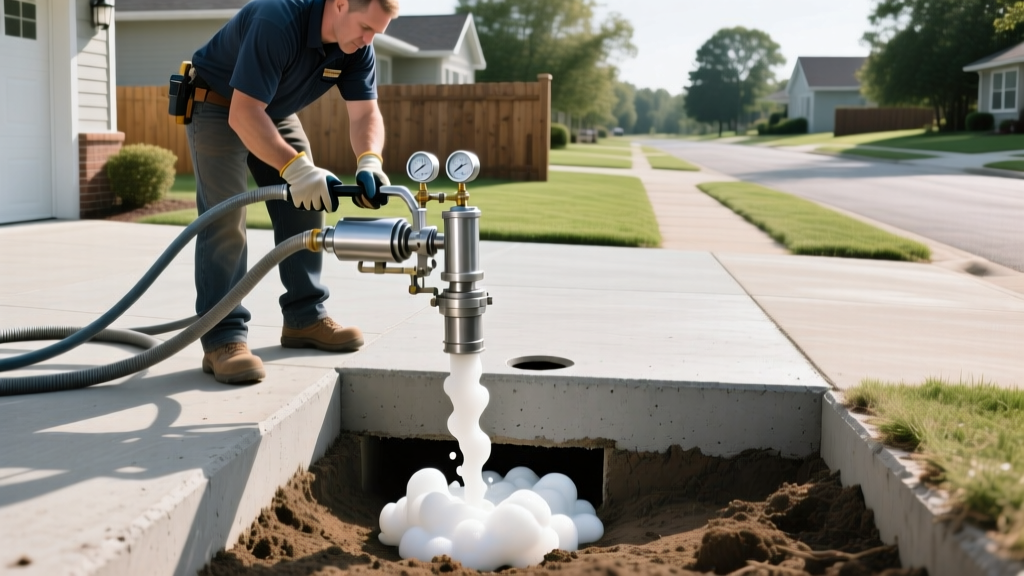
- Manifold Hose Run Limitations: Polyurethane proportioners require precise temperature and pressure control. If the injection site is more than 150 feet from where the contractor can park their rig, the resin may cure prematurely in the hoses or fail to expand properly. Long hose runs require specialized heated manifolds, typically triggering a $500+ mobilization surcharge.
- Sub-Slab Plumbing Leaks: In 22% of Texas slab settlement cases, the root cause is a micro-leak in the copper or PVC supply lines washing out the subgrade. If the contractor injects foam without first conducting a hydrostatic plumbing test, the foam will simply wash away. Ensure a plumbing isolation test is included in the diagnostic phase.
How to Evaluate a Regional Foundation Repair Quote
Do not accept a quote based solely on a "per hole" or "per square foot" estimate without demanding a geotechnical justification. A highly accurate, professional quote in 2026 should include the following documentation:
The Minimum Viable Quote Checklist:
1. Soil classification report or local PI reference.
2. Specific resin manufacturer, model number, and cured density (lb/ft³).
3. Reaction time specification (e.g., 15s vs 45s gel) matched to soil permeability.
4. Maximum allowable hose-run distance from the pump rig.
5. A warranty clause explicitly stating the soil moisture maintenance requirements (e.g., "Warranty void if perimeter soaker hoses are not operated 3x weekly during drought conditions").
By shifting your focus from generic national averages to the specific geotechnical demands of your region, you can accurately forecast the true foundation injection repair cost. Whether you are combating the aggressive clays of the South or the freeze-thaw cycles of the North, demanding material specificity and subsurface mapping is the only way to ensure a permanent structural correction.
Written by
Marcus ChenMarcus Chen is a licensed structural engineer (PE) and building materials analyst with over 12 years of experience across residential, commercial, and industrial construction. He holds a Master of Science in Civil Engineering from UC Berkeley and spent six years at Thornton Tomasetti before transitioning to independent consulting and technical writing. Marcus specializes in material selection for seismic-prone regions, concrete reinforcement strategies, and lifecycle cost analysis. His work has been cited by the American Concrete Institute (ACI) and the Structural Engineers Association of California (SEAOC). When he is not on a job site or at his desk, you will find him hiking the Sierra Nevada or restoring a 1920s craftsman bungalow in Oakland, CA.
More from Marcus Chen
View all
Construction Cost
How Much Did the Eiffel Tower Cost to Build?
How much did the Eiffel Tower cost to build in 1889? We adjust for inflation and compare its budget to modern skyscraper construction.
Aug 4, 2026

Fire Resistance
What Is a Fire Resistant Material? Testing & Certification Guide
Discover what is a fire resistant material through ASTM and UL testing. Learn how fire ratings, certifications, and assemblies work in construction.
Aug 4, 2026

Construction Cost
How Much Did the Burj Khalifa Cost to Build?
How much did the Burj Khalifa cost to build? We break down the $1.5B project and extract 5 money-saving strategies for your next build.
Jul 30, 2026