Foundation Building Materials Fraud and Leak Risks: Regional Guide
Learn how foundation building materials fraud causes severe leak risks. A regional guide to spotting fakes, verifying ASTM specs, and preventing failure.
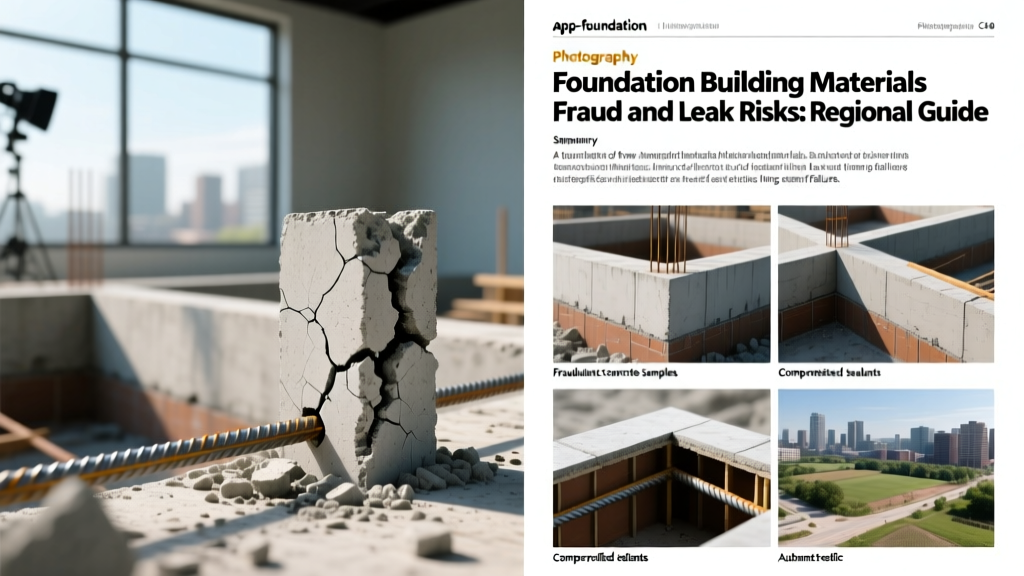
The Hidden Cost of Counterfeit Foundation Materials
When foundation building materials fraud leads to a leak, the structural and financial consequences are catastrophic. Below-grade components are uniquely vulnerable to substitution scams because they are buried and hidden from final inspection. In 2026, the proliferation of unverified online B2B construction marketplaces has accelerated the distribution of counterfeit waterproofing membranes, substandard post-tension cables, and diluted epoxy resins. According to the Federal Trade Commission (FTC), construction material fraud costs the industry billions annually, with below-grade waterproofing and structural concrete being primary targets due to their high margins and hidden installation.
This regional guide breaks down the specific fraud schemes targeting different climate zones, the resulting leak failure modes, and the exact testing protocols general contractors must use to verify material integrity before backfilling.
Regional Breakdown: Fraud Schemes and Leak Vulnerabilities
Pacific Northwest & Northeast (Hydrostatic Pressure Zones)
Regions with high annual rainfall and elevated water tables subject foundation walls to immense hydrostatic pressure. The primary defense is a high-density polyethylene (HDPE) dimple board paired with an elastomeric membrane.
- The Fraud: Counterfeit HDPE dimple boards manufactured from brittle, recycled plastics rather than virgin HDPE. Additionally, off-spec polyurethane membranes that lack the required elastomeric elongation properties are frequently sold under the labels of premium brands like Tremco Paraseal.
- The Leak Result: When backfilled, the brittle dimple boards crush under soil load, eliminating the drainage plane. Hydrostatic pressure builds directly against the concrete, causing the fake membrane to shear and resulting in severe basement weeping and structural bowing.
- Verification: Demand a mill test report (MTR) and perform a field bend test. Genuine HDPE will flex and return to shape; counterfeit recycled plastic will snap or exhibit a white stress fracture line when bent 180 degrees.
Texas & Southwest (Expansive Clay & Thermal Cycling)
Post-tension (PT) slab-on-grade foundations are standard in Texas to combat expansive clay soils. Furthermore, sodium bentonite panels are heavily used for moisture mitigation in commercial builds.
- The Fraud: Substandard PT cables utilizing low-grade steel that lacks proper grease sheathing, leading to premature corrosion. In waterproofing, fraudulent suppliers substitute cheap calcium bentonite (often sold as agricultural cat litter) for high-swelling sodium bentonite (e.g., Cetco Voltex).
- The Leak Result: Corroded PT cables lose tension, causing the slab to heave and crack during drought-flood cycles. These cracks breach the foundation envelope. Meanwhile, calcium bentonite only swells a fraction of the volume of sodium bentonite, leaving gaps at the seams where groundwater infiltrates the sub-slab vapor barrier.
- Verification: For bentonite, perform a simple swell test in a graduated cylinder with distilled water. Sodium bentonite will expand to 12-15 times its dry volume; calcium bentonite will barely expand beyond 3-5 times.
Southeast & Gulf Coast (High Water Table & Storm Surge)
Crawl spaces and shallow basements in the Southeast require robust perimeter drainage and active pump systems to handle sudden deluges and high ambient humidity.
- The Fraud: Non-perforated corrugated pipes fraudulently labeled as French drain weeping tiles. Additionally, counterfeit sump pumps featuring undersized motors and plastic impellers disguised as cast-iron commercial-grade units.
- The Leak Result: Non-perforated pipes fail to intercept the rising water table, directing bulk water toward the foundation footing instead of away from it. This causes capillary rise, rotting crawl space joists and fostering toxic black mold within 60 days of the first heavy rain.
- Verification: Physically inspect the pipe perforations. Fraudulent pipes often feature shallow, machine-scored lines rather than fully punched, deburred holes. Check the sump pump motor housing for a genuine UL (Underwriters Laboratories) certification stamp, not just a printed sticker.
Material Verification Matrix: Spotting the Fakes
Use this matrix to cross-reference delivered materials against genuine specifications before signing the delivery receipt.
| Material | Genuine ASTM Spec | Fraudulent Tell | Field Testing Method |
|---|---|---|---|
| Elastomeric Membrane | ASTM C836 (60-mil min) | Tears easily, strong chemical solvent odor | Mil thickness gauge; 200% elongation stretch test |
| HDPE Dimple Board | ASTM D6978 | Uneven dimple heights, cloudy/color-streaked | 180-degree bend test; compressive load resistance |
| Epoxy Crack Injection | ASTM C881 (Type I, Grade 1) | Excessive shrinkage post-cure, fails to bond | Test cure on scrap concrete; attempt pry-bar removal |
| Corrugated Drain Pipe | ASTM F405 (Perforated) | Holes are merely scored, not fully punched | Visual inspection; water flow rate test |
Step-by-Step Verification Protocol for General Contractors
Relying on supplier invoices is insufficient. Implement this mandatory receiving protocol for all below-grade materials to mitigate foundation building materials fraud and leak liabilities.
- Chain of Custody Audit: Verify the Bill of Lading (BOL) matches the exact manufacturer part numbers. Fraudsters often swap premium SKUs for 'contractor grade' equivalents during transit.
- Lot Number Verification: Photograph the lot numbers on waterproofing membranes and contact the manufacturer's regional representative to verify the batch was distributed to your specific geographic region.
- Destructive Field Testing: Cut a 6x6 inch sample from the delivered membrane roll. Use a digital caliper to verify thickness at five distinct points. If the variance exceeds 5%, reject the shipment.
- Chemical Compatibility Check: Ensure the primer and membrane are from the same manufacturer batch. Fraudulent suppliers often bundle genuine membranes with cheap, incompatible primers that cause delamination within 18 months.
- Third-Party Inspection: For commercial projects exceeding $5M, hire an independent American Concrete Institute (ACI) certified inspector to witness the pour and verify the admixture tickets for the foundation concrete.
Legal and Financial Recourse for Material Fraud
If you discover fraudulent materials after the foundation is poured, immediate action is required to limit liability and secure funding for remediation.
- Stop Work & Quarantine: Immediately halt backfilling. Quarantine all remaining suspect materials on-site and photograph them in situ.
- Mechanic's Lien & Bond Claims: File a notice of intent to lien against the supplier. If the supplier is bonded, file a claim against their surety bond for breach of implied warranty of merchantability.
- Forensic Material Testing: Send samples to an accredited geotechnical laboratory (e.g., Intertek or SGS) for gas chromatography-mass spectrometry (GC-MS) to definitively prove the chemical composition deviates from the manufacturer's published Technical Data Sheet (TDS).
Frequently Asked Questions
Can counterfeit waterproofing membranes be applied over genuine primers?
Yes, but the system will fail. The chemical cross-linking required for a watertight seal will not occur, leading to micro-fissures that allow water ingress under hydrostatic pressure.
How do I report a supplier for foundation material fraud?
File a formal complaint with the FTC and your state's Contractor Licensing Board. If the fraud crosses state lines, it may constitute mail or wire fraud, which falls under FBI jurisdiction.
Are there visual indicators of substandard post-tension cables?
Genuine PT cables feature a thick, uniform layer of corrosion-inhibiting grease inside a high-density polyethylene sheathing. Substandard cables often have dry spots, thin sheathing, or use low-grade petroleum jelly instead of specialized corrosion inhibitors.
Written by
Elena RodriguezElena Rodriguez is a civil engineer and technical writer specializing in concrete technology, masonry systems, and ASTM/ACI compliance. She earned her B.S. in Civil Engineering from Texas A&M University and spent a decade at a materials testing laboratory, performing over 2,000 concrete compressive strength tests and masonry prism evaluations. Elena is an ACI-certified Field Testing Technician (Grade I) and a member of ASTM Committee C12 on Natural Building Stone. She currently consults on forensic engineering cases involving concrete failures and moisture intrusion. Based in San Antonio, TX, Elena is a proud member of the Society of Women Engineers (SWE) and coaches her daughter's FIRST Robotics team.
More from Elena Rodriguez
View all
Walls & Panels
Cost Analysis: Light Gauge Steel Framing Advantages and Disadvantages
Evaluate light gauge steel framing advantages and disadvantages through a strict cost analysis lens, comparing material, labor, and lifecycle expenses.
Aug 4, 2026

Walls & Panels
Gypsum Board Types: Exact Specifications, Thickness & Dimensions
Compare standard, Type X, and moisture-resistant gypsum board types. Get exact specifications, thicknesses, dimensions, and ASTM standards for your project.
Aug 4, 2026

Fire Resistance
Best Fire-Resistant Outdoor Decking Materials: 2026 Buyer Guide
Discover the best fire-resistant outdoor decking materials for 2026. Compare Class A PVC, aluminum, and hardwood options for WUI compliance and safety.
Aug 4, 2026