Foundation Building Materials Santa Ana: Complete Sourcing Guide
Expert guide to sourcing foundation building materials in Santa Ana. Covers soil-specific concrete, rebar, vapor barriers, and local costs.

Geotechnical Realities: Santa Ana Soil Profiles
Constructing a durable foundation in Santa Ana requires navigating a complex geotechnical landscape. The city sits on an alluvial fan deposited by the Santa Ana River, resulting in highly variable subsurface conditions. Engineers and builders must account for three primary soil hazards: expansive Adobe clays that can exert upward swelling pressures exceeding 15,000 pounds per square foot (psf), localized liquefaction zones near the river basin, and sulfate-rich soils that chemically degrade standard concrete. Sourcing the correct foundation building materials in Santa Ana is not merely a logistical task; it is a structural necessity dictated by these subsurface realities and the stringent California Building Code (CBC).
According to the California Geological Survey, Orange County's inland basin soils exhibit high shrink-swell potential. Standard 3000 psi concrete slabs poured directly on unamended native clay will inevitably crack and heave. Material selection must prioritize moisture isolation and structural reinforcement.
Concrete Mix Designs for Expansive and Sulfate Soils
Standard ready-mix concrete is insufficient for Santa Ana's aggressive soil chemistry. Sulfate ions present in the alluvial deposits react with the tricalcium aluminate (C3A) in ordinary Portland cement, causing ettringite formation, expansion, and eventual concrete spalling. To mitigate this, material sourcing must specify sulfate-resistant formulations.
Required Concrete Specifications
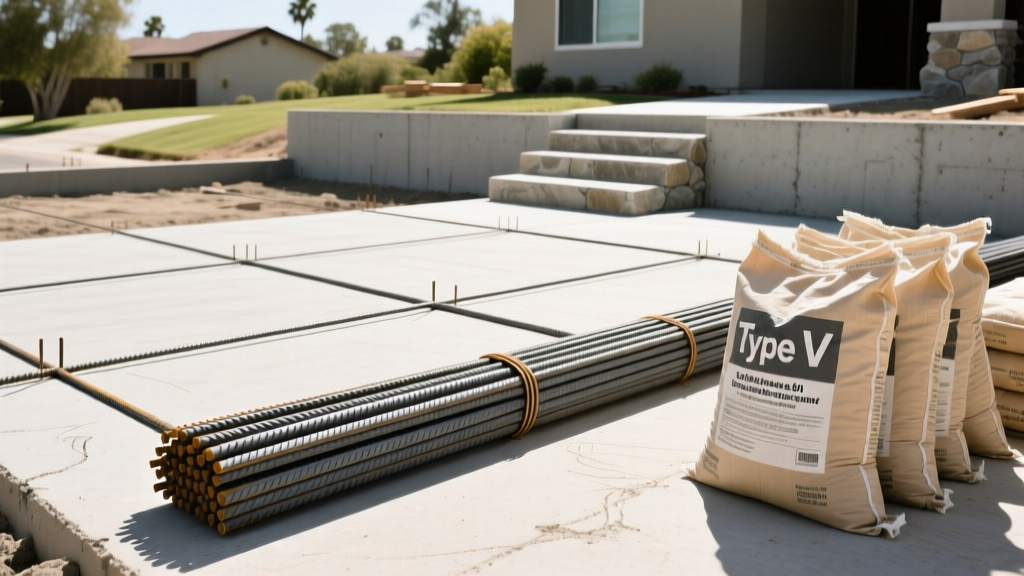
- Cement Type: ASTM C150 Type V (Sulfate-Resisting Portland Cement) is mandatory for sites with severe sulfate exposure. For moderate exposure, Type II/V or a blend of Type I/II with 25% Class F fly ash is acceptable.
- Compressive Strength: Minimum 3,000 psi at 28 days for standard footings; 4,000 psi is strongly recommended for post-tensioned slabs and mat foundations.
- Water-Cement Ratio: Strictly limited to 0.45 maximum to reduce permeability and limit sulfate ingress.
- Slump: 4 to 5 inches. Higher slumps achieved with excess water compromise the structural matrix; utilize polycarboxylate-based high-range water reducers (superplasticizers) to maintain workability.
Reinforcement: Rebar and Post-Tensioning Systems
The tensile forces generated by differential settlement and seismic activity in the Los Angeles basin require robust steel reinforcement. The American Concrete Institute (ACI) provides the baseline standards, but local Santa Ana engineering firms typically exceed these minimums to counteract expansive soil pressures.
Grade 60 Rebar vs. Post-Tensioning
For conventional reinforced concrete foundations, ASTM A615 Grade 60 rebar is the standard. In Santa Ana, #4 (1/2-inch) and #5 (5/8-inch) bars are most common. However, for residential slab-on-grade construction over expansive clay, post-tensioned (PT) concrete is the superior choice. PT slabs utilize 270 ksi, low-relaxation, seven-wire steel strands encased in a greased, plastic sheathing. This active reinforcement compresses the concrete, effectively neutralizing the tensile stresses caused by soil swelling.
Pro-Tip for PT Slabs: Ensure the stressing wedges and anchorages are fully encapsulated in a non-shrink grout with a minimum compressive strength of 4,000 psi to prevent corrosion at the dead ends of the tendons.
Moisture Control and Vapor Mitigation Systems
Santa Ana's high water table in western zones and the natural capillary action of fine-grained alluvial soils necessitate aggressive sub-slab moisture control. Failure to install adequate vapor barriers leads to flooring adhesive failure, mold growth, and accelerated corrosion of embedded steel.
Barrier Material Specifications
Do not use standard 6-mil polyethylene sheeting. The industry standard for commercial and high-end residential projects in Orange County is a 15-mil, cross-laminated polyolefin membrane (such as Stego Wrap or Raven Industries VaporBlock). These materials must meet ASTM E1745 Class A requirements, demonstrating a water vapor permeance of less than 0.03 perms after conditioning. Additionally, a 4-inch capillary break of clean, washed 3/4-inch gravel (ASTM D448 No. 57) must be placed beneath the vapor barrier to disrupt the upward migration of soil moisture.
Deep Foundation Alternatives: Helical Piers and Caissons
In areas adjacent to the Santa Ana River or within designated liquefaction zones, shallow spread footings are structurally inadequate. Deep foundation systems transfer structural loads past the unstable surface soils into competent bearing strata or bedrock.
Helical Piers for Retrofit and New Construction
Helical piers (e.g., Chance SS5 or SS175 series) are increasingly specified in Santa Ana for both new builds and seismic retrofits. These galvanized steel shafts are mechanically torqued into the ground until they reach a predetermined refusal torque, verifying the load-bearing capacity. They are ideal for sites with limited access where large drill rigs cannot operate.
Drilled Caissons
For multi-story commercial structures or heavy residential builds, bell-bottomed drilled caissons are standard. These are drilled to depths of 30 to 60 feet, penetrating the alluvial fan to reach the dense, Pleistocene-era load-bearing strata. The bell at the base increases the end-bearing surface area, distributing the structural load safely.
2026 Material Sourcing and Cost Matrix
Procuring foundation building materials in Santa Ana requires accounting for regional supply chain dynamics, Orange County labor rates, and local batching plant proximity. The table below outlines current estimated material costs for the region.
| Material Category | Specific Specification | Estimated Unit Cost (2026) |
|---|---|---|
| Ready-Mix Concrete | Type V Sulfate-Resistant, 4000 psi | $185 - $210 per Cubic Yard |
| Reinforcement Steel | ASTM A615 Grade 60, #4 and #5 Bar | $0.95 - $1.25 per Linear Foot |
| Post-Tension Tendons | 270 ksi, 0.5-inch, 7-wire encapsulated | $1.80 - $2.40 per Linear Foot |
| Vapor Barrier | 15-mil Cross-Laminated (ASTM E1745 Class A) | $0.55 - $0.75 per Square Foot |
| Helical Piers | Galvanized SS5 Square Shaft (Material Only) | $850 - $1,150 per Pier |
| Capillary Break Gravel | 3/4-inch Washed Drain Rock (No. 57) | $45 - $65 per Ton |
Navigating Code Compliance and Permitting
All foundation materials and designs must comply with the latest iteration of the California Building Code (CBC), which integrates strict seismic and energy efficiency mandates. The International Code Council publishes the base standards, but California's amendments significantly alter material requirements. For instance, CBC Chapter 18 dictates specific geotechnical investigation requirements for expansive soils, mandating that soil reports explicitly state the required isolation joints, over-excavation depths, and concrete mix designs. Furthermore, Title 24 energy codes increasingly influence sub-slab insulation requirements, necessitating the sourcing of high-density, closed-cell rigid foam insulation (minimum R-10) for slab perimeters to prevent thermal bridging.
Frequently Asked Questions
Can I use standard Type I Portland cement for a Santa Ana foundation?
While Type I is cheaper and widely available, it is highly susceptible to sulfate attack. If your geotechnical report indicates moderate to severe sulfate levels—which is common in Santa Ana's alluvial basin—using Type I will result in premature concrete degradation. Always defer to the site-specific soil report, but default to Type II/V or Type V when in doubt.
Are post-tensioned slabs required by the city of Santa Ana?
The city does not explicitly mandate post-tensioning for all residential builds; conventional heavily reinforced slabs with stiffened grade beams are also code-compliant. However, structural engineers overwhelmingly specify PT slabs in Santa Ana because they offer superior resistance to differential movement in expansive soils while often using less overall steel, offsetting the higher material cost of the tendons.
How deep do drilled caissons need to go in Santa Ana?
Caisson depth is entirely dictated by the geotechnical engineer's bearing capacity calculations. In western Santa Ana near the river, you may only need to drill 20 to 30 feet to reach competent alluvium. In eastern areas closer to the hills, or in zones with deep liquefaction potential, caissons may need to be drilled 50 to 80 feet to socket into the underlying bedrock or dense Pleistocene strata.
Written by
Priya KapoorPriya Kapoor is a real estate market analyst and construction economics researcher with expertise in housing affordability, development feasibility, and infrastructure investment. She holds a Master of Regional Planning from Cornell University and previously worked as a senior analyst at CBRE's Investment Properties group, where she modeled returns for $4B in mixed-use development pipelines. Priya now runs an independent research practice advising developers, municipalities, and REITs on construction cost forecasting and market timing. She publishes the quarterly "BuildMat Market Pulse" report tracking material price indices across 12 commodity categories. Based in Austin, TX, Priya serves on the board of Habitat for Humanity Austin and is a marathon runner.
More from Priya Kapoor
View all
Construction Cost
Cost to Build a 1600 Sq Ft Home in 2026: Full Breakdown
Accurate 2026 cost to build a 1600 sq ft home—material, labor, and regional pricing breakdowns included. Plan your budget with real-time estimates.
Aug 11, 2026

Wood & Lumber
Name the Types of Wood for Pressure Treatment and Preservation
Learn how to name the types of wood best suited for pressure treatment. Compare species treatability, chemical retention levels, and 2026 preservation costs.
Aug 4, 2026

Stone & Masonry
Stone Veneer Suppliers Lindenhurst: 2026 Cost Analysis
Analyze 2026 stone veneer costs in Lindenhurst, NY. Compare local supplier pricing, delivery fees, and Suffolk County installation labor rates.
Aug 4, 2026