Settling Foundation Repair Cost: 2026 Pricing Guide by Repair Method
Discover the true settling foundation repair cost in 2026. Compare pricing for piering, mudjacking, and polyurethane foam by severity and method.

The Baseline: Average Settling Foundation Repair Cost
When a home's foundation settles unevenly, the structural integrity and property value plummet. The settling foundation repair cost depends entirely on the failure mechanism, the soil profile, and the chosen remediation technique. In 2026, homeowners facing minor slab settlement can expect to pay between $3,000 and $5,000 for surface-level lifting, while severe structural underpinning projects routinely range from $15,000 to over $40,000. Understanding these costs requires looking past national averages and analyzing the specific engineering methods required to stabilize your soil.
• Minor Settlement (Slab Lifting): $3,200 – $6,500
• Moderate Settlement (Partial Piering): $12,000 – $22,000
• Severe Structural Failure (Full Underpinning): $25,000 – $45,000+
• Average Cost per Pier Installed: $1,800 – $2,800
Cost Breakdown by Repair Method
Different settlement symptoms demand entirely different engineering solutions. Applying a slab-lifting technique to a failing load-bearing footing will result in repeated failure, just as installing deep piers for a minor concrete patio dip is a massive waste of capital. Below is the current pricing matrix for the primary repair methodologies.
| Repair Method | Best Application | 2026 Cost Range | Expected Lifespan |
|---|---|---|---|
| Polyurethane Foam Jacking | Non-structural slab lifting, void filling | $15 – $25 per sq. ft. | 50+ years |
| Cementitious Mudjacking | Heavy exterior flatwork, driveway settling | $4 – $8 per sq. ft. | 10 – 15 years |
| Steel Push Piers | Stabilizing heavy load-bearing footings | $1,500 – $2,500 per pier | Permanent (75+ years) |
| Helical Piers | Lightweight structures, new construction tie-backs | $1,800 – $3,000 per pier | Permanent (75+ years) |
Deep Foundation Underpinning: Push vs. Helical Piers
When expansive soils or poor compaction cause the actual concrete footings to drop, surface repairs are useless. You must bypass the active soil zone and transfer the home's load to stable bedrock or a load-bearing stratum. According to the International Association of Certified Home Inspectors (InterNACHI), differential settlement exceeding 1 inch over 20 feet requires structural underpinning.
Steel Push Piers utilize the weight of the structure itself to drive steel pipe sections deep into the ground. Systems like the Earth Contact Products (ECP) Model 288 push pier can handle working loads up to 70,000 lbs. The cost is heavily influenced by the depth required to reach refusal (bedrock). If bedrock is 20 feet down, you might pay $1,600 per pier. If it is 60 feet down, the material and labor costs push the price closer to $2,400 per pier.
Helical Piers are screwed into the ground like a giant wood screw, independent of the structure's weight. They are ideal for lighter structures (like sunrooms or porches) or situations where the bedrock is too deep for push piers. Installation must strictly adhere to ICC-ES AC357 acceptance criteria to ensure the helical plates can sustain the design load without stripping the soil.
Slab Lifting: Polyurethane Foam vs. Cementitious Mudjacking
If the footings are stable but the interior concrete slab has settled due to sub-slab voids or minor soil consolidation, slab jacking is the correct approach.
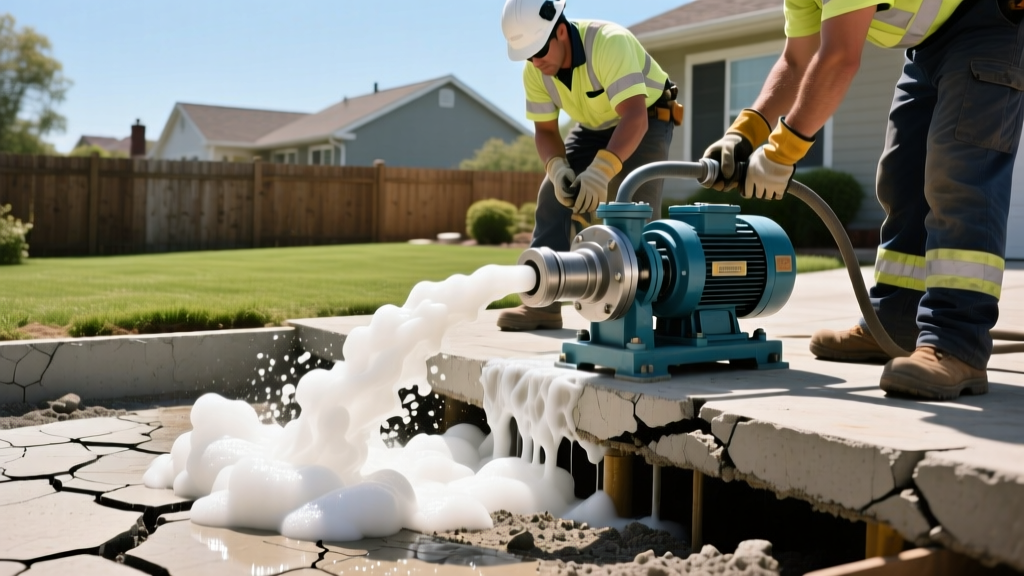
High-Density Polyurethane Foam is the modern standard for interior slab lifting. Technicians drill 5/8-inch holes through the slab and inject a two-part resin that expands and cures in roughly 15 seconds. A 2.5 lb/cubic foot density foam can lift thousands of pounds while adding virtually no weight to the underlying soil. Because the resin is impervious to water, it will not wash away, making it highly effective in areas prone to heavy rainfall or plumbing leaks.
Mudjacking uses a slurry of topsoil, sand, and Portland cement. It requires larger drill holes (1.5 to 2 inches) and pumps thousands of pounds of heavy, water-logged material beneath the slab. While significantly cheaper upfront, the U.S. Geological Survey (USGS) notes that introducing heavy, moisture-laden materials to expansive clay soils can trigger secondary swelling and subsequent re-settlement once the slurry dries and shrinks.
Hidden Variables That Spike Your Final Invoice
Contractor estimates often exclude site-specific complications. When budgeting your settling foundation repair cost, account for these frequent edge cases:
- Post-Tensioned (PT) Slabs: Common in Texas, Nevada, and California, PT slabs contain high-tension steel cables. Drilling blindly for pier brackets or foam injection can snap a tendon. Contractors must use ground-penetrating radar (GPR) or X-ray the slab before drilling, adding $800 to $1,500 to the project.
- Sub-Slab Plumbing Leaks: If a sewer line or water main is leaking beneath the foundation, the soil will wash out (piping) or expand. No foundation repair will hold until the leak is fixed. You will need a hydrostatic pressure test ($350–$500) and potentially trenchless pipe lining before foundation work begins.
- Interior Finish Demolition: Installing interior push piers requires jackhammering through the basement or crawlspace floor. If your basement is fully finished with drywall, flooring, and HVAC ductwork, the demolition and subsequent rebuilding can add $5,000 to $12,000 to the total project cost.
- Grade Beam Access: Homes with thick, heavily reinforced concrete grade beams require specialized core drilling and heavy-duty hydraulic equipment to attach pier brackets, increasing labor time by 20% to 30%.
Beware of contractors quoting under $5,000 to 'fix' severe structural settlement by simply shimming wooden beams in a crawlspace or patching drywall cracks with epoxy. These are cosmetic band-aids. True structural repair requires transferring the load to stable soil. Always demand a licensed structural engineer's report (costing $500–$800) before signing a repair contract.
Decision Framework: Matching the Repair to the Settlement
Use this diagnostic flow to determine which repair method your property actually requires before soliciting bids.
Scenario A: The Drywall is Cracking, but Floors are Level
Diagnosis: Perimeter footing settlement. The exterior footings are dropping, pulling the walls apart.
Action: Install exterior push piers or helical piers along the failing wall. Do not use interior foam jacking.
Scenario B: The Floors are Sloping, but Drywall is Intact
Diagnosis: Interior slab settlement or crawlspace beam deflection. The perimeter is stable, but the center is dropping.
Action: For slab-on-grade, use polyurethane foam jacking. For pier-and-beam, install supplemental adjustable lally columns or sister the failing wooden joists.
Scenario C: Doors Stick and Floors Slope Simultaneously
Diagnosis: Global differential settlement. Both the perimeter and the interior are moving independently.
Action: Comprehensive underpinning (piers on the exterior) combined with interior slab stabilization. This is the most expensive scenario and requires a phased engineering approach.
Frequently Asked Questions
Does homeowners insurance cover settling foundation repair costs?
Standard HO-3 policies explicitly exclude earth movement, soil expansion, and natural settling. Insurance will only cover foundation repairs if the damage was the direct result of a covered peril, such as a sudden, accidental plumbing leak beneath the slab or damage from a fallen tree. Always review your policy's 'Earth Movement' exclusion clause.
How long does a typical piering project take?
An average exterior push pier installation (10 to 15 piers) takes 3 to 5 days for a professional crew. However, if interior flooring must be removed, or if bedrock is exceptionally deep requiring extensive pipe coupling, the timeline can extend to two weeks. Polyurethane slab lifting is much faster, typically completed in a single day for an average-sized home.
Can I sell a house with an unrepaired settling foundation?
You can legally sell the home, but you must disclose the known defect in almost all U.S. states. In practice, traditional mortgage lenders will flag the settlement during the appraisal and require a structural engineer's clearance or demand the repairs be completed prior to funding the loan. Most sellers end up negotiating a credit at closing equal to 1.5 times the actual repair cost to compensate the buyer for taking on the project risk.
Written by
Marcus ChenMarcus Chen is a licensed structural engineer (PE) and building materials analyst with over 12 years of experience across residential, commercial, and industrial construction. He holds a Master of Science in Civil Engineering from UC Berkeley and spent six years at Thornton Tomasetti before transitioning to independent consulting and technical writing. Marcus specializes in material selection for seismic-prone regions, concrete reinforcement strategies, and lifecycle cost analysis. His work has been cited by the American Concrete Institute (ACI) and the Structural Engineers Association of California (SEAOC). When he is not on a job site or at his desk, you will find him hiking the Sierra Nevada or restoring a 1920s craftsman bungalow in Oakland, CA.
More from Marcus Chen
View all
Construction Cost
How Much Did the Eiffel Tower Cost to Build?
How much did the Eiffel Tower cost to build in 1889? We adjust for inflation and compare its budget to modern skyscraper construction.
Aug 4, 2026

Fire Resistance
What Is a Fire Resistant Material? Testing & Certification Guide
Discover what is a fire resistant material through ASTM and UL testing. Learn how fire ratings, certifications, and assemblies work in construction.
Aug 4, 2026

Construction Cost
How Much Did the Burj Khalifa Cost to Build?
How much did the Burj Khalifa cost to build? We break down the $1.5B project and extract 5 money-saving strategies for your next build.
Jul 30, 2026