Crumbling Foundation Repair Cost & Structural Analysis Guide
Analyze the structural causes of crumbling foundations and compare 2026 repair costs for spalling, rebar corrosion, and carbonation damage.

The Structural Pathology of Crumbling Concrete
When a homeowner observes a "crumbling" foundation, a structural engineer sees a specific degradation mechanism compromising the load-bearing cross-section. Concrete does not disintegrate randomly; it fails due to distinct chemical and physical pathologies. Accurately identifying the failure mode is the first step in determining the true crumbling foundation repair cost, as superficial patching over active chemical degradation will result in recurring failure within 12 to 18 months.
Primary Failure Mechanisms
- Rebar Corrosion (Rust Jacking): As embedded steel oxidizes, it expands up to 7 times its original volume. This generates internal tensile stresses exceeding concrete's low tensile strength (typically 300-500 psi), causing the concrete cover to delaminate and spall. The Portland Cement Association notes that chloride ingress and carbonation are the primary catalysts for this depassivation.
- Carbonation: Atmospheric CO2 reacts with calcium hydroxide in the concrete, lowering the pH from ~12.5 to below 8.5. This destroys the protective alkaline environment around the rebar. Carbonation-induced crumbling typically presents as a uniform, powdery degradation across the entire wall surface rather than localized spalling.
- Freeze-Thaw Scaling: In saturated concrete lacking an adequate air-entrainment system (typically 4-8% microscopic air voids), freezing water expands 9%, causing surface scaling. This is common in older foundations poured before modern ASTM C33 aggregate standards were strictly enforced.
- Alkali-Silica Reaction (ASR): Often called "concrete cancer," ASR occurs when reactive silica in aggregates reacts with alkali hydroxides, forming an expansive gel. This causes severe map-cracking and deep structural crumbling that cannot be patched; the affected sections must be replaced.
Diagnostic Testing Costs: The Pre-Repair Phase
Before pricing a repair, structural engineers must quantify the damage. Skipping diagnostics often leads to change orders and underestimated crumbling foundation repair costs.
| Diagnostic Method | Purpose | 2026 Average Cost | Standard |
|---|---|---|---|
| Phenolphthalein Testing | Measures carbonation depth (pH indicator) | $150 - $300 per wall | ASTM C876 |
| Half-Cell Potential | Maps probability of active rebar corrosion | $400 - $800 per zone | ASTM C876 |
| Ground Penetrating Radar (GPR) | Locates rebar placement and internal voids | $800 - $1,500 per day | ASTM D6432 |
| Core Sampling & Petrography | Analyzes air-entrainment and ASR gel presence | $250 - $450 per core | ASTM C42 / C295 |
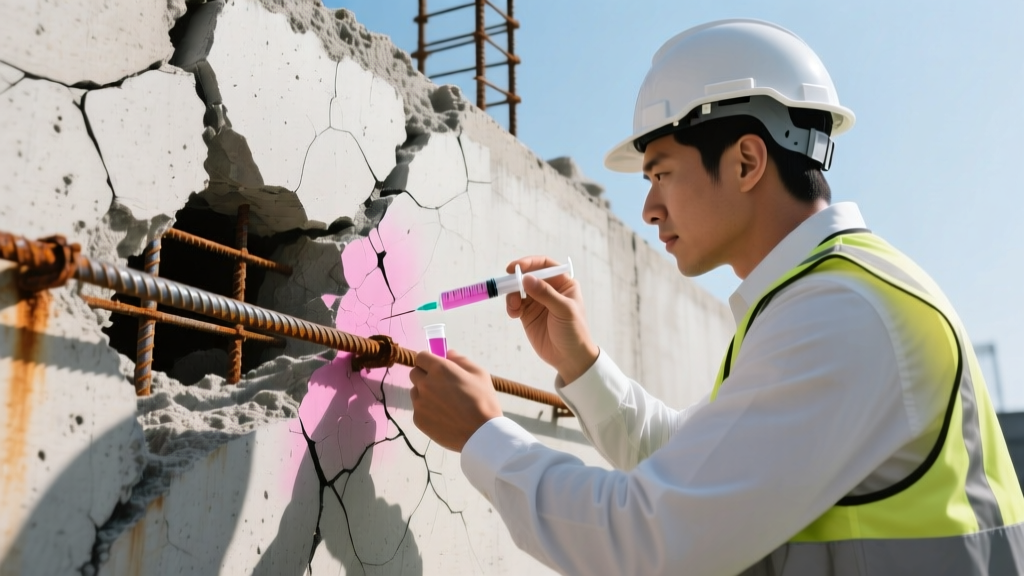
Crumbling Foundation Repair Cost Breakdown by Method
Once the pathology is confirmed, the repair strategy dictates the budget. Below is a structural analysis of repair methods, moving from superficial restoration to full load-bearing reinforcement.
1. Surface Scaling & Minor Spalling (Depth < 1 Inch)
When the structural rebar is not exposed and the crumbling is strictly limited to the cement paste and fine aggregate (mortar flaking), polymer-modified mortars are sufficient.
- Materials: SikaTop-122 Surfactant or Quikrete Concrete Resurfacer.
- Process: Scarify the surface to a bright, clean aggregate profile (CSP 3-5), apply a bonding agent (e.g., SikaLatex), and trowel on the polymer mortar.
- Cost: $8 to $16 per square foot installed. This restores the concrete cover but adds zero structural load capacity.
2. Deep Spalling & Rebar Exposure (Depth > 1 Inch)
When rust jacking has blown off the concrete cover, the rebar must be exposed, cleaned, and passivated before patching.
- Materials: Sika MonoTop-612 Structural Repair Mortar, Simpson Strong-Tie CP 100 epoxy paste.
- Process: Chip concrete 1 inch behind the rebar to ensure full encapsulation. Sandblast the steel to bright metal. Apply a zinc-rich primer or migrating corrosion inhibitor (MCI). Form and pour or hand-pack high-build structural mortar.
- Cost: $45 to $95 per linear foot of spalled area. If more than 20% of the wall's rebar is exposed, costs scale exponentially due to shoring requirements.
3. Structural Epoxy Injection (For Active Crumbling Along Crack Lines)
If crumbling is localized along structural cracks (width > 0.015 inches) that are actively leaking or shifting, epoxy injection restores the monolithic tensile strength of the wall.
- Materials: Sikadur-35 Hi-Mod LV or Loctite PC 7000 series structural epoxies.
- Cost: $50 to $110 per linear foot. Note: Polyurethane foam injection ($25-$40/ft) stops water but provides no structural bonding; it must not be used for load-bearing crack repair.
4. Carbon Fiber Reinforcement (Sistering)
When crumbling has compromised the wall's flexural capacity, but full replacement is cost-prohibitive, carbon fiber straps provide tensile reinforcement superior to steel without adding bulk.
- Materials: CarbonArmor or Simpson Strong-Tie Carbon Fiber systems.
- Cost: $1,200 to $1,800 per vertical strap (installed). A standard 30-foot basement wall requiring 6 straps will cost between $7,200 and $10,800, plus the cost of the underlying concrete patching.
Step-by-Step Structural Remediation for Oxidized Rebar
To ensure a permanent repair when dealing with rust-induced crumbling, structural engineers mandate a strict adherence to the following protocol. Deviating from these steps guarantees the patch will fail as the underlying rebar continues to oxidize.
- Substrate Preparation: Use pneumatic chipping hammers (not rotary hammer drills, which cause micro-fracturing) to remove all delaminated concrete. The perimeter of the patch must be saw-cut to a minimum depth of 1/4 inch to prevent feather-edging, which leads to premature bond failure.
- Rebar Excavation: Excavate at least 3/4 inch behind the exposed rebar. If the rebar has lost more than 20% of its cross-sectional area to rust, it must be supplemented with a new dowel bar tied alongside it, per ACI 318 development length requirements.
- Passivation: Apply a two-part zinc-rich epoxy primer to the steel. This acts as a sacrificial anode, protecting the steel even if moisture eventually penetrates the new patch.
- Forming and Placement: For patches exceeding 2 inches in depth, build rigid forms. Use a non-shrink, high-flow structural grout (e.g., MasterFlow 713) rather than hand-troweled mortar to eliminate honeycombing and air voids behind the rebar.
- Curing: Maintain a wet cure or apply a high-solids curing compound for a minimum of 72 hours to prevent plastic shrinkage cracking in the new repair material.
"The most common error in foundation repair is treating a symptom rather than the pathology. Patching carbonated concrete without first applying a penetrating silane sealer or migrating corrosion inhibitor is essentially sealing the moisture inside, accelerating the very rebar corrosion you are trying to stop."
— Structural Forensics Engineering Guidelines, 2025
When to Abandon Repair: The 40% Rule and Full Replacement Costs
Structural analysis dictates that there is a point of diminishing returns where repair costs exceed the cost of full replacement, or where the residual safety factor drops below acceptable limits (typically 1.4 for dead loads and 1.7 for live loads).
The 40% Rule: If more than 40% of a foundation wall's surface area requires deep structural patching, or if the footing itself is crumbling and losing bearing area, engineers will recommend full wall replacement. Attempting to stitch together a highly degraded wall results in a "quilted" structural profile with unpredictable load paths and shear weaknesses.
Full Wall Replacement Costs
- House Shoring & Jacking: $2,000 - $5,000 to temporarily support the superstructure.
- Demolition & Hauling: $1,500 - $3,500 depending on access and local dump fees.
- Forming, Rebar, and Pouring: $150 - $350 per linear foot for a standard 8-foot poured concrete wall (2,500 to 3,000 psi mix with 5/8" Grade 60 rebar at 16" O.C.).
- Waterproofing & Backfill: $40 - $80 per linear foot for exterior dimple board and French drain integration.
For a 1,200 sq ft rectangular home (approx. 140 linear feet of foundation), full replacement costs typically range from $35,000 to $65,000 in 2026, heavily dependent on soil conditions, excavation access, and regional labor rates.
Frequently Asked Questions (FAQ)
Does homeowner's insurance cover crumbling foundation repair?
Generally, no. Standard HO-3 policies exclude "settling, cracking, shrinking, bulging, or expansion" of foundations. Coverage is usually only triggered if the crumbling is the direct, sudden result of a covered peril, such as a vehicle striking the foundation or a sudden plumbing leak that washes away the supporting soil (underground pipe coverage endorsement required).
Can I use hydraulic cement to fix crumbling corners?
Hydraulic cement (like Waterplug) is excellent for stopping active, high-pressure water leaks because it expands as it cures. However, it has poor long-term bonding strength and high shrinkage characteristics compared to polymer-modified structural mortars. It should only be used as a temporary water-stopping measure, not as a permanent structural patch for crumbling concrete.
How long does a structural epoxy injection last?
When injected into a dry, properly prepared crack, structural epoxy has a compressive strength exceeding 7,000 psi (stronger than the concrete itself). The repair is considered permanent and will outlast the original foundation, provided the underlying soil settlement or hydrostatic pressure issue that caused the crack has been resolved.
Written by
David NakamuraDavid Nakamura is a licensed architect (AIA) and construction technology writer focused on sustainable building methods, mass timber engineering, and high-performance building envelopes. He holds a Master of Architecture from the University of Washington and is a certified Passive House Consultant (CPHC). David spent eight years at the Seattle firm Mithun, where he led the design of three LEED Platinum projects, before founding his own practice specializing in net-zero residential design. He serves on the editorial advisory board of GreenBuilder Magazine and has authored peer-reviewed papers on cross-laminated timber (CLT) connections for the Journal of Structural Engineering. In his spare time, David teaches woodworking at Pratt Fine Arts Center and kayaks the Puget Sound.
More from David Nakamura
View all
Construction Cost
Labor Cost to Build a Deck Per Sq Ft: 2026 Installation Guide
Discover the exact labor cost to build a deck per sq ft in 2026. This installation guide breaks down contractor rates, complexity factors, and hidden fees.
Aug 4, 2026

Construction Cost
How Much Does It Cost to Build a 3 Bedroom House? Financing Guide
Learn exactly how much it costs to build a 3 bedroom house and explore 2026 financing options, construction loan types, and budget frameworks for your build.
Aug 4, 2026

Construction Cost
Cost to Build a Tennis Court: 2026 Guide
How much does it cost to build a tennis court in 2026? Breakdowns for asphalt, concrete, and synthetic surfaces plus fencing and lighting.
Jul 30, 2026