Choosing the Right Flat Roofing Material for Your Climate Region
Discover the best flat roofing material for your specific climate. Compare EPDM, TPO, PVC, and modified bitumen for snow, heat, and coastal zones.

The Physics of Flat Roofs in Extreme Weather
Flat and low-slope roofs (defined as having a pitch of 3:12 or less) face unique environmental stresses that steep-slope roofs naturally shed. Without gravity-assisted runoff, flat roofs must withstand prolonged hydrostatic pressure from ponding water, extreme thermal expansion and contraction, and direct, unshielded UV radiation. Selecting the correct flat roofing material is not a matter of aesthetic preference; it is a structural necessity dictated by your regional climate. A membrane that performs flawlessly in the arid Southwest will rapidly degrade in the freeze-thaw cycles of the Midwest.
As of 2026, commercial and residential flat roofing systems have evolved, with 80-mil thicknesses becoming the baseline standard for commercial applications due to increased severity in weather events. Below is a technical breakdown of how to match specific single-ply and built-up membranes to distinct climate zones, including exact material specifications, installation nuances, and failure modes.
Hot & Arid Climates: Beating Thermal Shock and UV Degradation
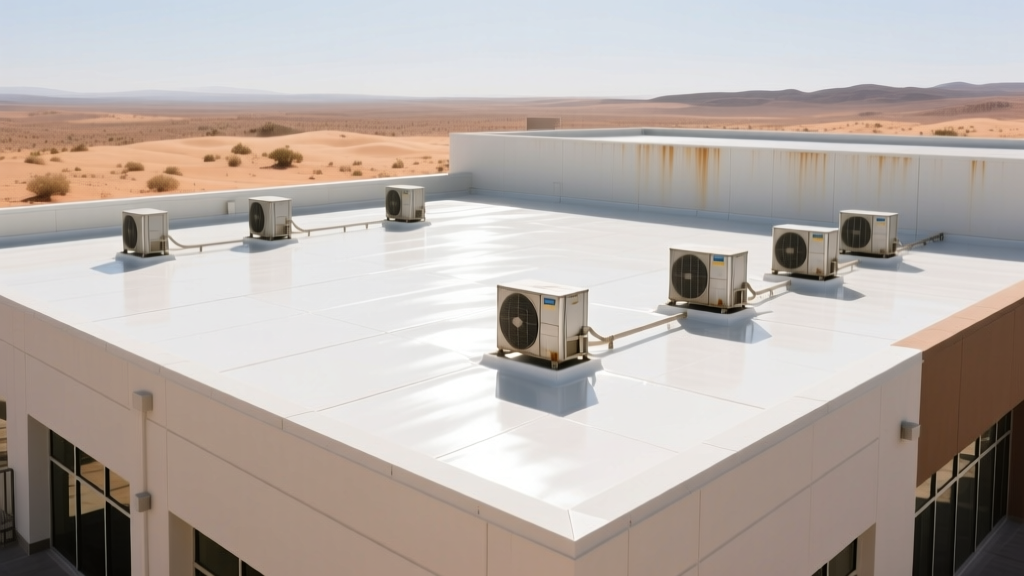
In regions like the American Southwest, Southern California, and the Middle East, rooftop temperatures can exceed 160°F (71°C) during peak summer months. The primary enemies here are UV radiation and thermal shock—the rapid temperature drop when monsoon rains hit a superheated membrane, causing severe contraction.
Recommended Materials: TPO and PVC
Thermoplastic Polyolefin (TPO) and Polyvinyl Chloride (PVC) are the undisputed leaders in high-heat zones. Their white, highly reflective surfaces boast a Solar Reflectance Index (SRI) of 100 or higher, which keeps the roof deck cooler and reduces building cooling loads by up to 15%, aligning with the EPA's Heat Island Effect guidelines for cool roofing.
- Specific Product Benchmark: GAF EverGuard Extreme TPO (80-mil) or Sika Sarnafil G410 PVC.
- Installed Cost Range: $5.50 to $8.50 per square foot (materials and labor).
- Crucial Installation Detail: TPO seams must be hot-air welded at precisely 1,000°F to 1,150°F. In high ambient heat, welders must adjust their speed and temperature dials constantly; a weld that is too hot will scorch the polymer, while a cold weld will peel within two years.
Cold & Snowy Climates: Managing Freeze-Thaw Cycles
In the Northeast, Great Lakes, and Mountain regions, flat roofs must handle heavy snow loads, ice damming at parapets, and the mechanical stress of freeze-thaw cycles. When snow melts and pools, then freezes at night, the resulting ice expansion can tear poorly adhered membranes.
Recommended Materials: EPDM and SBS Modified Bitumen
Ethylene Propylene Diene Monomer (EPDM) remains a top-tier flat roofing material for cold climates. Unlike thermoplastics, EPDM is a thermoset rubber that remains highly flexible at temperatures as low as -40°F. Furthermore, installing black EPDM in snowy climates is a strategic advantage: it absorbs solar heat, passively melting the bottom layer of snowpack and reducing the risk of structural collapse from snow accumulation.
| Feature | 60-Mil EPDM (Elevate RubberGard) | SBS Modified Bitumen (2-Ply) |
|---|---|---|
| Cold Flexibility | Excellent (Down to -40°F) | Very Good (Down to -20°F) |
| Seam Integrity | Requires primer and tape (vulnerable if prep is poor) | Torch-applied or hot-mopped (monolithic, highly reliable) |
| Puncture Resistance | Moderate (Needs walkway pads) | High (Heavy granule surface) |
| Estimated Installed Cost | $4.50 - $6.50 / sq. ft. | $6.00 - $9.00 / sq. ft. |
Insulation Strategy for Cold Zones: Polyisocyanurate (Polyiso) insulation suffers from "thermal drift," where its R-value actually drops in freezing temperatures. For flat roofs in severe cold climates, specify a hybrid insulation assembly: use a base layer of XPS (Extruded Polystyrene) which maintains its R-value in the cold, topped with a high-density polyiso cover board to provide a firm substrate for the membrane.
Coastal & High-Wind Zones: Resisting Uplift and Salt Spray
Hurricane-prone coasts and high-wind corridors demand flat roofing systems engineered for extreme uplift resistance. Salt spray can also corrode standard mechanical fasteners, leading to catastrophic roof blow-offs during tropical storms.
Recommended Materials: Fully Adhered PVC or Mechanically Fastened TPO with Enhanced Edges
To meet the stringent FORTIFIED Roof standards and FM Global 1-90 wind uplift ratings, the attachment method is just as critical as the flat roofing material itself. Fully adhered PVC systems, where the membrane is glued directly to the cover board using low-VOC adhesives, eliminate the risk of fasteners backing out or rusting in salt-air environments.
"In coastal zones, the perimeter edge detail is where 90% of wind-related flat roof failures occur. Specifying a membrane with a reinforced scrim and utilizing continuous edge metal with 12-inch on-center fastener spacing into structural steel or concrete is non-negotiable for FM 1-90 compliance." — Guidelines adapted from the National Roofing Contractors Association (NRCA).
Decision Matrix: Matching Material to Your Zip Code
Use this practical framework to finalize your material selection based on your primary environmental stressor:
- If your primary concern is high UV and cooling costs (Southwest, Deep South): Specify 80-mil white TPO or PVC. Ensure the contractor uses an automatic hot-air welder with daily test welds and peel checks.
- If your primary concern is heavy snow and freeze-thaw (Northeast, Midwest): Specify 60-mil or 90-mil black EPDM, fully adhered over a tapered EPS insulation system (minimum 1/4" per foot slope) to prevent ice-damming from ponding water.
- If your primary concern is high wind and salt air (Gulf Coast, Atlantic Seaboard): Specify fully adhered, fleece-backed PVC. Use stainless steel or heavily galvanized fasteners for the underlying insulation layers to prevent sub-surface corrosion.
- If your roof has heavy foot traffic for HVAC maintenance (Urban Centers): Regardless of climate, specify a double-layer modified bitumen system or a single-ply membrane protected by a poured-in-place rubberized walkway or concrete pavers.
Common Climate-Induced Failure Modes to Monitor
Even the best materials fail if the climate-specific installation details are ignored. Watch for these specific failure modes during annual inspections:
- Blistering (Hot/Humid Climates): Caused by moisture trapped between the membrane and insulation expanding in the heat. Fix: Core vents to release pressure; do not simply slice and patch.
- Seam Shrinkage (Cold Climates): EPDM and TPO can pull away from flashings during extreme cold contraction. Fix: Ensure all perimeter flashings utilize reinforced membrane strips and termination bars with continuous bead of polyurethane sealant.
- Alligatoring (Arid/High UV Climates): Surface cracking on modified bitumen or coated roofs due to UV depletion of the asphalt's oils. Fix: Apply an elastomeric acrylic or silicone roof coating before the cracks penetrate the scrim.
By treating your local climate as the primary design parameter rather than an afterthought, you can extend the service life of your flat roof from a premature 10 years to a reliable 25 to 30 years.
Written by
Elena RodriguezElena Rodriguez is a civil engineer and technical writer specializing in concrete technology, masonry systems, and ASTM/ACI compliance. She earned her B.S. in Civil Engineering from Texas A&M University and spent a decade at a materials testing laboratory, performing over 2,000 concrete compressive strength tests and masonry prism evaluations. Elena is an ACI-certified Field Testing Technician (Grade I) and a member of ASTM Committee C12 on Natural Building Stone. She currently consults on forensic engineering cases involving concrete failures and moisture intrusion. Based in San Antonio, TX, Elena is a proud member of the Society of Women Engineers (SWE) and coaches her daughter's FIRST Robotics team.
More from Elena Rodriguez
View all
Walls & Panels
Cost Analysis: Light Gauge Steel Framing Advantages and Disadvantages
Evaluate light gauge steel framing advantages and disadvantages through a strict cost analysis lens, comparing material, labor, and lifecycle expenses.
Aug 4, 2026

Walls & Panels
Gypsum Board Types: Exact Specifications, Thickness & Dimensions
Compare standard, Type X, and moisture-resistant gypsum board types. Get exact specifications, thicknesses, dimensions, and ASTM standards for your project.
Aug 4, 2026

Fire Resistance
Best Fire-Resistant Outdoor Decking Materials: 2026 Buyer Guide
Discover the best fire-resistant outdoor decking materials for 2026. Compare Class A PVC, aluminum, and hardwood options for WUI compliance and safety.
Aug 4, 2026