Choosing the Right Roof Membrane Material by Climate
Discover the best roof membrane material for your specific climate zone. Compare TPO, EPDM, PVC, and silicone for heat, cold, wind, and rain.

The Climate Imperative for Low-Slope Roofs
Flat and low-slope roofs (under a 3:12 pitch) rely entirely on a continuous, impermeable waterproofing layer. Selecting the correct roof membrane material is not a one-size-fits-all decision; a system that thrives in the freezing, snow-heavy winters of Minnesota will degrade prematurely in the UV-baked, high-hail environment of Arizona. In 2026, with extreme weather events increasing in frequency, matching your membrane's chemical and physical properties to your specific microclimate is the single most critical factor in achieving a 25- to 30-year service life.
Quick-Reference Climate Decision Matrix
| Climate Zone | Primary Threat | Optimal Membrane | Critical Specification |
|---|---|---|---|
| Hot & Arid (Southwest) | UV Degradation, Thermal Shock | TPO (White) | 80-mil, SRI > 100, HALS stabilized |
| Cold & Snowy (Northern) | Freeze-Thaw, Ice Dams | EPDM (Black) or Mod-Bit | 60-mil reinforced, 30ft wide rolls |
| Coastal & High-Wind | Hurricane Uplift, Salt Spray | PVC (Fully Adhered) | FM 1-135 wind rating, KEE polymer |
| Temperate & High-Rain | Ponding Water, Biological Growth | Silicone or PVC | Seamless liquid application, >30 dry mils |
Zone 1: Hot & Arid (High UV and Extreme Heat)
In regions like Arizona, Nevada, and West Texas, the roof surface can easily exceed 160°F in the summer. The primary enemies here are ultraviolet (UV) radiation and thermal shock from sudden monsoon downpours hitting superheated membranes.
The Solution: High-Reflectivity TPO
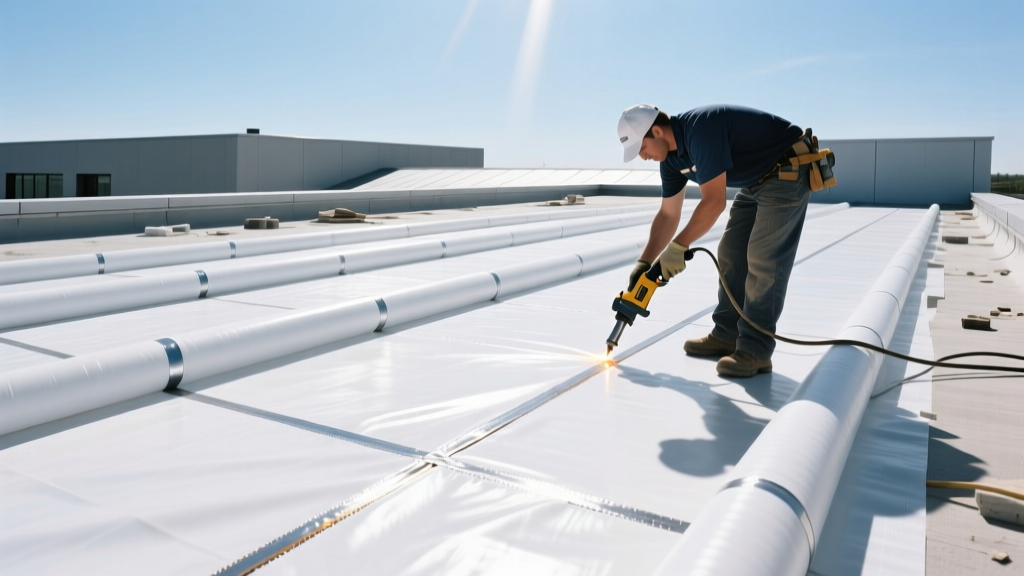
Thermoplastic Polyolefin (TPO) is the undisputed leader in hot climates due to its heat-welded seams and high solar reflectance. According to the US Department of Energy, cool roofs can reduce peak cooling demand by 10-15%, significantly lowering HVAC strain.
- Material Spec: Do not use standard 45-mil or 60-mil TPO in high-hail zones (like Dallas or Phoenix). Specify 80-mil TPO (e.g., Carlisle Sure-Weld or GAF EverGuard Extreme) to pass FM 4473 severe hail impact tests.
- Chemical Additives: Ensure the product data sheet explicitly lists Hindered Amine Light Stabilizers (HALS). Early 2000s TPO failed because it lacked sufficient UV inhibitors; modern 2026 formulations with HALS prevent the polymer from chalking and cracking.
- SRI Value: Demand a Solar Reflectance Index (SRI) of 100 or higher. White TPO typically starts at an SRI of 106 but drops as it collects dirt. Specify a membrane with a self-cleaning surface topography to maintain an SRI above 80 after three years of weathering.
Zone 2: Cold & Snowy (Freeze-Thaw and Ice Accumulation)
In the upper Midwest and Northeast, roofs must handle heavy snow loads, ice damming, and extreme cold-weather flexibility. A membrane that becomes brittle at -20°F will crack when the building's roof deck expands and contracts.
The Solution: Reinforced EPDM
Ethylene Propylene Diene Monomer (EPDM) remains highly flexible at temperatures as low as -40°F. Unlike TPO, which requires heat welding (a process that becomes difficult and unreliable in sub-freezing ambient air), EPDM seams can be secured with cold-weather liquid adhesives and primer.
In cold climates, specify black EPDM. The dark surface absorbs solar radiation, helping to melt snow loads and reduce the weight stress on the roof deck. Furthermore, black EPDM avoids the 'thermal shock' condensation issues that can occur when white membranes keep the roof deck too cold relative to the warm, humid interior air below.
- Seam Minimization: The weakest point of any EPDM roof is the taped or glued seam. Specify 30-foot wide rolls (available from manufacturers like Elevate, formerly Firestone) to reduce seam overlap by up to 65% compared to standard 10-foot rolls.
- Reinforcement: Always choose polyester-reinforced EPDM (minimum 60-mil). Unreinforced EPDM is prone to tearing under the sheer weight of wet snow and ice removal operations.
Zone 3: Coastal & High-Wind (Hurricanes and Salt Spray)
Facilities within 15 miles of the coastline face a dual threat: corrosive salt air and catastrophic wind uplift. Mechanically attached membranes (where plates and screws hold the material) are highly vulnerable to wind getting underneath and peeling the roof off like a sardine can.
The Solution: Fully Adhered KEE PVC
Polyvinyl Chloride (PVC) membranes, specifically those formulated with Ketone Ethylene Ester (KEE) polymers (such as Sika Sarnafil or Johns Manville), offer superior chemical resistance to salt spray and airborne industrial pollutants.
- Wind Uplift Rating: Standard commercial roofs require an FM 1-90 wind rating. Coastal buildings must specify FM 1-135 or FM 1-150. This is achieved by utilizing a fully adhered system, where the PVC is bonded directly to the insulation using a low-VOC, two-part polyurethane adhesive.
- Perimeter Fastening: Even in fully adhered systems, the perimeter edge metal must be secured with heavy-duty fasteners spaced no more than 12 inches on center (o.c.) to prevent wind from breaching the edge.
- Animal Fat Resistance: If the coastal building houses a restaurant with rooftop exhaust vents, PVC is mandatory. TPO and EPDM will dissolve and blister when exposed to animal fats and grease, whereas PVC is chemically inert to lipids.
Zone 4: Temperate & High-Rainfall (Ponding Water)
In the Pacific Northwest and Southeast, low-slope roofs frequently suffer from poor drainage, leading to 'ponding water' (water that remains for more than 48 hours after a rainstorm). Most standard membranes will eventually re-emulsify, blister, or degrade under constant submersion.
The Solution: Liquid-Applied Silicone
For existing roofs with chronic ponding issues, or complex roofs with dozens of pipe penetrations, liquid-applied 100% silicone is the ultimate waterproofing solution. Silicone is completely impervious to ponding water and cures to form a seamless, monolithic rubber blanket.
Acrylic roof coatings are water-based and will re-emulsify (turn back into liquid) if exposed to ponding water. Always verify the product data sheet specifies '100% Silicone' (e.g., Henry Pro-Grade 988 or GAF Unity) for flat roofs with less than a 1/4 inch per foot slope.
- Application Thickness: Silicone must be applied at a minimum of 30 dry mils (which requires roughly 45 wet mils, as silicone contains solvents that evaporate). Apply in two coats with a reinforcing polyester mesh embedded at all seams and penetrations.
- Primer Requirements: Silicone does not adhere well to dirty or chalky surfaces. Power wash the existing roof and apply a bleed-tracker primer if coating over asphalt or modified bitumen to prevent oils from staining the white silicone.
2026 Installed Cost and Lifespan Breakdown
Budgeting for a commercial low-slope roof requires looking beyond the material cost. The following table reflects average 2026 installed costs (material, labor, and standard insulation) for a 10,000 sq. ft. commercial roof.
| Membrane Type | Avg. Installed Cost (per sq. ft.) | Expected Lifespan | Maintenance Requirement |
|---|---|---|---|
| 60-mil TPO (Mechanically Attached) | $8.50 - $11.00 | 20 - 25 Years | Annual seam inspections |
| 80-mil TPO (Fully Adhered) | $11.50 - $14.00 | 25 - 30 Years | Low |
| 60-mil Reinforced EPDM | $9.00 - $12.50 | 25 - 30 Years | Re-tape seams every 10 yrs |
| 60-mil KEE PVC (Fully Adhered) | $12.00 - $16.50 | 25 - 35 Years | Very Low |
| Silicone Coating (Over existing) | $4.50 - $7.00 | 15 - 20 Years | Annual cleaning for SRI |
Note: Costs vary by regional labor rates and roof accessibility. Complex roofs with numerous HVAC curbs and skylights will push costs to the higher end of the spectrum.
The Hidden Variable: Insulation Compatibility
Your roof membrane material is only as good as the substrate beneath it. The National Roofing Contractors Association (NRCA) emphasizes that insulation choice directly impacts membrane performance.
- Polyisocyanurate (Polyiso): The standard for TPO and PVC. It offers the highest R-value per inch (R-5.6 to R-6.0). However, polyiso loses R-value in extreme cold due to the blowing agents inside the foam cells condensing. In Zone 2 (Cold), you must use a layer of EPS or XPS over the polyiso to keep it warm and maintain its thermal resistance.
- EPS (Expanded Polystyrene): Excellent for cold climates as its R-value remains stable in freezing temperatures. However, EPS melts at relatively low temperatures. You cannot directly heat-weld TPO or PVC seams over EPS without a protective cover board (like 1/2 inch high-density fiberglass-faced polyiso or gypsum).
Final Verification Steps Before Contracting
Before signing a roofing contract, require the contractor to provide a custom Wind Uplift Design Guide generated by the membrane manufacturer. This document will dictate the exact fastener spacing, adhesive ribbon width, and perimeter detailing required to meet your local building code's wind speed requirements. Furthermore, verify that the contractor is a 'Master Certified' or 'Platinum' installer for the specific brand of membrane being proposed; this is the only way to secure a 20-year or 30-year No Dollar Limit (NDL) warranty that covers both labor and materials. For verified product reflectivity and energy performance data, always cross-reference the specific product model on the EPA ENERGY STAR Roof Products database.
Written by
James ThorntonJames Thornton is a construction industry veteran with 25 years of hands-on experience in wood framing, lumber grading, and residential building codes. He started as a framing carpenter in rural Oregon, earned his ICC Residential Building Inspector certification, and eventually became a senior plan reviewer for the City of Portland Bureau of Development Services. James holds a B.S. in Wood Science & Technology from Oregon State University and is a certified lumber grader through the West Coast Lumber Inspection Bureau (WCLIB). He has inspected over 3,000 residential construction sites and authored the city's internal guide on advanced framing techniques (2x6 at 24" O.C.). James lives in Bend, OR, where he builds custom timber-frame cabins and competes in lumberjack sports.
More from James Thornton
View all
Insulation
Best Home Insulation Materials: Complete 2026 Guide
Compare top home insulation materials for 2026. Find R-values, installed costs per square foot, and best uses for fiberglass, spray foam, and mineral wool.
Aug 4, 2026

Sustainable Building
Certify Your Green Building Material for LEED and WELL
Step-by-step guide to certifying a green building material for LEED v5 and WELL v2. Master EPDs, HPDs, and VOC limits for 2026 project specifications.
Aug 4, 2026

Stone & Masonry
Veneer Stacked Stone Panels: Interior Design & Style Showcase
Discover how veneer stacked stone panels transform interiors. Explore modern design profiles, material pairings, and technical installation specs.
Aug 4, 2026