Shingle Roof Material Durability: Real-World Lifespan Guide
Analyze the true lifespan of every shingle roof material. Discover how installation, climate, and maintenance dictate long-term durability.

The Hierarchy of Shingle Roof Material Lifespans
When evaluating a shingle roof material for long-term durability, manufacturer estimates often diverge from actual field performance. The lifespan of any shingle system is dictated by its base composition, mat thickness, and granule adhesion quality. Below is a realistic breakdown of expected service life under normal environmental stress, factoring in current manufacturing standards and regional climate variables.
| Shingle Type | Expected Field Lifespan | Standard Wind Rating | Impact Rating (UL 2218) | Avg Material Cost (per sq) |
|---|---|---|---|---|
| 3-Tab Asphalt | 15–20 Years | 60–80 mph | Class 1 or 2 | $90–$120 |
| Architectural (Dimensional) | 25–30 Years | 110–130 mph | Class 3 or 4 | $130–$180 |
| Luxury / Premium Asphalt | 30–40 Years | 110–130 mph | Class 4 | $220–$320 |
| Synthetic Polymer | 50+ Years | 110+ mph | Class 4 | $350–$500 |
Architectural shingles, such as the GAF Timberline HDZ or Owens Corning Duration lines, dominate the market because they utilize a heavier fiberglass mat and multiple asphalt layers, providing superior resistance to thermal shock compared to single-layer 3-tab variants. Synthetic polymer shingles, while carrying a premium upfront cost, offer the highest baseline durability due to their uniform composition, which eliminates the organic degradation pathways inherent in petroleum-based asphalt.
Environmental Degradation: How Climate Attacks Shingles
A shingle roof material does not age uniformly; it degrades based on specific environmental stressors. Understanding these failure modes is critical for selecting the right product for your microclimate.
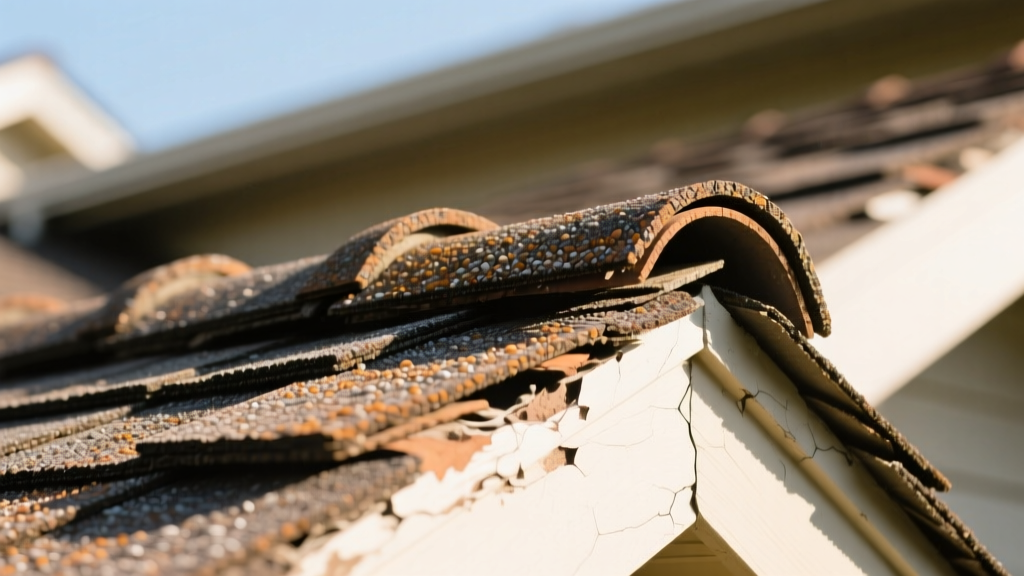
In regions with high diurnal temperature swings (e.g., the American Southwest), shingles expand and contract daily. This thermal cycling causes the asphalt binder to lose its volatiles, leading to micro-cracking and blistering. Once a blister ruptures, the underlying mat is exposed to UV radiation, accelerating failure.
In humid, coastal, or heavily wooded environments, Gloeocapsa magma (blue-green algae) colonizes the limestone filler in asphalt shingles, creating characteristic black streaks. While primarily aesthetic, severe moss and algae growth trap moisture against the granule surface, leading to premature granule loss and organic rot on the roof deck.
Standard architectural shingles often fracture under 1.5-inch hail. For hail-prone corridors (like Tornado Alley), specifying a Class 4 impact-resistant shingle roof material—tested to withstand a 2-inch steel ball dropped from 20 feet per the UL 2218 standard—is non-negotiable to prevent immediate mat fracturing and subsequent water infiltration.
Critical Installation Factors That Dictate Longevity
The most durable shingle roof material will fail prematurely if the underlying system is compromised. Field data from the National Roofing Contractors Association (NRCA) indicates that over 70% of premature roof failures are attributed to installation errors, not material defects.
1. Ventilation and the 1/300 Rule
Excessive attic heat bakes shingles from the underside, causing them to curl and lose adhesion. Proper ventilation requires a minimum Net Free Vent Area (NFVA) of 1 square foot for every 300 square feet of attic floor space (the 1/300 rule), provided there is a balanced 50/50 split between intake (soffit) and exhaust (ridge) vents. Without this balance, convective airflow stalls, trapping heat.
2. Fastener Precision
Pneumatic nail guns frequently overdrive or underdrive fasteners. An overdriven nail cuts through the fiberglass mat, voiding the shingle's wind warranty. An underdriven nail prevents the sealant strip from engaging. For high-wind regions, installers must use a 6-nail pattern per shingle (rather than the standard 4-nail) and place fasteners exactly on the manufacturer's designated nail line, using 1-1/4 inch galvanized roofing nails with a minimum 3/8-inch head diameter.
3. Underlayment and Ice & Water Shield
Standard #15 asphalt felt degrades rapidly when exposed to UV light during installation delays and absorbs moisture, causing wrinkling that telegraphs through the shingles. Upgrading to a synthetic underlayment (e.g., Tyvek Protec 120) provides superior tear resistance and slip resistance. Furthermore, installing a self-adhering ice and water shield at least 24 inches past the interior warm wall line in eaves and valleys prevents ice dam backflow.
Decoding Manufacturer Warranties vs. Actual Field Performance
Consumers are frequently misled by 'Lifetime' or '50-Year' warranty labels. It is vital to read the warranty limitations provided by organizations like the Asphalt Roofing Manufacturers Association (ARMA).
The Proration Trap: Most 'Lifetime' shingle warranties offer 100% coverage for material defects and labor only for the first 10 years. After year 10, the warranty prorates, meaning by year 30, the manufacturer may only cover 20% of the material cost, with zero labor coverage.
Wind warranties (e.g., 130 mph) are strictly conditional. They require the use of the manufacturer's proprietary starter strip, specific synthetic underlayment, and the aforementioned 6-nail high-wind application. If an independent inspector finds a single row of 4-nail applications, the entire wind warranty is voided. Always demand the contractor's nail-pattern photo documentation before making the final payment.
Proactive Maintenance Schedule for Maximum Durability
To push a shingle roof material to the absolute upper limit of its expected lifespan, implement this strict maintenance cadence:
- Biannual Visual Inspections (Spring/Fall): Check for lifted tabs, missing granules in gutters, and compromised flashing around pipe boots and chimneys.
- Zinc or Copper Strip Installation: If algae is prevalent, install metal flashing strips near the ridge. Rainwater washing over the metal creates a toxic environment for Gloeocapsa magma, preventing streaks without chemical washing.
- Gutter & Valley Clearing: Debris accumulation in valleys creates localized water dams. Water pooling on architectural shingles for more than 48 hours will eventually breach the sealant strips.
- Avoid Pressure Washing: Never use high-pressure water to clean a shingle roof. This strips the protective ceramic-coated granules, instantly reducing the shingle's UV resistance and fire rating. Use low-pressure soft washing with a 50/50 water and sodium hypochlorite solution.
When to Repair vs. Replace: The 30% Rule
Deciding between localized repairs and a full tear-off requires an objective damage assessment. Apply the 30% Rule: if the cost of required repairs exceeds 30% of the cost of a full replacement, or if damage (such as widespread granule loss, curling, or blistering) covers more than 30% of the total roof surface area, a full replacement is the only economically sound decision. Spot-repairing a roof that has reached the end of its binder lifecycle will only result in cascading failures and repeated labor costs within a 24-month window.
Written by
Sarah WhitfieldSarah Whitfield is a chartered quantity surveyor (MRICS) and construction cost analyst with 15 years of experience in material pricing, procurement strategy, and project budgeting. She earned her degree in Construction Management from the University of Reading (UK) and has worked on projects ranging from $2M custom homes to $180M mixed-use developments across North America and Europe. Sarah currently leads cost estimating for BuildMat Insight, maintaining a proprietary database of 4,000+ material price points updated quarterly. She is a frequent contributor to RSMeans cost data panels and has presented at the International Cost Engineering Council (ICEC) congress. Based in Denver, CO, Sarah is an avid trail runner and volunteer mentor for Women in Construction.
More from Sarah Whitfield
View all
Wood & Lumber
What Are the Different Types of Wood? A Builder's Guide
Compare structural softwoods, finish hardwoods, and engineered lumber. Analyze Janka ratings, MOE values, and 2026 pricing for construction.
Aug 4, 2026

Walls & Panels
Steel Framing vs Wood Framing: Corrosion and Moisture Defense
Compare steel framing vs wood framing for moisture resistance. Learn about galvanized coatings, condensation risks, and corrosion protection strategies.
Jul 21, 2026

Stone & Masonry
How to Cut Stone Veneer: Wet Saw vs Grinder Comparison
Compare the best tools for cutting stone veneer. We review wet saws, angle grinders, and chop saws to help you achieve clean, chip-free cuts.
Jul 21, 2026