Corrugated Roof Material Lifespan and Durability Breakdown
Analyze corrugated roof material lifespan, comparing Galvalume, aluminum, and polycarbonate. Learn failure modes, gauge specs, and maintenance.

The longevity of a corrugated roof material is rarely a single static number; it is a calculated intersection of metallurgical coatings, fastener integrity, and thermal dynamics. While manufacturer warranties often advertise 40- to 50-year lifespans, real-world performance hinges on specific gauge selections, environmental stressors, and the chemical compatibility of adjacent flashing materials. Understanding the exact failure modes of corrugated panels allows builders and homeowners to engineer a roof system that actually reaches its maximum service life.
Material-Specific Lifespans and Coating Specifications
Not all corrugated metal is created equal. The substrate and protective coating dictate the baseline lifespan before structural degradation begins. Below is a breakdown of the most common corrugated roof material variants and their expected service life under standard atmospheric conditions.
| Material Type | Coating / Alloy Spec | Expected Lifespan | Primary Failure Mode |
|---|---|---|---|
| Galvalume Steel | AZ55 (55% Al, 43.4% Zn, 1.6% Si) | 40 – 60+ Years | Cut-edge creep corrosion |
| Galvanized Steel | G90 (0.90 oz/sq ft Zinc) | 20 – 40 Years | Uniform zinc depletion & rust |
| Aluminum | 5052-H32 Marine Grade Alloy | 50+ Years | Pitting in high-salinity zones |
| Polycarbonate | UV-Extruded Co-extrusion | 15 – 25 Years | UV yellowing & micro-cracking |
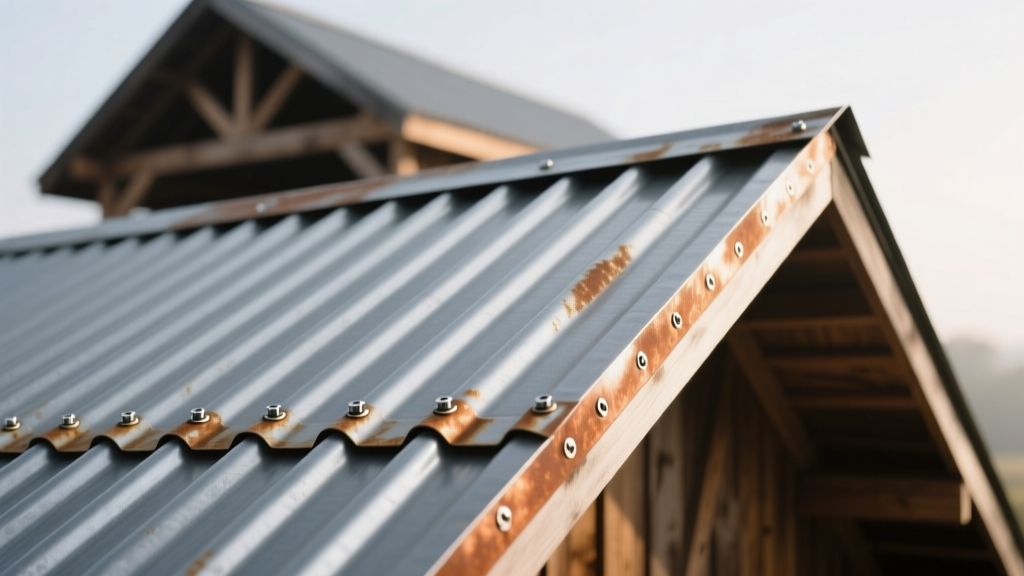
The Anatomy of Corrugated Roof Degradation
To maximize the lifespan of a corrugated roof material, you must engineer against its specific vulnerabilities. Surface rust is rarely the first point of failure; mechanical and chemical breakdowns usually compromise the system first.
1. Fastener Back-Out and Thermal Cycling
Steel and aluminum expand and contract at different rates (steel's coefficient of thermal expansion is roughly 6.5 x 10^-6 /°F, while aluminum is 13.0 x 10^-6 /°F). On a 40-foot run of corrugated roofing, a 50°F temperature swing between night and day can cause the panels to shift by nearly a tenth of an inch. Over thousands of cycles, this movement walks the fasteners backward out of the purlins. Once the #10 hex washer head woodgrip screws lose their clamping force, wind uplift can tear the panels, and water infiltrates the neoprene or EPDM washer seal.
2. Galvanic Corrosion (Bimetallic Coupling)
A catastrophic failure mode occurs when dissimilar metals are used in the presence of an electrolyte (rainwater). According to the Metal Construction Association, allowing copper flashing or untreated copper gutters to drain onto Galvalume or galvanized corrugated panels will cause rapid, severe galvanic corrosion. The zinc and aluminum coatings will sacrificially deplete within months, leading to structural perforation of the steel substrate. Always use compatible metals: aluminum or galvanized steel flashing for steel panels, and isolate copper entirely.
3. Paint System Chalking and Fading
For pre-painted corrugated panels, the aesthetic lifespan is dictated by the resin system. Silicone Modified Polyester (SMP) paints typically begin to chalk and fade after 15 to 20 years. Conversely, Polyvinylidene Fluoride (PVDF) systems, commonly branded as Kynar 500® or Hylar 5000®, contain 70% PVDF resins that resist UV degradation and chalk-fading for 40+ years. If longevity is the priority, specifying a PVDF finish is non-negotiable.
Environmental Stressors and Gauge Selection
The physical thickness of the corrugated roof material—measured in gauges—directly correlates to its durability against mechanical damage and wind uplift. The Insurance Institute for Business & Home Safety (IBHS) emphasizes that proper fastening and gauge selection are critical for surviving severe wind events.
- 29-Gauge (0.0149 inches): The thinnest standard option. Prone to oil-canning (visible waviness) and denting from hail or foot traffic. Suitable only for low-wind, interior agricultural or shed applications. Lifespan reduction: High risk of mechanical failure.
- 26-Gauge (0.0188 inches): The industry standard for residential and light commercial corrugated roofs. Provides adequate stiffness to span standard purlin spacing (24" to 36" on center) and resists minor hail impact. Optimal balance of cost and lifespan.
- 24-Gauge (0.0239 inches): Required for high-snow-load regions, coastal high-wind zones (HVHZ), and commercial applications. The thicker substrate holds fastener threads more securely, drastically reducing the risk of back-out and wind-uplift failure. Maximum mechanical lifespan.
Maintenance Protocols to Extend Service Life
A "maintenance-free" corrugated roof is a myth. Implementing a scheduled maintenance protocol can easily add 10 to 15 years to the system's functional lifespan.
- Year 5 & 10 Fastener Audit: Walk the roof (using fall protection and foam-soled shoes to prevent coating damage) and inspect a 10% random sample of exposed fasteners. Use a torque-controlled drill set to 15-20 in-lbs to re-seat any backed-out screws. Do not overtighten, as this will crush and permanently deform the EPDM washer.
- Year 15-20 Washer Replacement: Standard EPDM and neoprene washers degrade under UV exposure and ozone, eventually hardening and cracking. Proactively replace all exposed fasteners with new screws featuring premium, oversized EPDM washers at the 20-year mark. This is significantly cheaper than replacing the entire roof.
- Debris and Moisture Traps: Clear leaf litter and pine needles from valleys and flashing transitions. Organic debris holds moisture against the metal, creating a localized acidic environment that strips Galvalume coatings and accelerates rust.
When to Repair vs. Replace: A Decision Matrix
Determining whether to patch a failing corrugated roof or invest in a full replacement requires assessing the extent of substrate degradation.
- Localized rust spots less than 2 inches in diameter (treat with phosphoric acid converter and touch-up paint).
- Leaking fastener penetrations with intact panel structural integrity.
- Faded or chalky paint without active substrate corrosion.
- Widespread "creep corrosion" at the panel laps and cut edges affecting more than 15% of the roof area.
- Perforation holes along the corrugation ridges or valleys.
- Severe oil-canning combined with elongated fastener holes caused by decades of thermal expansion.
Ultimately, the lifespan of a corrugated roof material is engineered, not just purchased. By specifying an AZ55 Galvalume coating, utilizing 26-gauge or thicker panels, pairing them with PVDF paint systems, and executing a 15-year fastener maintenance cycle, building owners can reliably achieve a 50-year service life from their corrugated roofing investment.
Written by
Marcus ChenMarcus Chen is a licensed structural engineer (PE) and building materials analyst with over 12 years of experience across residential, commercial, and industrial construction. He holds a Master of Science in Civil Engineering from UC Berkeley and spent six years at Thornton Tomasetti before transitioning to independent consulting and technical writing. Marcus specializes in material selection for seismic-prone regions, concrete reinforcement strategies, and lifecycle cost analysis. His work has been cited by the American Concrete Institute (ACI) and the Structural Engineers Association of California (SEAOC). When he is not on a job site or at his desk, you will find him hiking the Sierra Nevada or restoring a 1920s craftsman bungalow in Oakland, CA.
More from Marcus Chen
View all
Construction Cost
How Much Did the Eiffel Tower Cost to Build?
How much did the Eiffel Tower cost to build in 1889? We adjust for inflation and compare its budget to modern skyscraper construction.
Aug 4, 2026

Fire Resistance
What Is a Fire Resistant Material? Testing & Certification Guide
Discover what is a fire resistant material through ASTM and UL testing. Learn how fire ratings, certifications, and assemblies work in construction.
Aug 4, 2026

Construction Cost
How Much Did the Burj Khalifa Cost to Build?
How much did the Burj Khalifa cost to build? We break down the $1.5B project and extract 5 money-saving strategies for your next build.
Jul 30, 2026