Longest Lasting Roofing Material: 2026 Cost Breakdown
Discover the true cost of the longest lasting roofing material in 2026. We break down slate, copper, and metal pricing, structural needs, and lifecycle ROI.

The True Cost of Century-Long Roofing Systems
When homeowners and commercial developers search for the longest lasting roofing material, the conversation often stalls at the initial sticker price. In 2026, the cost gap between a standard 30-year architectural asphalt shingle roof and a century-lasting slate or copper system is wider than ever, driven by specialized labor shortages and raw material inflation. However, evaluating roofing economics purely on day-one installation costs is a fundamental financial error.
To accurately assess the longest lasting roofing material options, we must shift the metric from cost per square (100 square feet) installed to annualized lifecycle cost. A premium roofing system that costs four times as much upfront but lasts five times as long—while eliminating secondary tear-off and disposal fees—actually yields a superior long-term return on investment. Below, we break down the exact 2026 pricing, structural prerequisites, and hidden costs of the premier century-class roofing materials.
Key Terminology: The Roofing Square
All pricing in this guide is calculated per roofing square, the industry standard unit equal to 100 square feet of roof area. A typical 2,500 sq. ft. home with a standard pitch requires approximately 25 to 30 squares of material, factoring in waste and overhangs.
Material-by-Material Cost Breakdown (2026 Pricing)
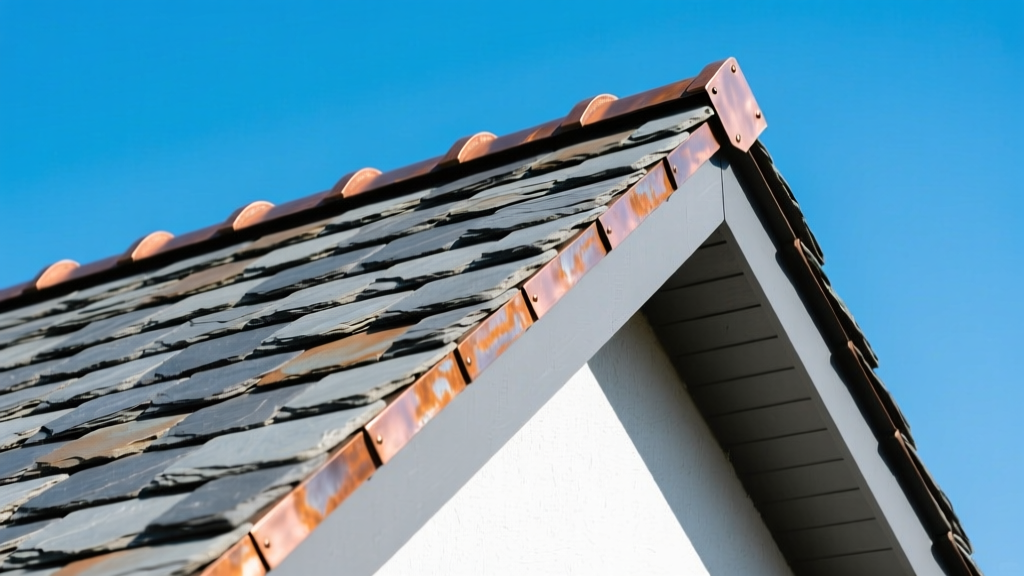
Natural Slate: The 100+ Year Benchmark
Natural slate is universally recognized as the longest lasting roofing material in existence, with S1-grade slate (tested under ASTM C406 standards) routinely lasting 100 to 150 years. According to the National Slate Association, high-quality unfading slate from quarries in Vermont, Virginia, or Canada retains its structural integrity and color for well over a century.
- Material Cost: $900 – $1,800 per square
- Installation Labor: $900 – $1,400 per square
- Total Installed Cost: $1,800 – $3,200 per square
The Catch: Slate is exceptionally heavy, weighing between 800 and 1,500 pounds per square. Most modern residential trusses are engineered for 250-300 lbs per square. Installing slate almost always requires a structural engineering assessment and framing reinforcement, which we detail in the hidden costs section below.
Copper Roofing: The 70-100 Year Patina
Copper offers a lifespan rivaling slate but at a fraction of the weight. It is highly malleable, making it ideal for complex rooflines, dormers, and low-pitch applications. The Copper Development Association notes that cold-rolled copper roofing develops a protective verde patina over 20 to 30 years, which actually halts further corrosion and extends the material's life indefinitely.
- Material Cost (16 oz & 20 oz): $1,600 – $2,500 per square
- Installation Labor: $1,200 – $2,000 per square
- Total Installed Cost: $2,800 – $4,500 per square
Pro Tip: Never use copper in direct contact with aluminum or untreated steel flashings. Galvanic corrosion will destroy the dissimilar metals within a few seasons. Always use copper or stainless steel fasteners and flashings.
Standing Seam Metal: The 50-70 Year Workhorse
While not quite a century material, 24-gauge Galvalume standing seam metal is the most practical longest lasting roofing material for modern agricultural, commercial, and residential applications. The Metal Roofing Alliance highlights that concealed-fastener standing seam systems eliminate the primary failure point of metal roofs: exposed screw gaskets drying out and leaking.
- Material Cost (24-gauge Kynar 500 finish): $550 – $850 per square
- Installation Labor: $550 – $950 per square
- Total Installed Cost: $1,100 – $1,800 per square
Specification Rule: For coastal environments within 1,500 feet of saltwater, you must upgrade from Galvalume steel to .032 or .040 aluminum standing seam panels to prevent salt-induced oxidation, adding roughly 15% to the material cost.
Clay and Concrete Tile: The 50-100 Year Heavyweight
Clay tiles easily last 100 years, while concrete tiles typically last 50 to 70 years before color fading and minor spalling become apparent. However, tile roofs harbor the most deceptive lifecycle cost in the industry: The Underlayment Trap.
While the clay tiles themselves will last a century, the synthetic or felt underlayment beneath them degrades in 25 to 30 years due to thermal cycling and UV exposure at the overlaps. Replacing the underlayment requires a 'lift and relay' process, costing $800 to $1,200 per square in 2026 labor rates.
- Total Installed Cost (Clay): $1,600 – $2,800 per square
- Total Installed Cost (Concrete): $1,200 – $1,900 per square
The Hidden Costs: Structural Reinforcement and Decking
Choosing the longest lasting roofing material often triggers a cascade of secondary construction requirements. Heavy materials like slate and clay tile cannot simply be nailed to standard 7/16-inch OSB decking.
Warning: Structural Upgrade Requirements
- Engineering Assessment: $500 – $1,500 for a licensed structural engineer to evaluate existing truss load capacities.
- Truss Reinforcement: $2,500 – $6,000+ to sister existing trusses or add mid-span bearing walls for slate/tile.
- Decking Upgrade: Slate requires minimum 5/8-inch CDX plywood or traditional 1x6 solid wood board decking to hold the thick slate nails without blowout. Budget an extra $150-$250 per square for decking replacement.
Comparison Matrix: Upfront vs. Annualized Cost
The table below illustrates why the highest upfront cost does not equate to the highest long-term expense. We compare the premier century materials against a high-end architectural asphalt baseline.
| Material | Installed Cost / Sq | Expected Lifespan | Annualized Cost / Sq | Tear-Off Required? |
|---|---|---|---|---|
| Architectural Asphalt | $450 - $650 | 25 - 30 Years | $18.00 - $21.66 | Yes (Every 30 yrs) |
| 24-Gauge Standing Seam | $1,100 - $1,800 | 50 - 70 Years | $15.71 - $36.00 | Yes (Can overlay once) |
| Natural Slate (S1 Grade) | $1,800 - $3,200 | 100 - 150 Years | $12.00 - $32.00 | No |
| 16 oz Copper | $2,800 - $4,500 | 70 - 100+ Years | $28.00 - $64.28 | No |
Lifecycle Cost Analysis: Upfront vs. Long-Term Value
When you factor in the cost of tear-off and disposal—which averages $120 to $180 per square in 2026 due to stringent landfill tipping fees and environmental regulations—the financial advantage of century roofs becomes undeniable. An asphalt roof will require complete removal and disposal at least three times over a 90-year period. A slate or copper roof requires zero tear-offs. Furthermore, century-class roofs consistently appraise at a 3% to 5% premium on residential property valuations, effectively subsidizing a portion of the initial installation cost upon resale.
Decision Framework: Which Century-Roof Fits Your Budget?
Selecting the longest lasting roofing material requires matching your structural reality with your financial liquidity. Use this framework to make your final decision:
- Choose Natural Slate if: You are building a custom legacy home, your roof pitch is steep (minimum 8:12), and your framing is engineered to support 1,000+ lbs per square. It offers the highest prestige and lowest annualized maintenance cost.
- Choose Copper if: You have a complex roof with numerous valleys, turrets, or low-pitch transitions where slate cannot be safely installed, and you possess the premium budget required for specialized sheet metal artisans.
- Choose Standing Seam Metal if: You want a 60-year lifespan without the burden of structural reinforcement. It is lightweight (approx. 150 lbs per square), sheds snow efficiently, and integrates seamlessly with modern solar panel mounting clamps.
- Choose Clay Tile if: You are in a high-wind, coastal, or Mediterranean climate zone, and you are prepared to budget for a mid-lifecycle underlayment replacement at the 30-year mark.
Written by
Elena RodriguezElena Rodriguez is a civil engineer and technical writer specializing in concrete technology, masonry systems, and ASTM/ACI compliance. She earned her B.S. in Civil Engineering from Texas A&M University and spent a decade at a materials testing laboratory, performing over 2,000 concrete compressive strength tests and masonry prism evaluations. Elena is an ACI-certified Field Testing Technician (Grade I) and a member of ASTM Committee C12 on Natural Building Stone. She currently consults on forensic engineering cases involving concrete failures and moisture intrusion. Based in San Antonio, TX, Elena is a proud member of the Society of Women Engineers (SWE) and coaches her daughter's FIRST Robotics team.
More from Elena Rodriguez
View all
Walls & Panels
Cost Analysis: Light Gauge Steel Framing Advantages and Disadvantages
Evaluate light gauge steel framing advantages and disadvantages through a strict cost analysis lens, comparing material, labor, and lifecycle expenses.
Aug 4, 2026

Walls & Panels
Gypsum Board Types: Exact Specifications, Thickness & Dimensions
Compare standard, Type X, and moisture-resistant gypsum board types. Get exact specifications, thicknesses, dimensions, and ASTM standards for your project.
Aug 4, 2026

Fire Resistance
Best Fire-Resistant Outdoor Decking Materials: 2026 Buyer Guide
Discover the best fire-resistant outdoor decking materials for 2026. Compare Class A PVC, aluminum, and hardwood options for WUI compliance and safety.
Aug 4, 2026