Rubber Roof Material Comparison: EPDM vs TPO vs PVC Membranes
Compare EPDM, TPO, and PVC single-ply membranes. Analyze 2026 costs, failure modes, chemical resistance, and lifespan to choose the right flat roof system.

The Single-Ply Membrane Landscape: Beyond the 'Rubber' Label
When property owners and facility managers search for a rubber roof material, they are almost exclusively looking for single-ply membranes designed for low-slope and flat commercial or residential roofs. However, the industry terminology often creates confusion. True rubber roofing refers specifically to EPDM (Ethylene Propylene Diene Monomer). Yet, EPDM competes directly with two thermoplastic membranes—TPO (Thermoplastic Polyolefin) and PVC (Polyvinyl Chloride)—which are frequently, albeit incorrectly, lumped into the 'rubber roof' category by general contractors and building supply catalogs.
Selecting the correct membrane requires looking past marketing labels and evaluating polymer chemistry, seam integrity, and environmental stressors. As of 2026, material science advancements have shifted the baseline thickness standards and altered the cost-to-lifespan ratios of these three dominant systems.
Head-to-Head Matrix: EPDM vs. TPO vs. PVC
The following comparison matrix reflects current 2026 market data for fully adhered and mechanically attached commercial installations. Costs represent total installed pricing per square foot (SF), including standard polyiso insulation, fasteners/adhesives, and membrane.
| Feature | EPDM (True Rubber) | TPO (Thermoplastic) | PVC (Thermoplastic) |
|---|---|---|---|
| 2026 Installed Cost | $5.50 - $8.50 / SF | $6.50 - $10.00 / SF | $8.00 - $12.50 / SF |
| Standard Thickness | 60-mil (Reinforced) | 60-mil to 80-mil | 50-mil to 60-mil |
| Expected Lifespan | 25 - 30+ Years | 20 - 25 Years | 25 - 30+ Years |
| Seam Method | Butyl splice tape / Liquid adhesive | Hot-air welding | Hot-air welding / Solvent |
| Solar Reflectivity (SRI) | Low (Black) / High (White) | Very High (White) | Very High (White) |
| Chemical/Fat Resistance | Very Poor (Degrades rapidly) | Poor to Moderate | Excellent |
| Cold Weather Flexibility | Exceptional (-40°F) | Moderate (Can stiffen) | Good (Depends on plasticizers) |
Deep Dive: Performance, Polymer Chemistry, and Failure Modes
EPDM: The Proven Thermoset Rubber
EPDM remains the benchmark for cold-climate durability and puncture resistance. Because it is a thermoset rubber, it possesses incredible memory and elasticity. A 60-mil reinforced EPDM membrane can stretch over 300% before tearing, allowing it to accommodate significant structural settling and thermal shock without splitting.
The Primary Failure Mode: EPDM's weakest link is the seam. Because it cannot be heat-welded, contractors rely on butyl-based splice tapes or liquid adhesives. Over 15 to 20 years, UV exposure and thermal cycling cause the membrane to shrink. This shrinkage exerts immense tensile stress on the seams and perimeter flashings, frequently leading to tape peeling, membrane tearing at parapet walls, and subsequent water infiltration.
Best Application: Unoccupied commercial warehouses in northern climates, residential low-slope additions, and buildings where initial budget constraints outweigh long-term maintenance costs.
TPO: The Modern Thermoplastic Standard
TPO was engineered to combine the hot-air welded seams of PVC with the cold-weather flexibility of EPDM. Early generations of TPO (pre-2011) suffered from premature cracking and UV degradation, but modern formulations utilizing advanced polymer blends have largely resolved these issues. Today, 80-mil TPO is frequently specified for commercial projects demanding high wind-uplift ratings and energy efficiency.
The Primary Failure Mode: TPO is highly susceptible to ponding water if the roof lacks adequate slope. While the membrane itself is waterproof, constant water immersion can eventually cause the scrim (the internal polyester reinforcing layer) to wick moisture and delaminate. Additionally, TPO seams require precise heat-welder temperatures; if the ambient temperature drops below 40°F, achieving a proper monolithic weld becomes highly difficult, leading to cold-seam failures.
Best Application: Large footprint retail stores, hospitals, and office buildings in moderate to hot climates where the high Solar Reflectance Index (SRI) of white TPO significantly reduces HVAC cooling loads. According to the Department of Energy's Cool Roofs overview, highly reflective thermoplastic membranes can reduce peak cooling demand by 10% to 15%.
PVC: The Chemical-Resistant Heavyweight
PVC is the oldest and most chemically stable of the thermoplastic single-plies. It is inherently fire-resistant and possesses exceptional puncture resistance. The most critical advancement in PVC technology is the use of KEE (Ketone Ethylene Ester) polymers. Standard PVC relies on liquid plasticizers to remain flexible; over decades, these plasticizers can leach out, leaving the roof brittle. KEE-PVC uses a solid polymer modifier that prevents this leaching, ensuring a 30+ year lifespan.
The Primary Failure Mode: PVC is highly sensitive to incompatible materials. If PVC comes into contact with polystyrene insulation, asphalt, or coal tar pitch (often found in roof retrofits), a chemical reaction occurs that melts and destroys the PVC membrane. A separation slip sheet is mandatory in retrofit scenarios.
Best Application: Restaurants, food processing plants, and chemical manufacturing facilities. The EPA's Heat Island Effect guide on cool roofs notes the durability of reflective PVC systems, but its true superpower is resisting animal fats, vegetable oils, and industrial exhaust that will dissolve EPDM and degrade TPO within months.
The 2026 Decision Framework: Which Membrane Fits Your Building?
Use this diagnostic framework to select the optimal rubber roof material based on your specific building profile and environmental constraints.
- Scenario A: High UV, Hot Climate, Large Flat Roof (e.g., Texas, Arizona, Florida)
Verdict: 80-mil White TPO. The high reflectivity will yield massive energy savings, and the thicker 80-mil profile provides necessary resistance to high-wind uplift events and hail common in these regions. - Scenario B: Extreme Cold, Heavy Snow Load, Low Budget (e.g., Minnesota, Maine)
Verdict: 60-mil Reinforced Black EPDM. Black EPDM absorbs solar heat, aiding in snowmelt and preventing ice damming at the parapets. Its thermoset nature ensures it remains highly flexible at -40°F, whereas thermoplastics can become rigid and crack under shifting snow loads. - Scenario C: Commercial Kitchen, Chemical Plant, or Grease Exhaust
Verdict: 50-mil or 60-mil KEE-PVC. Non-negotiable. Only PVC offers the chemical resistance required to survive lipid and hydrocarbon exposure. - Scenario D: Roof Retrofit over Existing Asphalt BUR (Built-Up Roof)
Verdict: Fleece-Backed TPO or Fleece-Backed EPDM. The thick polyester fleece backing prevents the asphalt oils from migrating into and degrading the new single-ply membrane, while also providing a cushion against the rough, granular surface of the old roof.
Installation Nuances That Void Warranties
Even the most premium rubber roof material will fail prematurely if installation protocols are ignored. Manufacturers routinely deny warranty claims based on the following site errors:
- Improper Fastener Pull-Through: In mechanically attached systems, the fastener plate must sit flush with the insulation. If the drill clutch is set too high and the plate cuts into the insulation facer, the membrane will tent over the fastener, eventually wearing a hole through the material. Manufacturers require daily pull-test calibrations.
- Moisture in the Substrate: Fully adhered systems require bonding adhesive applied directly to the substrate (like wood decking or concrete). If the substrate has a moisture content above 20%, the adhesive will fail to cure, and trapped moisture will vaporize under solar heat, creating massive blisters in the membrane.
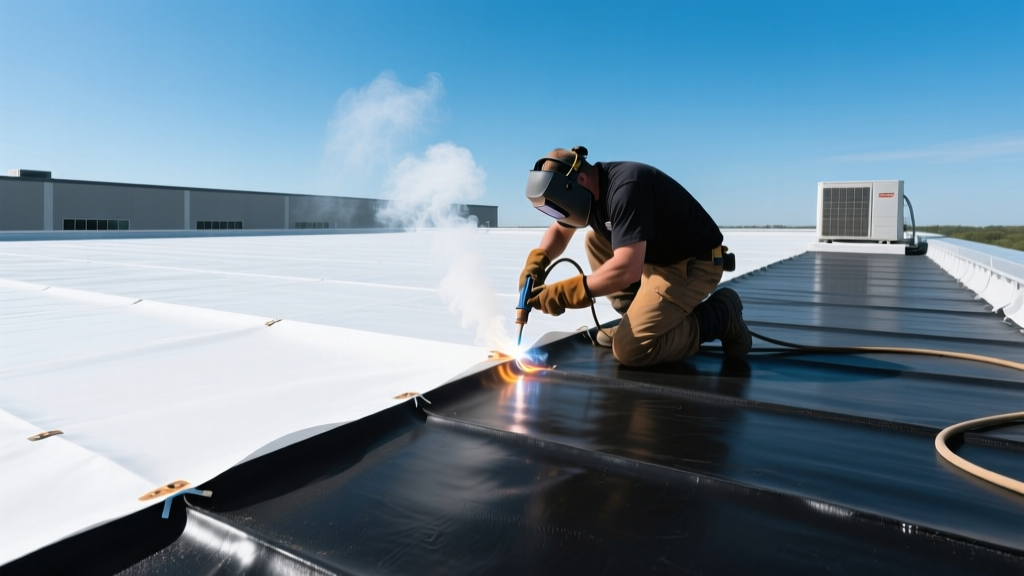
- Inadequate Seam Overlap: While 3-inch overlaps are standard for TPO and PVC, field conditions often result in wavy seams. If the effective weld area drops below 1.5 inches due to material rippling, the seam will not pass the manufacturer's peel-test requirements.
Frequently Asked Questions
Can I install a rubber roof material directly over existing shingles?
No. Single-ply membranes require a continuous, rigid, and smooth substrate. Installing EPDM, TPO, or PVC directly over asphalt shingles will result in severe telegraphing, where the shingle edges press into and eventually puncture the membrane. You must install a layer of minimum 1/2-inch roofing-grade fiberboard or polyiso insulation over the shingles to create a viable separation and thermal break.
Does white EPDM perform as well as white TPO?
White EPDM utilizes a titanium dioxide coating to achieve reflectivity, but it is notoriously difficult to keep clean. Dirt, pollution, and biological growth (algae) bond aggressively to the white EPDM surface, causing it to lose its SRI (Solar Reflectance Index) rating within 3 to 5 years. White TPO and PVC have inherently reflective polymer structures that shed dirt more effectively and maintain their cool-roof ratings much longer.
What is the difference between 45-mil and 60-mil EPDM?
The 'mil' refers to the thickness of the membrane (1 mil = 1/1000th of an inch). While 45-mil EPDM is still used in some residential applications, 60-mil reinforced EPDM is the commercial standard. The reinforced version includes an internal polyester scrim that increases tensile strength by up to 300% and drastically reduces the long-term shrinkage that plagues unreinforced 45-mil variants.
Written by
Elena RodriguezElena Rodriguez is a civil engineer and technical writer specializing in concrete technology, masonry systems, and ASTM/ACI compliance. She earned her B.S. in Civil Engineering from Texas A&M University and spent a decade at a materials testing laboratory, performing over 2,000 concrete compressive strength tests and masonry prism evaluations. Elena is an ACI-certified Field Testing Technician (Grade I) and a member of ASTM Committee C12 on Natural Building Stone. She currently consults on forensic engineering cases involving concrete failures and moisture intrusion. Based in San Antonio, TX, Elena is a proud member of the Society of Women Engineers (SWE) and coaches her daughter's FIRST Robotics team.
More from Elena Rodriguez
View all
Walls & Panels
Cost Analysis: Light Gauge Steel Framing Advantages and Disadvantages
Evaluate light gauge steel framing advantages and disadvantages through a strict cost analysis lens, comparing material, labor, and lifecycle expenses.
Aug 4, 2026

Walls & Panels
Gypsum Board Types: Exact Specifications, Thickness & Dimensions
Compare standard, Type X, and moisture-resistant gypsum board types. Get exact specifications, thicknesses, dimensions, and ASTM standards for your project.
Aug 4, 2026

Fire Resistance
Best Fire-Resistant Outdoor Decking Materials: 2026 Buyer Guide
Discover the best fire-resistant outdoor decking materials for 2026. Compare Class A PVC, aluminum, and hardwood options for WUI compliance and safety.
Aug 4, 2026