Cost Breakdown: Types of Roofs Materials & Pricing for 2026
Compare the 2026 costs for different types of roofs materials. Detailed pricing breakdown for asphalt, metal, tile, and flat membranes per square foot.

The Real Economics of Roof Replacement in 2026
Replacing a roof is one of the most significant capital expenditures for any residential or commercial property. In 2026, the pricing landscape for roofing systems is heavily influenced by fluctuating petroleum costs (which dictate asphalt and synthetic membrane prices), metallurgical commodity shifts, and localized labor shortages. To accurately budget, contractors and property owners must measure costs in 'squares'—the industry standard unit equal to 100 square feet of roof area.
This guide provides a granular cost breakdown across the primary types of roofs materials, moving beyond generic averages to detail specific material grades, labor multipliers, and the hidden structural costs that frequently derail project budgets.
Comprehensive Cost Matrix: Types of Roofs Materials
The table below outlines the baseline material and fully installed costs per square (100 sq. ft.) for standard residential and commercial applications. These figures assume a standard pitch (4/12 to 6/12) and include standard underlayment and tear-off of one existing layer.
| Material Type | Material Cost (Per Sq.) | Labor & Overhead (Per Sq.) | Total Installed (Per Sq.) | Expected Lifespan |
|---|---|---|---|---|
| 3-Tab Asphalt Shingles | $90 - $120 | $150 - $200 | $240 - $320 | 15 - 20 Years |
| Architectural Asphalt | $130 - $190 | $180 - $250 | $310 - $440 | 25 - 30 Years |
| Exposed Fastener Metal | $150 - $250 | $250 - $350 | $400 - $600 | 25 - 40 Years |
| Standing Seam Metal | $400 - $650 | $450 - $650 | $850 - $1,300 | 40 - 60+ Years |
| Concrete Tile | $400 - $600 | $600 - $900 | $1,000 - $1,500 | 40 - 50 Years |
| Clay Tile | $800 - $1,200 | $800 - $1,200 | $1,600 - $2,400 | 50 - 100 Years |
| Synthetic Slate | $500 - $750 | $500 - $700 | $1,000 - $1,450 | 40 - 50 Years |
| Natural Slate | $1,000 - $1,600 | $1,000 - $1,500 | $2,000 - $3,100 | 75 - 100+ Years |
| TPO Membrane (60-mil) | $120 - $180 | $200 - $350 | $320 - $530 | 20 - 30 Years |
Asphalt Shingles: Grading the Budget-Friendly Standard
Asphalt remains the dominant choice in North America due to its balance of cost and weather resistance. However, not all asphalt shingles perform equally. In 2026, the market has largely shifted away from organic felt-based mats toward fiberglass-reinforced architectural shingles.
Material Specifics and Upgrades
- Standard Architectural: Products like the GAF Timberline HDZ or Owens Corning Duration offer dimensional depth and wind warranties up to 130 mph when installed with the manufacturer's proprietary accessory system (e.g., starter strips, ridge caps, and leak barriers).
- Impact-Resistant (IR) Upgrades: For hail-prone regions, upgrading to a Class 4 impact-resistant shingle (like the Malarkey Legacy) adds roughly $40 to $60 per square in material costs. This investment frequently yields a 15% to 25% discount on homeowner's insurance premiums, resulting in a net-positive ROI within five years.
- Underlayment Economics: Skipping traditional 15lb asphalt felt in favor of synthetic underlayment (such as Tyvek Protec 120) adds about $15 per square but drastically reduces slip hazards for installers and prevents wrinkling when exposed to moisture during installation.
Metal Roofing: The Fastener and Finish Variables
Metal roofing pricing is highly volatile based on the gauge of the steel or aluminum and the fastening mechanism. The most critical distinction in metal roofing is between exposed fastener systems and concealed clip systems.
Standing Seam vs. Exposed Fastener
Exposed fastener panels (like 29-gauge R-panel) are screwed directly through the metal into the decking. The neoprene washers on these screws degrade over time due to UV exposure and thermal expansion, requiring maintenance every 15 years. Standing seam roofs utilize a concealed clip system that allows the metal panels to 'float' and expand/contract with temperature changes. While standing seam costs nearly double, it eliminates the primary failure point of metal roofs: fastener back-out and washer degradation.
Premium Systems: Tile, Slate, and the Structural Tax
When evaluating premium types of roofs materials, the cost of the material itself is only half the equation. The 'structural tax'—the cost to reinforce the roof framing to support extreme weight—is a frequent budget surprise.
Weight Limits and Framing Reinforcement
Standard residential roof trusses are typically engineered to support a dead load of 10 to 15 pounds per square foot (PSF), equating to 1,000 to 1,500 lbs per square. Asphalt shingles weigh roughly 250-350 lbs per square. Natural slate and clay tile, however, can weigh 800 to 1,200 lbs per square.
For the aesthetic of slate without the structural burden, synthetic slate (manufactured from engineered polymers and recycled rubber, such as DaVinci Roofscapes) weighs under 300 lbs per square and installs with standard roofing nail guns, significantly reducing specialized labor costs.
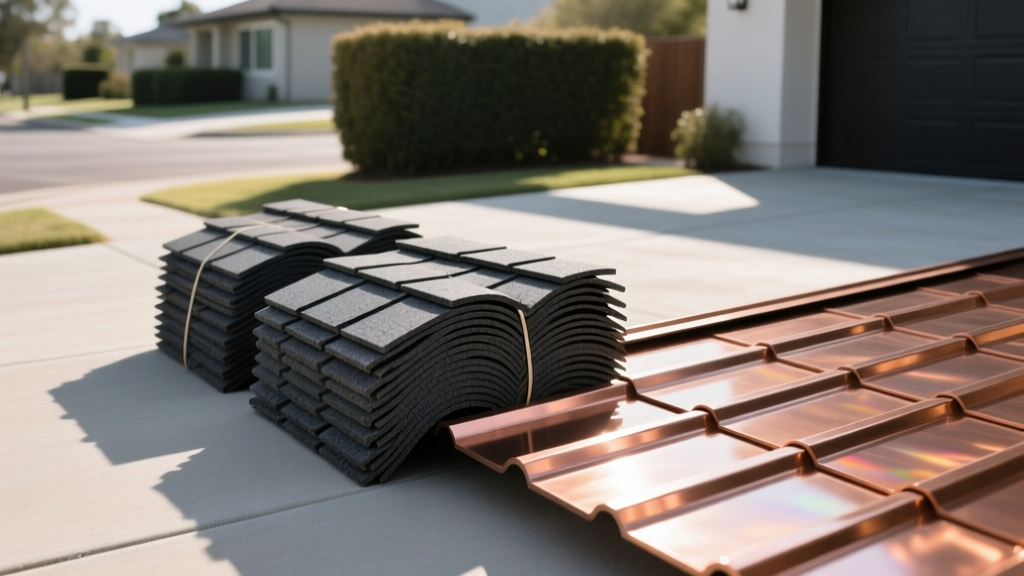
Flat and Low-Slope Membranes: TPO, EPDM, and PVC
For commercial buildings or residential properties with low-slope additions (pitches under 2/12), traditional shingles will void manufacturer warranties and trap water. Single-ply membranes are the required standard.
- TPO (Thermoplastic Polyolefin): The current market leader for commercial flat roofs. A 60-mil mechanically attached TPO system costs between $3.20 and $5.30 per square foot installed. TPO's white reflective surface meets Department of Energy cool roof standards, significantly reducing HVAC cooling loads in southern climates.
- EPDM (Rubber): Black EPDM is highly durable in cold, northern climates and resists hail punctures well. However, because it absorbs heat, it is generally discouraged in high-sun environments unless coated with a reflective silicone topcoat.
- PVC (Polyvinyl Chloride): PVC is heat-welded, creating seams that are actually stronger than the membrane itself. It is highly resistant to chemical exposure and grease, making it the mandatory choice for flat roofs over commercial kitchens or restaurants.
Hidden Cost Variables That Derail Budgets
A material quote is not a final project cost. The following variables must be calculated into any accurate 2026 roofing budget:
1. Tear-Off and Disposal
Tearing off existing layers costs between $100 and $150 per square. If the existing roof has two layers (the legal maximum in most jurisdictions), disposal fees and labor time will push this closer to $200 per square. Dumpster fees and municipal tipping rates have risen steadily, adding $800 to $1,500 in pure disposal costs for an average 30-square roof.
2. Decking Replacement (The Unknown Variable)
Once the old roof is torn off, the wood decking (sheathing) is exposed. It is standard to budget for a 10% to 15% decking replacement rate due to dry rot or water damage. In 2026, a sheet of 5/8-inch CDX plywood costs roughly $70 to $90. Replacing one square of decking (just over three sheets of plywood) will add $250 to $350 in material and labor. For a 30-square roof, a 10% contingency equates to roughly $1,000 in reserve funds.
3. Pitch and Complexity Multipliers
Roofing labor is calculated on a baseline pitch (usually 4/12 to 6/12). If your roof pitch exceeds 8/12, OSHA fall protection requirements and the physical difficulty of the work trigger a labor multiplier. An 8/12 to 10/12 pitch typically incurs a 1.2x labor multiplier, while anything over 12/12 or featuring multiple dormers, valleys, and steep turrets can trigger a 1.5x to 2.0x multiplier.
Decision Framework: Matching Material to Environment
Choosing among the various types of roofs materials requires aligning the physical properties of the material with your specific environmental stressors and financial parameters. The Insurance Institute for Business & Home Safety (IBHS) provides rigorous testing frameworks that inform these choices.
- High Wind / Coastal Zones (110+ mph): Choose a standing seam metal roof or concrete tile secured with hurricane clips and adhesive. Avoid standard shingles, which are prone to lifting and creasing in sustained hurricane-force winds.
- Heavy Hail Corridors (Midwest/Texas): Specify Class 4 impact-resistant architectural shingles or heavy-gauge (24-gauge or lower) metal panels. Avoid natural slate and clay tile, which will shatter upon impact from large hailstones.
- Wildfire Zones (WUI - Wildland Urban Interface): Metal, slate, and concrete tile are inherently non-combustible and carry a Class A fire rating by nature of their composition. Ensure that all soffit and ridge vents are fitted with 1/8-inch metal mesh to prevent wind-blown ember intrusion, a requirement under the National Roofing Contractors Association (NRCA) guidelines for fire-prone areas.
- Strict Budget / Short-Term Ownership: If the property is a flip or you plan to sell within 7 years, a high-quality architectural shingle system provides the best aesthetic return on investment without overcapitalizing the property with premium metal or slate.
By analyzing the exact material specifications, anticipating structural requirements, and accounting for hidden labor multipliers, property owners can accurately forecast the true cost of their roofing system and select a material that offers long-term performance rather than just a low initial bid.
Written by
Marcus ChenMarcus Chen is a licensed structural engineer (PE) and building materials analyst with over 12 years of experience across residential, commercial, and industrial construction. He holds a Master of Science in Civil Engineering from UC Berkeley and spent six years at Thornton Tomasetti before transitioning to independent consulting and technical writing. Marcus specializes in material selection for seismic-prone regions, concrete reinforcement strategies, and lifecycle cost analysis. His work has been cited by the American Concrete Institute (ACI) and the Structural Engineers Association of California (SEAOC). When he is not on a job site or at his desk, you will find him hiking the Sierra Nevada or restoring a 1920s craftsman bungalow in Oakland, CA.
More from Marcus Chen
View all
Construction Cost
How Much Did the Eiffel Tower Cost to Build?
How much did the Eiffel Tower cost to build in 1889? We adjust for inflation and compare its budget to modern skyscraper construction.
Aug 4, 2026

Fire Resistance
What Is a Fire Resistant Material? Testing & Certification Guide
Discover what is a fire resistant material through ASTM and UL testing. Learn how fire ratings, certifications, and assemblies work in construction.
Aug 4, 2026

Construction Cost
How Much Did the Burj Khalifa Cost to Build?
How much did the Burj Khalifa cost to build? We break down the $1.5B project and extract 5 money-saving strategies for your next build.
Jul 30, 2026