How EPDM Roof Material Performs in Extreme Climates
Discover how EPDM roof material performs across extreme climates. Compare black vs. white membranes, thicknesses, and attachment methods for your region.

The Chemistry of Climate Resilience
Ethylene Propylene Diene Monomer (EPDM) is a synthetic rubber terpolymer that has dominated the low-slope commercial roofing market for over five decades. Its exceptional climate adaptability stems from its saturated polymer backbone, which lacks the double carbon bonds found in natural rubber or asphalt. This chemical structure makes the EPDM roof material inherently immune to ozone degradation, UV radiation breakdown, and extreme thermal cycling. However, specifying the correct color, thickness, and attachment method is critical; a system that thrives in the freezing winters of Minnesota will cause severe energy penalties if deployed without modification in the arid heat of Arizona.
- Temperature Tolerance: -40°F to 300°F (continuous exposure)
- Elongation: 300% minimum (unreinforced); 15% minimum (reinforced)
- Standard Thicknesses: 45-mil, 60-mil, 90-mil
- Expected Lifespan: 30 to 50+ years depending on maintenance and climate
Climate Zone Breakdown: Selecting the Right System
Cold and Snowy Regions (Zones 5-8)
In northern climates characterized by heavy snow loads and prolonged sub-freezing temperatures, black EPDM offers a distinct thermodynamic advantage. Black membranes possess a solar absorptance of up to 90%. On a clear, 25°F winter day, the surface temperature of a black EPDM roof can reach 85°F to 95°F. This passive solar heating accelerates snowmelt and significantly reduces the formation of destructive ice dams at the eaves and parapets.
The Shrinkage Risk: Over a 20-year period in regions with extreme seasonal temperature swings, unreinforced black EPDM can shrink by 1% to 1.5%. This dimensional change pulls tension on perimeter flashings and penetrations. To mitigate this in Zones 5-8, specify reinforced EPDM (which includes an internal polyester scrim to lock dimensions) and use liquid-applied flashing systems (such as Carlisle SecurSeal or Holcim QuickSeal) rather than standard 3-inch seam tapes, which can peel under sustained tension.
Hot and Arid Regions (Zones 1-3)
Deploying black EPDM in the Sunbelt is generally a costly mistake. During peak summer months in states like Texas, Nevada, and Arizona, ambient temperatures of 105°F can push black membrane surface temperatures past 175°F. This massive thermal load transfers into the building envelope, forcing HVAC systems to work overtime and increasing cooling costs by 20% to 30%.
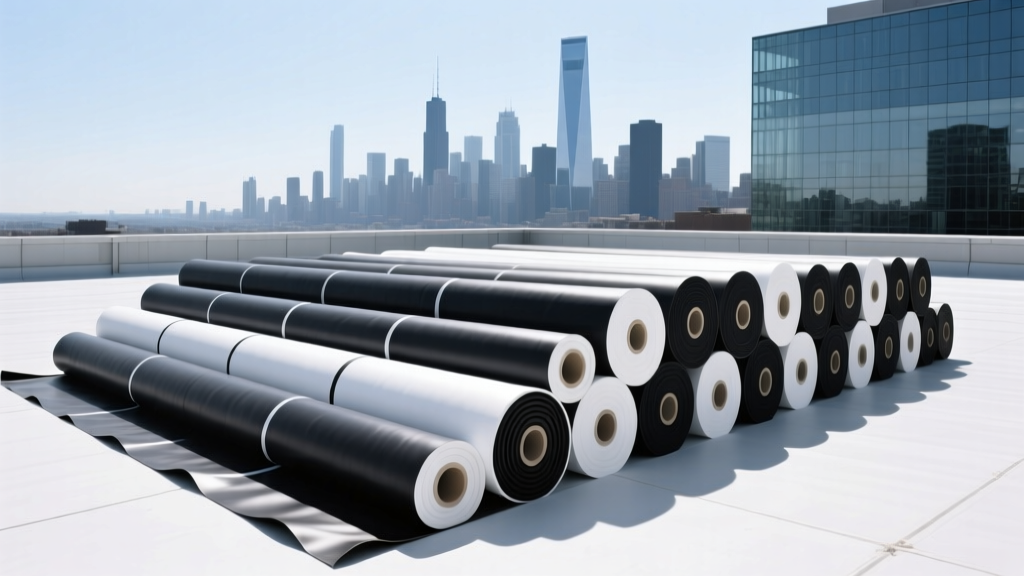
The Cool Roof Solution: For these zones, white EPDM is mandatory for energy efficiency. White EPDM membranes are typically coated with titanium dioxide, reflecting up to 80% of solar radiation and maintaining surface temperatures within 10°F to 15°F of ambient air. According to the Department of Energy's Cool Roofs guidelines, this reflectivity can reduce peak cooling demand by up to 15%. While white EPDM carries a 15% to 20% upfront material premium over black, the HVAC energy payback in Zone 1-3 climates typically occurs within 3 to 4 years.
High-Wind and Coastal Corridors
In hurricane-prone coastal regions, traditional ballasted EPDM systems (which rely on the weight of river stone or pavers to hold the membrane down) are strictly prohibited by modern building codes due to the risk of wind scour and airborne projectiles. Instead, fully adhered systems are required. By bonding the EPDM directly to a high-density polyisocyanurate (polyiso) cover board using solvent-based or water-based bonding adhesives, the roof assembly can achieve FM 1-90 or UL 580 wind uplift ratings, capable of withstanding sustained winds exceeding 110 mph.
Thickness, Attachment, and Regional Matrix
Selecting the correct membrane thickness and attachment strategy is a balancing act between regional weather threats and budget constraints. The following matrix provides a framework for specification:
| Membrane | Attachment Method | Ideal Climate Zone | Primary Threat Mitigated | Est. Material Cost (2026) |
|---|---|---|---|---|
| 45-mil Unreinforced | Mechanically Fastened | Mild, inland (Zone 4) | Standard UV / Rain | $0.85 - $1.05 / sq ft |
| 60-mil Reinforced | Fully Adhered | Cold/Snowy (Zones 5-8) | Shrinkage, ice dams, punctures | $1.30 - $1.60 / sq ft |
| 60-mil White | Fully Adhered | Hot/Arid (Zones 1-3) | Thermal shock, HVAC overload | $1.55 - $1.85 / sq ft |
| 90-mil Reinforced | Fully Adhered | Coastal / Hail-Prone | Hail impact, extreme wind uplift | $1.90 - $2.30 / sq ft |
Thermal Shock and Ponding Water Tolerance
One of the most severe tests for any flat roof is thermal shock—the rapid contraction that occurs when a cold summer thunderstorm drops 50°F rain onto a 160°F membrane. While asphalt-based systems (like BUR or Mod-Bit) can become brittle and crack under this rapid contraction, EPDM's elastomeric properties allow it to stretch and recover without micro-fracturing. Reinforced EPDM limits this thermal movement to less than 0.5%, protecting the seams from tearing.
Furthermore, EPDM is entirely impervious to ponding water. Unlike asphalt, which can re-emulsify or degrade when submerged for weeks, EPDM's synthetic rubber composition will not break down chemically when exposed to standing water, making it ideal for low-slope roofs with poor drainage gradients.
Seam Technology: Tape vs. Liquid Flashing
The membrane itself rarely fails; the seams are the weak point. In climates with low thermal variance, standard 3-inch butyl seam tape applied with a primer is sufficient and highly cost-effective. However, in regions with high diurnal temperature swings (such as the high deserts of the American West, where days are hot and nights are near freezing), the constant expansion and contraction can cause tape edges to track dirt and eventually un-zip.
For these extreme environments, upgrade to a liquid-applied flashing system. Products utilizing EPDM-infused liquid sealants cure into a seamless, vulcanized rubber layer that moves monolithically with the membrane, eliminating the physical edge where tape failures initiate.
2026 Cost and Lifecycle Expectations
When budgeting an EPDM installation, material costs represent only 25% to 35% of the total project expense. A fully adhered 60-mil EPDM system, including polyiso insulation, cover boards, adhesives, and labor, typically ranges from $5.50 to $8.50 per square foot installed in 2026, varying heavily by regional labor rates and roof complexity.
While TPO (Thermoplastic Polyolefin) and PVC are aggressive competitors in the single-ply market, EPDM maintains a distinct lifecycle advantage in cold climates. TPO membranes can become brittle and prone to shattering in sub-zero temperatures after 15 years of UV exposure, whereas EPDM retains its flexibility indefinitely. For building owners prioritizing a 40-year service life with minimal mid-cycle tear-offs, EPDM remains the most resilient choice on the market.
Written by
Priya KapoorPriya Kapoor is a real estate market analyst and construction economics researcher with expertise in housing affordability, development feasibility, and infrastructure investment. She holds a Master of Regional Planning from Cornell University and previously worked as a senior analyst at CBRE's Investment Properties group, where she modeled returns for $4B in mixed-use development pipelines. Priya now runs an independent research practice advising developers, municipalities, and REITs on construction cost forecasting and market timing. She publishes the quarterly "BuildMat Market Pulse" report tracking material price indices across 12 commodity categories. Based in Austin, TX, Priya serves on the board of Habitat for Humanity Austin and is a marathon runner.
More from Priya Kapoor
View all
Construction Cost
Cost to Build a 1600 Sq Ft Home in 2026: Full Breakdown
Accurate 2026 cost to build a 1600 sq ft home—material, labor, and regional pricing breakdowns included. Plan your budget with real-time estimates.
Aug 11, 2026

Wood & Lumber
Name the Types of Wood for Pressure Treatment and Preservation
Learn how to name the types of wood best suited for pressure treatment. Compare species treatability, chemical retention levels, and 2026 preservation costs.
Aug 4, 2026

Stone & Masonry
Stone Veneer Suppliers Lindenhurst: 2026 Cost Analysis
Analyze 2026 stone veneer costs in Lindenhurst, NY. Compare local supplier pricing, delivery fees, and Suffolk County installation labor rates.
Aug 4, 2026