EPDM Roofing Material Cost vs TPO and PVC: A Flat Roof Comparison
Compare EPDM roofing material cost against TPO, PVC, and Mod-Bit. Get 2026 pricing, hidden cost factors, and lifecycle analysis for flat roof systems.

The True Economics of Single-Ply Membranes
Ethylene Propylene Diene Terpolymer (EPDM) has dominated the low-slope commercial and residential flat roof market for over four decades. However, when evaluating EPDM roofing material cost, looking exclusively at the raw membrane price per square foot is a critical error. The true financial footprint of a flat roof system encompasses membrane thickness, attachment methodology, insulation requirements, and long-term lifecycle maintenance.
As supply chains stabilize and manufacturing processes evolve in 2026, the cost gap between EPDM, Thermoplastic Polyolefin (TPO), and Polyvinyl Chloride (PVC) has shifted. According to the Whole Building Design Guide (WBDG), single-ply membranes now account for the vast majority of new low-slope installations, making a direct cost-to-performance comparison essential for facility managers and property owners.
Breaking Down EPDM Roofing Material Cost
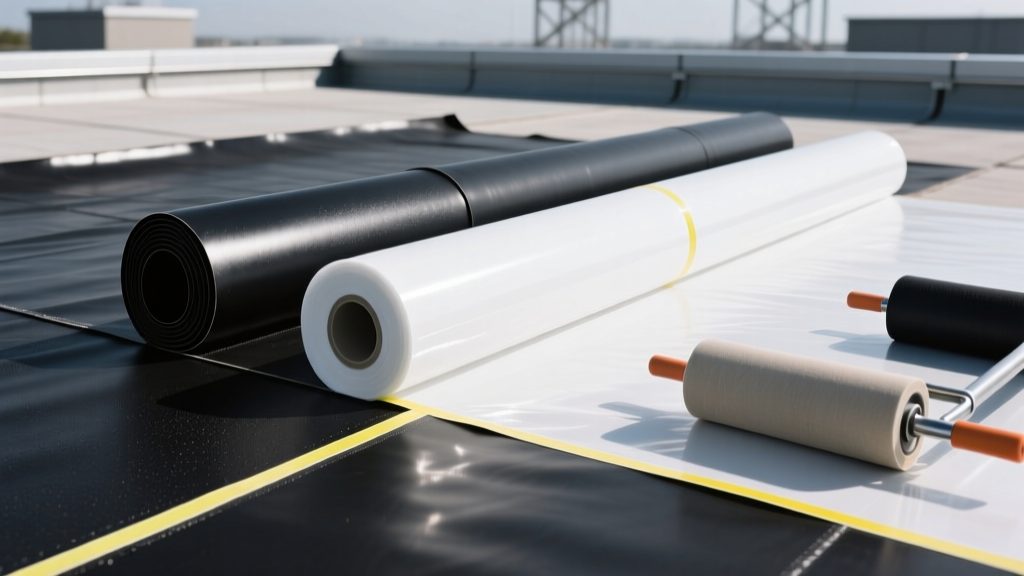
EPDM is primarily manufactured in black or white, with black being the most common due to its lower production cost and superior UV resistance in colder climates. Pricing fluctuates based on membrane thickness (measured in mils) and reinforcement.
Membrane Thickness and Pricing Tiers
- 45-Mil Non-Reinforced: $0.50 – $0.70 per sq. ft. (Material only). Best suited for ballasted systems or simple residential applications with minimal foot traffic.
- 60-Mil Non-Reinforced: $0.75 – $1.05 per sq. ft. (Material only). The industry standard for commercial fully adhered and mechanically attached systems.
- 60-Mil Scrim-Reinforced: $1.10 – $1.40 per sq. ft. (Material only). Features a polyester scrim layer that drastically improves puncture resistance and mitigates long-term shrinkage.
- 90-Mil Heavy Duty: $1.30 – $1.75 per sq. ft. (Material only). Reserved for high-traffic roofs, plaza decks, or severe hail zones.
Installation Method Variables
The National Roofing Contractors Association (NRCA) outlines three primary attachment methods for EPDM, each carrying distinct labor and material multipliers:
- Fully Adhered ($4.50 – $7.50/sq. ft. installed): The membrane is glued directly to the insulation using water-based or solvent-based bonding adhesives. This offers the highest wind uplift resistance but requires expensive adhesives (approx. $1.50/sq. ft. added cost).
- Mechanically Attached ($3.80 – $6.00/sq. ft. installed): The membrane is fastened to the structural deck using plates and screws, with seams sealed via butyl tape. Faster to install, but requires wider seam overlaps (6-inch minimum).
- Ballasted ($3.20 – $5.00/sq. ft. installed): The membrane is laid loose over the roof deck and held down by river-washed stone or pavers. Lowest labor cost, but requires a structurally robust deck to support 10-15 lbs per square foot of added dead load.
The Flat Roof Cost Matrix: EPDM vs. Alternatives
To contextualize EPDM roofing material cost, we must compare it directly against its primary single-ply competitors (TPO and PVC) and traditional Modified Bitumen systems. The following matrix reflects 2026 national averages for a 60-mil, fully adhered commercial application.
| Material | Membrane Cost (per sq. ft.) | Fully Adhered Installed Cost | Expected Lifespan | Seam Technology | Energy Efficiency |
|---|---|---|---|---|---|
| EPDM (Black) | $0.75 - $1.05 | $4.50 - $7.50 | 20 - 30 Years | Butyl Seam Tape / Liquid | Low (Absorbs Heat) |
| EPDM (White) | $1.10 - $1.50 | $5.50 - $8.50 | 20 - 25 Years | Butyl Seam Tape / Liquid | High (Reflects UV) |
| TPO (60-mil) | $0.85 - $1.25 | $5.00 - $8.00 | 15 - 25 Years | Hot-Air Welded | High (Reflects UV) |
| PVC (60-mil) | $1.30 - $1.80 | $7.00 - $11.00 | 20 - 30+ Years | Hot-Air / Solvent Welded | High (Reflects UV) |
| Mod-Bit (SBS) | $1.00 - $1.50 | $6.00 - $9.50 | 15 - 20 Years | Torch / Hot Mop | Low to Moderate |
Hidden Cost Factors That Skew EPDM Estimates
When soliciting bids, contractors often present a base square-footage price that omits critical ancillary components. To accurately forecast your EPDM roofing material cost, you must account for the following hidden variables:
1. Polyiso Insulation Requirements
Modern energy codes require continuous roof insulation. Polyisocyanurate (Polyiso) is the standard, costing between $0.65 and $1.10 per square foot per inch of thickness. Because Polyiso provides roughly R-6.5 per inch, a roof requiring R-30 will need nearly 5 inches of insulation, adding $3.50 to $5.50 per square foot to the total project cost before the EPDM membrane is even unrolled.
2. Penetration Flashing and Detailing
Flat roofs are rarely flat; they are cluttered with HVAC curbs, plumbing vents, and skylights. EPDM utilizes uncured flashing rubber to wrap complex penetrations. While TPO and PVC can be custom-welded into shapes, EPDM requires skilled labor to mold uncured rubber and seal it with pourable polyurethane sealants in termination pockets. Labor costs for detailing can add 15% to 20% to the total installation price on roofs with high penetration density.
3. Seam Tape vs. Liquid Adhesives
Standard 3-inch double-sided butyl seam tape is the baseline for EPDM seams. However, in high-wind zones or for critical inside/outside corners, contractors must upgrade to 6-inch tape or use liquid EPDM splice adhesives (like Carlisle's Sure-Seal). Liquid adhesives are significantly more expensive and require strict temperature and humidity parameters during application, potentially increasing labor time.
Lifecycle Cost Analysis: The Shrinkage Factor
The most significant long-term cost associated with traditional EPDM is membrane shrinkage. Over 15 to 20 years, exposure to UV radiation and thermal cycling causes non-reinforced EPDM to shrink, pulling away from flashings and putting immense tension on seam tapes. This leads to the most common EPDM failure mode: seam detachment at the roof perimeter.
To mitigate this lifecycle cost, specify scrim-reinforced EPDM (such as Elevate's RubberGard RE or Carlisle's Sure-Seal R). While the initial EPDM roofing material cost increases by roughly $0.35 per square foot, the internal polyester grid completely halts shrinkage, effectively eliminating perimeter flashing failures and extending the functional lifespan of the roof by a decade.
Furthermore, if your building is located in a cooling-dominated climate (ASHRAE Zones 1-3), specifying white EPDM is an option. According to the EPA's ENERGY STAR program, cool roofs can significantly reduce peak cooling demand. However, white EPDM is inherently more expensive to produce than black, and it requires more frequent cleaning to maintain its solar reflectance index (SRI), adding to long-term maintenance costs.
Decision Framework: When to Specify EPDM
Use the following framework to determine if EPDM is the most cost-effective choice for your specific project:
- Choose EPDM if: You are in a heating-dominated climate (black EPDM absorbs winter sun, reducing heating loads), you have a large, simple roof plane with few penetrations, or you are utilizing a ballasted system over an existing, structurally sound roof.
- Choose TPO if: You require a highly reflective cool roof on a standard budget, and you want the superior, monolithic seam strength of hot-air welding without the premium price of PVC.
- Choose PVC if: The roof will be exposed to animal fats, vegetable oils, or chemical exhaust (e.g., over a restaurant kitchen), as EPDM and TPO will degrade rapidly when exposed to lipids, whereas PVC is highly chemically resistant.
Ultimately, accurately calculating EPDM roofing material cost requires looking past the commodity price of the rubber itself. By factoring in insulation mandates, reinforced membrane upgrades, and the specific attachment method required by your local wind codes, you can build a realistic budget that ensures a watertight, durable flat roof system for the next 30 years.
Written by
David NakamuraDavid Nakamura is a licensed architect (AIA) and construction technology writer focused on sustainable building methods, mass timber engineering, and high-performance building envelopes. He holds a Master of Architecture from the University of Washington and is a certified Passive House Consultant (CPHC). David spent eight years at the Seattle firm Mithun, where he led the design of three LEED Platinum projects, before founding his own practice specializing in net-zero residential design. He serves on the editorial advisory board of GreenBuilder Magazine and has authored peer-reviewed papers on cross-laminated timber (CLT) connections for the Journal of Structural Engineering. In his spare time, David teaches woodworking at Pratt Fine Arts Center and kayaks the Puget Sound.
More from David Nakamura
View all
Construction Cost
Labor Cost to Build a Deck Per Sq Ft: 2026 Installation Guide
Discover the exact labor cost to build a deck per sq ft in 2026. This installation guide breaks down contractor rates, complexity factors, and hidden fees.
Aug 4, 2026

Construction Cost
How Much Does It Cost to Build a 3 Bedroom House? Financing Guide
Learn exactly how much it costs to build a 3 bedroom house and explore 2026 financing options, construction loan types, and budget frameworks for your build.
Aug 4, 2026

Construction Cost
Cost to Build a Tennis Court: 2026 Guide
How much does it cost to build a tennis court in 2026? Breakdowns for asphalt, concrete, and synthetic surfaces plus fencing and lighting.
Jul 30, 2026