Flat Roofing Materials Compared: EPDM, TPO, PVC & Mod-Bit
Compare top flat roofing materials including EPDM, TPO, PVC, and Modified Bitumen. Analyze installed costs, lifespans, and ideal commercial use cases.

The Low-Slope Roofing Landscape
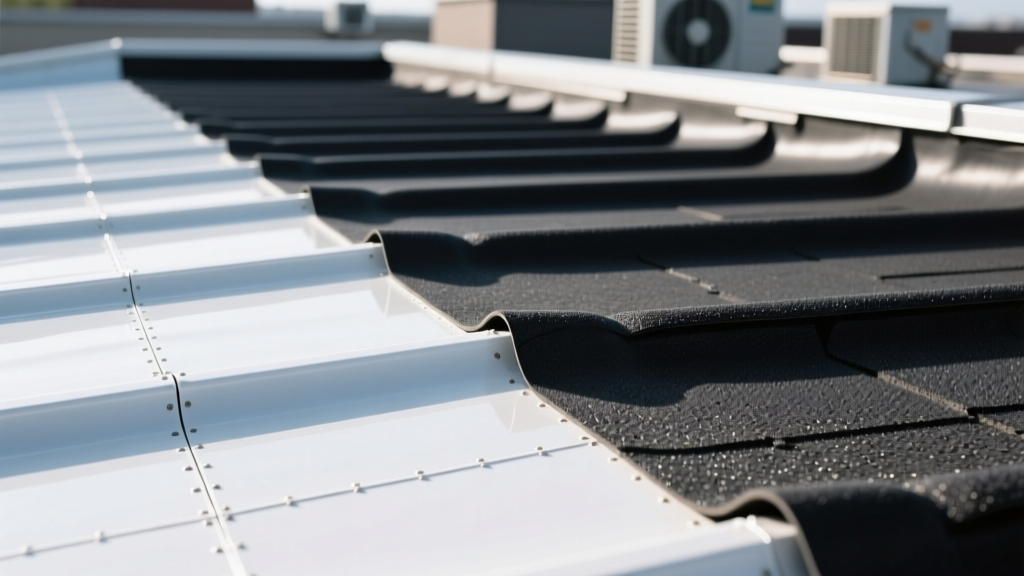
Specifying a roof for a structure with a pitch of 2:12 or less requires a fundamentally different approach than steep-slope residential roofing. Water does not shed rapidly; it ponds, tests seams, and exploits microscopic vulnerabilities. The commercial and residential flat roofing market is dominated by four primary systems: EPDM, TPO, PVC, and Modified Bitumen. Each system utilizes distinct chemical formulations, seam-joining methodologies, and structural reinforcements that dictate its lifespan, puncture resistance, and lifecycle cost.
Selecting the correct membrane is not merely about upfront material costs. It requires matching the roof's chemical exposure, foot traffic, and thermal movement profile to the material's physical properties. According to the Whole Building Design Guide, low-slope roof failures are overwhelmingly traced back to improper material selection for specific environmental stressors and poor seam execution, rather than the degradation of the membrane field itself.
Material Comparison Matrix
| Material | Standard Thickness | Seam Method | Expected Lifespan | Primary Vulnerability |
|---|---|---|---|---|
| EPDM (Rubber) | 60-mil (Non-reinforced) | Primer + Tape / Liquid Adhesive | 20 - 30 Years | Membrane shrinkage, seam tape failure |
| TPO | 60-mil (Polyester scrim reinforced) | Hot-Air Welding (1000°F+) | 20 - 25 Years | Thermal expansion/contraction stress |
| PVC / KEE | 50-mil or 60-mil (Reinforced) | Hot-Air or Solvent Welding | 25 - 30+ Years | Plasticizer migration (standard PVC) |
| Modified Bitumen | 160+ mil (2-ply system) | Torch-applied, Hot Mop, or Cold Adhesive | 15 - 20 Years | Blistering, granule loss, UV degradation |
EPDM: The Black Rubber Workhorse
Ethylene Propylene Diene Monomer (EPDM) is a synthetic rubber membrane that has been the baseline for low-slope roofing since the 1960s. It is highly resistant to UV radiation and extreme temperature fluctuations. The commercial standard is a 60-mil non-reinforced black membrane, though 45-mil is frequently used in residential applications to cut costs.
EPDM is prone to long-term thermal shrinkage, losing up to 3-5% of its dimensions over a 20-year period. If the membrane is fully adhered or mechanically attached without adequate slack at the perimeters, this shrinkage exerts immense pulling force on edge flashings, pipe boots, and parapet walls, eventually tearing the membrane or pulling it out of termination bars.
Because EPDM is a thermoset material, it cannot be heat-welded. Seams must be joined using a liquid primer and double-sided butyl tape, or liquid lap adhesives. The National Roofing Contractors Association (NRCA) consistently identifies seam degradation as the leading cause of EPDM roof failure. Modern liquid-applied seam adhesives have improved longevity over traditional tape, but the reliance on chemical bonds rather than thermal fusion remains the system's inherent weak point.
TPO: The Reflective Energy Standard
Thermoplastic Polyolefin (TPO) currently commands the largest market share in new commercial low-slope installations. Its bright white, highly reflective surface meets strict energy codes and reduces cooling loads. Modern TPO membranes are reinforced with an internal polyester scrim, providing high tensile strength and dimensional stability that EPDM lacks.
The Heat-Welding Advantage
As a thermoplastic, TPO seams are fused using hot-air welders that blow air at temperatures exceeding 1000°F. This process melts the top and bottom sheets together, creating a monolithic bond that is physically stronger than the membrane itself. When executed correctly, a heat-welded TPO seam eliminates the chemical degradation vulnerabilities associated with EPDM tape.
"Early generation TPO membranes (pre-2011) suffered from severe UV degradation and surface cracking. Current formulations utilize Hindered Amine Light Stabilizers (HALS) and advanced UV absorbers, drastically improving weatherability and meeting ASTM D6878 standards for long-term heat and UV resistance."
Installers must carefully calibrate welding speed and temperature. Ambient temperature, wind speed, and membrane surface temperature dictate the welder settings. A weld that is too cold results in a "false weld" that peels apart under wind uplift; a weld that is too hot burns through the scrim, destroying the membrane's structural integrity.
PVC and KEE: Heavy-Duty Chemical Resistance
Polyvinyl Chloride (PVC) is the premier choice for roofs exposed to harsh chemicals, animal fats, and vegetable oils. Standard PVC membranes rely on liquid plasticizers to maintain flexibility. However, if a PVC roof is installed over a restaurant kitchen exhaust, the aerosolized grease will extract these plasticizers from the membrane, causing it to become brittle, crack, and fail prematurely.
The KEE Solution
For restaurants, manufacturing facilities, and airports, specifiers must mandate a Ketone Ethylene Ester (KEE) membrane. KEE is a solid polymer plasticizer (such as DuPont's Elvaloy) that cannot be extracted by grease or jet fuel. Premium KEE membranes, like FiberTite or Sarnafil G410, cost significantly more than standard TPO or EPDM but offer unparalleled chemical resistance and a proven lifespan exceeding 30 years in aggressive environments.
Modified Bitumen: The Puncture-Resistant Hybrid
Modified Bitumen (Mod-Bit) bridges the gap between traditional built-up roofing (BUR) and single-ply membranes. It consists of asphalt modified with either SBS (Styrene-Butadiene-Styrene) rubber polymers or APP (Atactic Polypropylene) plastic polymers, reinforced with fiberglass or polyester mats. A standard Mod-Bit roof is a two-ply system (base sheet and granular cap sheet) resulting in a massive 160 to 180-mil thickness.
- SBS Modifiers: Offer rubber-like elasticity, allowing the roof to stretch and recover during extreme thermal cycling. Ideal for cold climates. Can be torch-applied, mopped in hot asphalt, or applied with cold-process adhesives.
- APP Modifiers: Create a more rigid, plastic-like membrane that flows smoothly when torched. Excellent for hot climates but less forgiving of structural movement.
The primary advantage of Mod-Bit is its sheer mass and puncture resistance. It is the preferred system for roofs with heavy foot traffic, extensive HVAC equipment servicing, or debris impact risks. The trade-off is weight, labor intensity, and the open-flame fire risk associated with torch-applied installations, which many municipal fire codes and insurance underwriters now heavily restrict.
Installed Cost and Lifecycle Analysis
Pricing fluctuates based on regional labor rates, roof complexity (penetrations, parapets), and insulation requirements. The following estimates reflect fully installed costs (membrane, fasteners/adhesive, and standard polyiso insulation) for a 10,000 sq. ft. commercial roof in 2026.
| System | Material Cost (per sq. ft.) | Labor & Equipment (per sq. ft.) | Total Installed Cost | Estimated Lifecycle Cost (per year) |
|---|---|---|---|---|
| 60-mil EPDM (Fully Adhered) | $2.10 - $2.80 | $3.40 - $4.50 | $5.50 - $7.30 | $0.22 - $0.29 |
| 60-mil TPO (Mechanically Attached) | $2.30 - $3.10 | $3.20 - $4.80 | $5.50 - $7.90 | $0.22 - $0.31 |
| 60-mil PVC (Mechanically Attached) | $3.50 - $4.80 | $3.50 - $5.20 | $7.00 - $10.00 | $0.23 - $0.33 |
| 2-Ply SBS Mod-Bit (Torch/Cold) | $2.80 - $3.90 | $4.20 - $6.10 | $7.00 - $10.00 | $0.35 - $0.50 |
While EPDM and TPO offer the lowest initial capital expenditure, evaluating the lifecycle cost per square foot per year reveals that premium PVC systems often provide superior long-term value due to their extended service life and reduced maintenance requirements.
Decision Framework: Matching Material to Building Use
Do not default to the lowest bid. Specify the membrane based on the building's operational profile:
Specification Guide
- Warehouses & Big Box Retail: Specify 60-mil mechanically attached TPO. The high solar reflectance reduces HVAC loads, and the heat-welded seams handle large, open roof planes efficiently.
- Restaurants & Food Processing: Mandate a 50-mil or 60-mil KEE/PVC membrane. Standard single-plies will dissolve under kitchen exhaust grease.
- Residential Low-Slope Additions: 60-mil fully adhered EPDM remains highly viable due to its ease of repair, lack of required hot-air welding equipment, and forgiving nature on complex, small-scale geometries.
- High-Traffic Maintenance Roofs & Schools: Specify a 2-ply SBS Modified Bitumen system (using cold adhesives if torching is prohibited). The 160+ mil thickness withstands dropped tools and constant foot traffic from maintenance crews.
Understanding the thermal dynamics, chemical exposures, and traffic patterns of your specific structure ensures the selected flat roofing material performs reliably for decades, rather than requiring costly tear-offs and replacements at the 10-year mark.
Written by
Sarah WhitfieldSarah Whitfield is a chartered quantity surveyor (MRICS) and construction cost analyst with 15 years of experience in material pricing, procurement strategy, and project budgeting. She earned her degree in Construction Management from the University of Reading (UK) and has worked on projects ranging from $2M custom homes to $180M mixed-use developments across North America and Europe. Sarah currently leads cost estimating for BuildMat Insight, maintaining a proprietary database of 4,000+ material price points updated quarterly. She is a frequent contributor to RSMeans cost data panels and has presented at the International Cost Engineering Council (ICEC) congress. Based in Denver, CO, Sarah is an avid trail runner and volunteer mentor for Women in Construction.
More from Sarah Whitfield
View all
Wood & Lumber
What Are the Different Types of Wood? A Builder's Guide
Compare structural softwoods, finish hardwoods, and engineered lumber. Analyze Janka ratings, MOE values, and 2026 pricing for construction.
Aug 4, 2026

Walls & Panels
Steel Framing vs Wood Framing: Corrosion and Moisture Defense
Compare steel framing vs wood framing for moisture resistance. Learn about galvanized coatings, condensation risks, and corrosion protection strategies.
Jul 21, 2026

Stone & Masonry
How to Cut Stone Veneer: Wet Saw vs Grinder Comparison
Compare the best tools for cutting stone veneer. We review wet saws, angle grinders, and chop saws to help you achieve clean, chip-free cuts.
Jul 21, 2026