Spray On Roofing Material Selection Framework For Flat Roofs
Compare SPF, silicone, polyurea, and acrylic spray on roofing materials. Use this 4-step selection framework to choose the right system for flat decks.
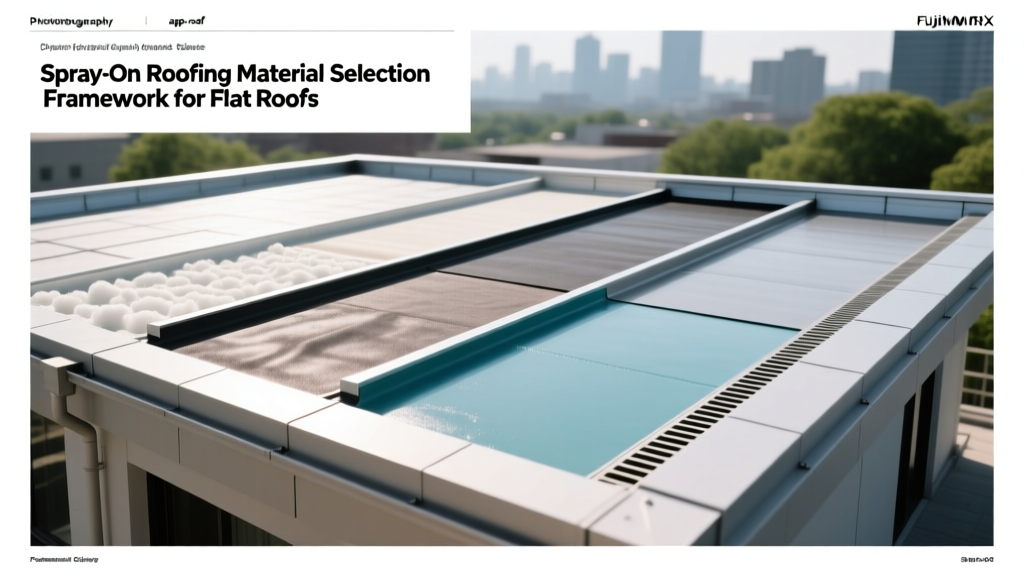
The Core Chemistry Matrix: SPF, Silicone, Polyurea, and Acrylic
Selecting the correct spray on roofing material requires moving beyond generic "liquid roof" marketing and evaluating the specific polymer chemistry against your deck's structural and environmental realities. The four primary spray-applied systems—Spray Polyurethane Foam (SPF), Silicone, Polyurea, and Acrylic—operate on fundamentally different physical principles. According to the Spray Polyurethane Foam Alliance, understanding the distinction between high-solids elastomers and water-based emulsions is the first critical filter in system selection.
| Chemistry Type | Cure Time | Ponding Water Tolerance | UV Stability | Tensile Strength (psi) | Primary Use Case |
|---|---|---|---|---|---|
| SPF (Closed-Cell) | 3-10 seconds | Excellent (when coated) | Poor (requires coating) | 40 - 60 | Insulation retrofit, uneven decks |
| High-Solids Silicone | 2 - 4 hours | Exceptional | Excellent | 150 - 250 | Flat roofs with chronic ponding |
| Polyurea (Aromatic) | 15 - 30 seconds | Good | Poor (chalks/degrades) | 1,500 - 2,500 | High-traffic decks, cold-climate application |
| Acrylic Emulsion | 8 - 24 hours | Very Poor | Good | 200 - 300 | Sloped metal roofs, budget re-coats |
The 4-Step Selection Framework
Use this sequential framework to eliminate incompatible systems before evaluating pricing.
Step 1: Substrate Compatibility & Moisture Assessment
Before specifying any spray-applied system, mandate a non-destructive infrared (IR) moisture survey. If the existing substrate (particularly EPS/XPS insulation or wood decking) retains moisture in more than 25% of the roof area, spray systems are disqualified until a partial tear-off is completed. Trapped moisture vaporizes under solar heat, causing catastrophic blistering in SPF and delamination in silicone. For direct-to-metal applications, verify the rust grade; polyurea requires SSPC-SP6 (Commercial Blast) preparation, whereas high-solids silicone (like Gaco S4200) can adhere to lightly rusted metal with an acrylic rust-inhibiting primer.
Step 2: Ponding Water & Climate Profiling
Ponding water—defined as standing water remaining 48 hours after precipitation—is the ultimate filter. Acrylics are immediately disqualified if the deck lacks a minimum 1/4:12 slope. Water-based acrylics re-emulsify and wash away under standing water. For flat decks with inadequate drainage, specify a 100% high-solids silicone (e.g., Henry 885HS or GacoFlex S2000). Silicone is chemically inert to water and will not degrade in perpetual immersion. In northern climates where winter application is required, aromatic polyurea cures in 15 seconds even at 20°F (-6°C), whereas silicone and acrylics require ambient temperatures above 40°F (4°C) and rising.
Step 3: Foot Traffic & Mechanical Abuse Tolerance
Roofs housing heavy HVAC arrays, satellite arrays, or requiring frequent maintenance access demand high tensile and tear strength. Standard silicone tears at roughly 25 lbs/inch. If heavy mechanical abuse is expected, specify a hybrid system: a base layer of polyurea (e.g., VersaFlex VF 1000) for its 2,000+ psi tensile strength and 400% elongation, topped with an aliphatic polyurethane or silicone UV-blocking topcoat. Alternatively, embed a polyester reinforcing fabric (like GacoPatch Fabric) into the silicone base coat at all parapet walls and penetrations to distribute mechanical stress.
Step 4: Lifecycle Cost & Re-Coat Intervals
The U.S. Department of Energy highlights that highly reflective spray coatings significantly reduce cooling loads, but reflectivity degrades without maintenance. Factor the mandatory re-coat cycle into your 20-year Net Present Value (NPV) calculation. Acrylics require re-coating every 5-7 years. Silicones and Polyureas typically run 15-20 years before a 1.5-gallon-per-square refresh is needed to maintain solar reflectance index (SRI) values above 78.
2026 Installed Cost & Lifecycle Economics
Pricing below reflects Q1 2026 national averages for commercial low-slope applications, including surface preparation (power washing, primer) but excluding major structural deck repairs.
| System Specification | Material Cost (per sq ft) | Labor & Prep (per sq ft) | Total Installed | Expected Lifecycle |
|---|---|---|---|---|
| Acrylic (2.5 gal / 100 sq ft) | $0.80 - $1.20 | $1.50 - $2.00 | $2.30 - $3.20 | 7 - 10 Years |
| High-Solids Silicone (3.0 gal / 100 sq ft) | $2.50 - $3.50 | $2.00 - $3.00 | $4.50 - $6.50 | 15 - 20 Years |
| Aromatic Polyurea + Aliphatic Topcoat | $3.80 - $5.00 | $3.50 - $5.00 | $7.30 - $10.00 | 20+ Years |
| 1.5" SPF + Silicone Topcoat | $4.00 - $5.50 | $3.00 - $4.50 | $7.00 - $10.00 | 20 - 30 Years |
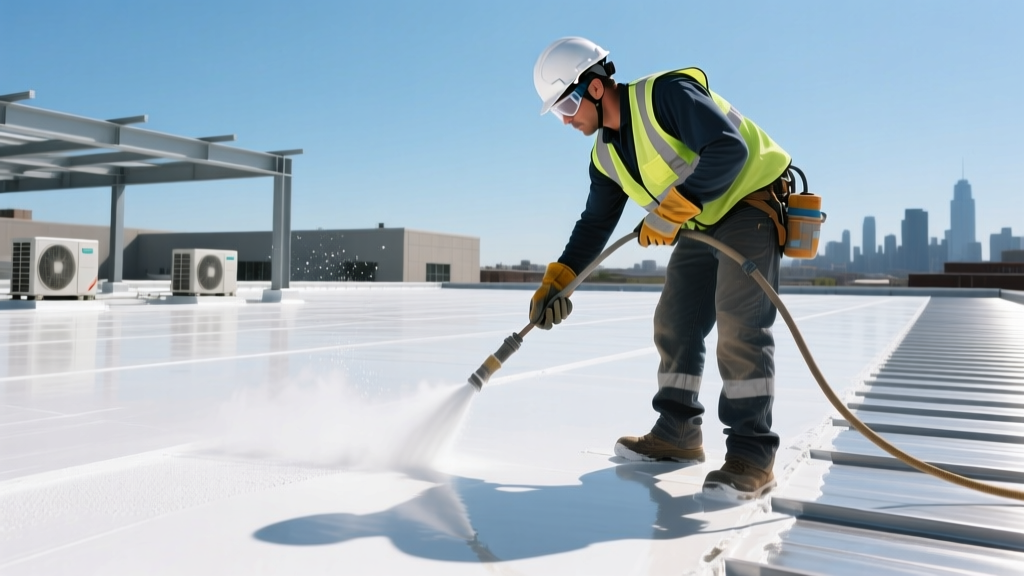
Critical Failure Modes & Edge Cases
Applying silicone or polyurea directly over aged EPDM (rubber) membranes will result in severe yellow/brown staining that bleeds through the white coating within 6 months, destroying the roof's solar reflectivity. You must specify a bleed-blocking primer, such as GacoBleedTrap or an epoxy-based tie-coat, at a minimum rate of 1.5 gallons per 100 square feet before the main spray application.
While the Environmental Protection Agency outlines the chemical safety of SPF, physical installation errors are common. If SPF is sprayed over a dusty or unprimed TPO/PVC single-ply membrane, wind uplift will peel the foam off in massive sheets. The single-ply membrane must be mechanically scarified or treated with a specialized adhesion-promoting primer (e.g., BASF Elastopaz primer) to achieve the required 2.0 lbs/sq ft uplift resistance per FM 4471.
Polyurea requires plural-component spray rigs heated to 150°F at 2,500 PSI. If your contractor's hose run exceeds 200 feet without auxiliary heating, the material will drop below optimal viscosity, resulting in a tacky, uncured "off-ratio" foam that lacks structural integrity. Always verify the contractor uses a heated hose whip and monitors ambient dew point; spraying polyurea when the substrate temperature is within 5°F of the dew point guarantees microscopic condensation and pinhole failures.
Final Specification Checklist for Architects & Owners
Hand this checklist to your roofing consultant or general contractor to ensure the bid documents specify the exact parameters required for your building's profile:
- Slope Verification: If slope is < 1/4:12, strike all acrylic emulsions from the bid. Mandate high-solids silicone or SPF.
- Moisture Mitigation: Require an IR moisture scan as a bid prerequisite. Specify core-cut verification for any anomalies detected.
- Adhesion Testing: Require a 4x4 foot mock-up with a 7-day cure, followed by an ASTM D903 peel-adhesion test. Minimum acceptable adhesion is 2.0 PLI (pounds per linear inch).
- Wet Mil Thickness: Specify the use of wet-mil gauges during application. For a 30-mil dry film thickness (DFT) silicone at 75% volume solids, the contractor must apply 40 wet mils. Do not accept "gallons per square" as the sole metric; substrate roughness drastically alters coverage rates.
- Warranty Exclusions: Review the manufacturer warranty for "ponding water" exclusions. Standard acrylic warranties void coverage if water stands for more than 48 hours. Ensure the selected chemistry aligns with the actual drainage reality of the deck.
Written by
Elena RodriguezElena Rodriguez is a civil engineer and technical writer specializing in concrete technology, masonry systems, and ASTM/ACI compliance. She earned her B.S. in Civil Engineering from Texas A&M University and spent a decade at a materials testing laboratory, performing over 2,000 concrete compressive strength tests and masonry prism evaluations. Elena is an ACI-certified Field Testing Technician (Grade I) and a member of ASTM Committee C12 on Natural Building Stone. She currently consults on forensic engineering cases involving concrete failures and moisture intrusion. Based in San Antonio, TX, Elena is a proud member of the Society of Women Engineers (SWE) and coaches her daughter's FIRST Robotics team.
More from Elena Rodriguez
View all
Walls & Panels
Cost Analysis: Light Gauge Steel Framing Advantages and Disadvantages
Evaluate light gauge steel framing advantages and disadvantages through a strict cost analysis lens, comparing material, labor, and lifecycle expenses.
Aug 4, 2026

Walls & Panels
Gypsum Board Types: Exact Specifications, Thickness & Dimensions
Compare standard, Type X, and moisture-resistant gypsum board types. Get exact specifications, thicknesses, dimensions, and ASTM standards for your project.
Aug 4, 2026

Fire Resistance
Best Fire-Resistant Outdoor Decking Materials: 2026 Buyer Guide
Discover the best fire-resistant outdoor decking materials for 2026. Compare Class A PVC, aluminum, and hardwood options for WUI compliance and safety.
Aug 4, 2026