Choosing the Right Flexible Roofing Material by Climate
Discover how to select the best flexible roofing material for extreme climates. Compare EPDM, TPO, PVC, and SBS for heat, cold, and high-wind regions.

The Physics of Roof Flexibility in Shifting Climates
Thermal expansion, structural settling, and extreme weather events demand roofing systems that can physically move without compromising their waterproof envelope. When selecting a flexible roofing material, contractors and building owners must account for the coefficient of thermal expansion (CTE) and the material's glass transition temperature. A membrane that remains pliable at -20°F will perform vastly differently than one engineered to reflect 140°F surface temperatures. The term flexible roofing material encompasses a range of single-ply and modified bitumen systems, but their climate-specific viability varies drastically based on polymer chemistry and installation methodology.
In regions with high diurnal temperature swings (e.g., the American Southwest or high-altitude zones), roofs can experience a 100°F temperature shift within 12 hours. This causes the membrane to expand and contract daily. Over a decade, this "flex fatigue" causes microscopic cracking at seams and penetrations if the material lacks adequate elastomeric recovery or if the attachment system restricts natural movement.
Climate Matrix: Matching Material to Environmental Stress
Not all flexible membranes are created equal. The following matrix breaks down the optimal and suboptimal environments for the four primary flexible roofing systems available in 2026.
| Material | Optimal Climate | Suboptimal Climate | Flexibility Rating |
|---|---|---|---|
| EPDM (Rubber) | Freeze-thaw cycles, heavy snow, extreme cold | High-UV, extreme heat (unless white-coated) | Excellent (Elastomeric) |
| TPO | High-UV, hot summers, energy-efficient mandates | Extreme cold, heavy hail corridors | Good (Thermoplastic) |
| PVC / KEE | Coastal, industrial, chemical-heavy, high humidity | Budget-constrained projects | Very Good (Plasticized) |
| SBS Mod-Bit | High-wind, hail-prone, steep-slope transitions | Highly reflective cool-roof mandates | Excellent (Rubberized Asphalt) |
Deep Dive: Material Performance by Region
EPDM (Ethylene Propylene Diene Monomer) for Freeze-Thaw Cycles
EPDM remains the gold standard for northern climates characterized by brutal winters and heavy snow loads. Its cross-linked polymer chains allow it to stretch up to 300% and recover without permanent deformation. For regions experiencing severe hail alongside freezing temperatures, the EPDM Roofing Manufacturers Association recommends a minimum 90-mil thickness, fully adhered to the substrate. While 60-mil black EPDM costs roughly $4.50 to $6.50 per square foot installed, upgrading to 90-mil reinforced EPDM (such as Carlisle SynTec's SecurGard) pushes costs to $6.00–$8.50 per square foot but provides critical puncture resistance against ice damming and hail impacts.
Climate Gotcha: Black EPDM absorbs immense solar radiation. In mixed climates with hot summers, this can cause underlying moisture to vaporize, leading to membrane blistering. In these zones, specify white EPDM or apply a reflective silicone coating post-installation.
TPO (Thermoplastic Polyolefin) for High-UV and Heat Domination
In the Sunbelt and southwestern regions, TPO dominates due to its inherent reflectivity and heat-welded seams. Modern TPO formulations blend polypropylene with ethylene-propylene rubber. However, early-generation TPO suffered from brittleness under intense UV exposure. When specifying TPO in 2026 for extreme heat zones, look for membranes with advanced UV stabilizer packages, such as GAF EverGuard Extreme. An 80-mil TPO system installed via mechanical attachment typically ranges from $5.50 to $8.00 per square foot.
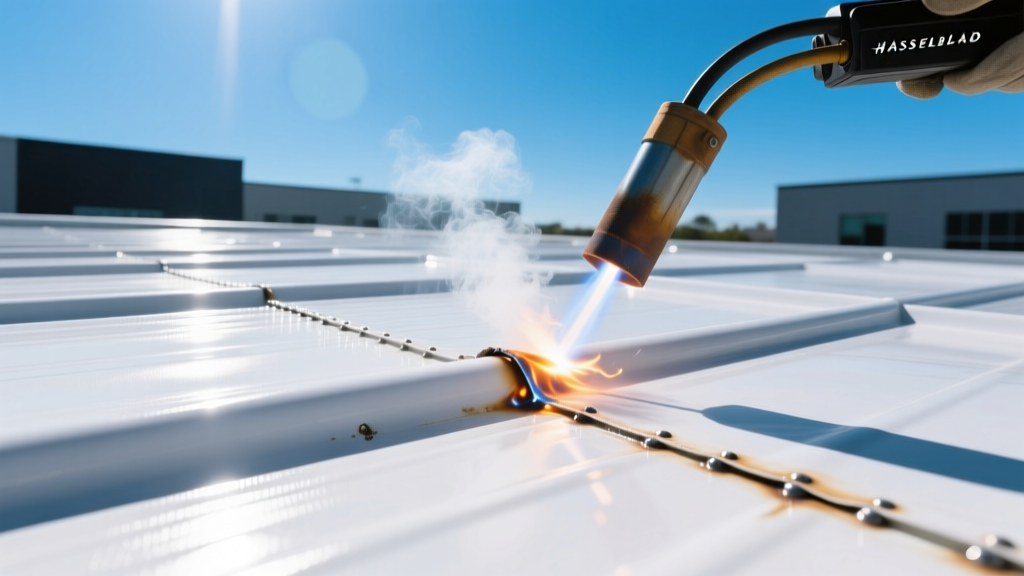
Installation Nuance: Heat-welding TPO seams requires precise temperature control (typically between 1,000°F and 1,150°F at the nozzle). In high-wind, high-heat regions, automated welders must be calibrated daily based on ambient temperature and humidity to prevent "cold welds" that will split during thermal contraction at night.
PVC and KEE for Coastal and Chemical-Heavy Zones
Standard PVC relies on liquid plasticizers to maintain flexibility. Over 15 to 20 years, these plasticizers can leach out, causing the membrane to shrink and become brittle. For coastal environments (salt spray) or industrial zones (airborne hydrocarbons and animal fats from HVAC exhaust), specify a KEE (Ketone Ethylene Ester) polymer membrane, such as Sika Sarnafil G 410. KEE is a solid polymer plasticizer that cannot leach out, ensuring the material remains permanently flexible. Expect to pay a premium: $7.00 to $10.50 per square foot installed. According to the Department of Energy, highly reflective PVC systems also significantly reduce cooling loads in hot, humid coastal climates, offsetting the higher initial material cost.
SBS Modified Bitumen for High-Wind and Hail Corridors
For low-slope roofs in Tornado Alley or regions with severe convective storms, Styrene-Butadiene-Styrene (SBS) modified bitumen offers unmatched tensile strength and flexibility. The SBS polymer acts like a rubber network within the asphalt, allowing the membrane to absorb the kinetic energy of hail strikes without fracturing. A 2-ply SBS system (base sheet and cap sheet) costs between $6.50 and $9.50 per square foot. While torch-applied SBS is common, cold-process adhesives are increasingly preferred in 2026 for occupied buildings, eliminating fire risks while providing a flexible bond that accommodates structural deflection during high-wind uplift events.
Attachment Systems: The Hidden Variable in Climate Performance
The most flexible roofing material will fail if the attachment method restricts its natural movement. Match the attachment system to the regional climate stressors:
- Fully Adhered: Best for high-wind zones and complex roof geometries. The membrane is glued directly to the insulation, distributing wind uplift forces evenly across the entire surface area. Prevents the "billowing" effect that fatigues mechanically fastened membranes.
- Mechanically Fastened: Cost-effective for large, open commercial roofs in moderate climates. However, in regions with extreme thermal cycling, the membrane can pull against the fastener plates, leading to "fastener back-out" and seam stress.
- Ballasted: Ideal for cold climates with high snow loads. The weight of the stone or pavers holds the system in place, allowing the membrane to float and expand/contract freely beneath the ballast without seam tension.
Common Climate-Induced Failure Modes and Fixes
Troubleshooting Environmental Degradation
Symptom: Seam splitting in TPO/PVC during winter.
Cause: Thermal contraction exceeding the peel strength of the weld or adhesive.
Fix: Increase seam width from the standard 1.5 inches to 2.5 inches and ensure automated welders are calibrated for sub-50°F ambient temperatures.
Symptom: Blistering in EPDM during summer.
Cause: Moisture trapped in the substrate vaporizes under high solar heat, creating pressure pockets.
Fix: Install roof vents (e.g., 1 per 1,000 sq. ft.) to allow vapor escape, or use a vapor retarder beneath the insulation in humid climates.
Symptom: Alligatoring on SBS Mod-Bit.
Cause: UV degradation of the asphalt surface due to loss of granule coverage.
Fix: Apply an aluminum roof coating or a silicone elastomeric coating to restore UV protection and surface flexibility.
Final Selection Framework
Use this decision matrix to finalize your material specification based on your primary environmental threat:
- If your primary threat is extreme cold, ice, and freeze-thaw cycling: Specify 90-mil reinforced EPDM, fully adhered or ballasted. The elastomeric recovery of rubber is unmatched in sub-zero temperatures.
- If your primary threat is intense solar radiation and high cooling costs: Specify 80-mil or thicker TPO with a high SRI (Solar Reflectance Index) rating, mechanically fastened with heat-welded seams.
- If your primary threat is chemical exposure, grease exhaust, or salt air: Specify a 60-mil KEE-based PVC membrane. The solid polymer plasticizer ensures the material will not become brittle from chemical attack.
- If your primary threat is severe hail and extreme wind uplift: Specify a 2-ply SBS Modified Bitumen system with a heavy granule surface, utilizing cold-process adhesives for maximum structural bonding and impact absorption.
Consulting the National Roofing Contractors Association technical guidelines for regional wind-uplift requirements (FM 1-90 or higher) is mandatory before finalizing any attachment method. Selecting the correct flexible roofing material is not just about the membrane itself; it is about engineering a complete, climate-responsive assembly that moves in harmony with the building beneath it.
Written by
Marcus ChenMarcus Chen is a licensed structural engineer (PE) and building materials analyst with over 12 years of experience across residential, commercial, and industrial construction. He holds a Master of Science in Civil Engineering from UC Berkeley and spent six years at Thornton Tomasetti before transitioning to independent consulting and technical writing. Marcus specializes in material selection for seismic-prone regions, concrete reinforcement strategies, and lifecycle cost analysis. His work has been cited by the American Concrete Institute (ACI) and the Structural Engineers Association of California (SEAOC). When he is not on a job site or at his desk, you will find him hiking the Sierra Nevada or restoring a 1920s craftsman bungalow in Oakland, CA.
More from Marcus Chen
View all
Construction Cost
How Much Did the Eiffel Tower Cost to Build?
How much did the Eiffel Tower cost to build in 1889? We adjust for inflation and compare its budget to modern skyscraper construction.
Aug 4, 2026

Fire Resistance
What Is a Fire Resistant Material? Testing & Certification Guide
Discover what is a fire resistant material through ASTM and UL testing. Learn how fire ratings, certifications, and assemblies work in construction.
Aug 4, 2026

Construction Cost
How Much Did the Burj Khalifa Cost to Build?
How much did the Burj Khalifa cost to build? We break down the $1.5B project and extract 5 money-saving strategies for your next build.
Jul 30, 2026