Best Norcross Roofing Materials: Norcross, GA Durability & Lifespan
Discover the best Norcross roofing materials for Norcross, GA homes. Compare lifespans, weather resistance, and top brands for local durability.

The Norcross Climate Stress Test: Why Local Durability Matters
Roofing in Gwinnett County requires navigating a highly specific microclimate. Norcross experiences hot, highly humid summers, frequent convective thunderstorms, and heavy debris from mature Loblolly and Slash pines. Standard builder-grade materials that perform well in arid climates often fail prematurely here due to thermal shock, algae proliferation, and wind-driven rain. According to National Weather Service Atlanta/Peachtree City climate data, the region averages over 50 inches of annual precipitation, with summer humidity routinely pushing dew points above 70°F. This environment accelerates granule loss on cheap asphalt and promotes rapid organic growth on north-facing slopes.
When evaluating Norcross roofing materials, Norcross, GA homeowners must prioritize three metrics: impact resistance (for summer hail and falling pine limbs), wind uplift ratings (for severe squalls), and long-term algae mitigation. As of 2026, the baseline for a durable residential roof in this zip code is no longer the standard 3-tab or basic architectural shingle; it requires engineered polymers, modified asphalt, or specialized metal coatings.
Material Lifespan Matrix for Gwinnett County Homes
The advertised lifespan of a roofing material rarely matches its actual performance in the humid subtropical Southeast. Below is an adjusted lifespan matrix based on local environmental degradation rates.
| Material Type | Manufacturer Advertised Lifespan | Expected Norcross, GA Lifespan | Wind Rating (ASTM D7158) | Algae Resistance Tech |
|---|---|---|---|---|
| 3-Tab Asphalt | 25-30 Years | 12-15 Years | Class D (60 mph) | None / Basic Copper Strip |
| Standard Architectural | 30 Years | 18-22 Years | Class F (110 mph) | Standard Copper-infused Granules |
| SBS Modified Asphalt | 40-50 Years | 28-35 Years | Class H (150 mph) | Time-Release Microsite Copper |
| 24-Ga Galvalume Metal | 40-60 Years | 45-55 Years | Class H (150+ mph) | N/A (Inorganic surface) |
| Synthetic Polymer Slate | 50+ Years | 40-50 Years | Class H (110+ mph) | N/A (Non-porous surface) |
Deep Dive: Top Performing Materials for the Area
SBS Modified Asphalt Shingles
For homeowners wanting the aesthetic of asphalt with extreme durability, SBS (Styrene-Butadiene-Styrene) modified shingles are the premier choice. Unlike standard oxidized asphalt, SBS shingles incorporate a rubberized polymer matrix. This allows the shingle to remain flexible during the extreme thermal expansion and contraction of Georgia summers, preventing the micro-cracking that leads to granule loss.
Specific Product Recommendations:
- Owens Corning Duration Storm: Features a woven polymeric scrim that provides exceptional tear strength. It carries a UL 2218 Class 4 impact rating, crucial for resisting damage from falling pine cones and summer hail.
- GAF Timberline AS II: Utilizes SBS modified asphalt and features the LayerLock technology for mechanical fusing. When installed with the proper GAF accessory system, it qualifies for the WindProven limited wind warranty with no maximum wind speed limitation.
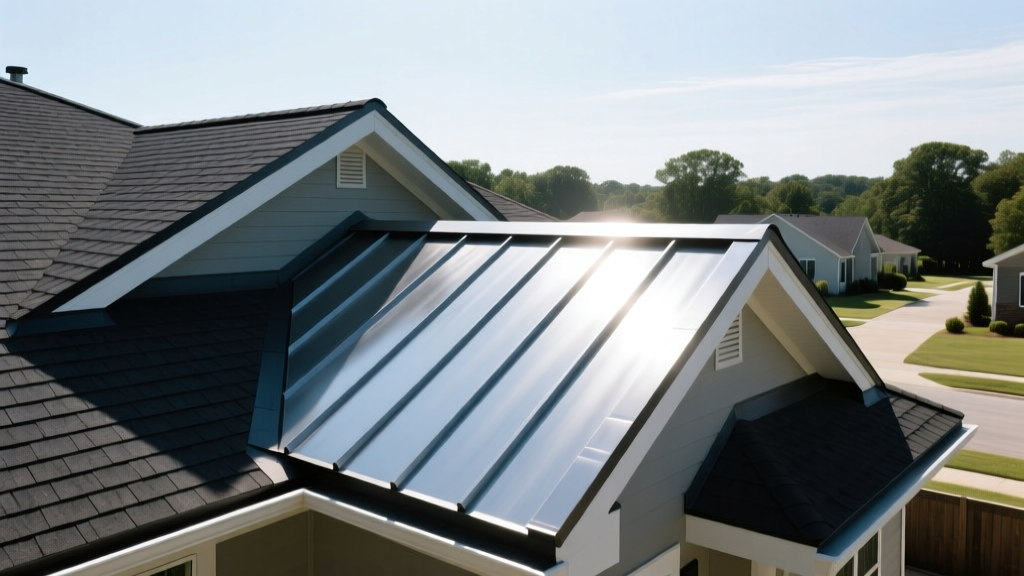
Standing Seam Metal Roofing (Galvalume)
Metal roofing is virtually immune to the organic growth and moisture rot that plagues asphalt in Norcross. However, not all metal roofs are equal. Exposed-fastener corrugated panels will experience fastener back-out and neoprene washer degradation within 15 years due to thermal cycling. Standing seam with concealed clips is mandatory for long-term durability.
Technical Specifications Required:
- Gauge & Coating: Specify 24-gauge steel (not 26 or 29-gauge) with an AZ55 Galvalume coating. The AZ55 designation means 0.55 ounces of aluminum-zinc alloy per square foot, providing superior galvanic protection against red rust in high-humidity environments.
- Paint Finish: Require a Kynar 500 (PVDF) resin-based coating. Standard SMP (Silicone Modified Polyester) paints will chalk and fade significantly under the intense Georgia UV index within a decade.
Synthetic Polymer Slate
For high-end properties in historic or upscale Norcross neighborhoods, natural slate is often desired but structurally prohibitive due to weight. Synthetic options like DaVinci Roofscapes or EcoStar provide the exact visual profile without the structural reinforcement costs. These injection-molded polymers are completely impervious to water absorption, meaning they will not spall or crack during freeze-thaw cycles, and they offer Class 4 impact resistance out of the box.
Many homeowners attempt to source materials from large retail home improvement stores to save money. In the Norcross market, these stores primarily stock "builder-grade" or "pro-cash" lines that lack the advanced algae-resistant granules and high-wind sealant strips required for local longevity. Professional roofing distributors (like ABC Supply or Beacon Building Products located in the greater Doraville/Norcross corridor) carry the premium, climate-specific SKUs that actually carry enforceable warranties in this region.
Hidden Lifespan Killers in the Norcross Area
Even the best Norcross roofing materials will fail prematurely if secondary environmental factors are ignored. The National Roofing Contractors Association (NRCA) notes that up to 80% of premature roof failures are due to system design flaws, not material defects.
1. Gloeocapsa Magma (Black Algae Streaks)
The black streaks seen on roofs across Gwinnett County are not dirt; they are colonies of Gloeocapsa magma, a cyanobacteria that feeds on the limestone filler in asphalt shingles. Standard copper strips nailed at the ridge are largely ineffective in Norcross because heavy summer downpours wash the copper ions away before they can coat the lower slopes. You must specify shingles with time-release microsite copper technology, such as the GAF StainGuard Plus Time-Release system, which encapsulates copper in porous ceramic granules to ensure a steady 20-year leaching rate.
2. Pine Needle Acid and Moisture Trapping
Norcross is heavily canopied. Pine needles accumulate in valleys and behind chimneys, holding moisture against the shingle surface and creating a highly acidic micro-environment as they decompose. This accelerates the breakdown of the asphalt binder. If your property has heavy pine coverage, metal roofing or synthetic slate is highly recommended, as their hard, non-porous surfaces allow needles to slide off rather than snag and accumulate.
3. Attic Condensation and HVAC Sweat
In July and August, Norcross attics can reach 140°F while the air conditioning ducts running through them are pushing 55°F air. Without proper attic ventilation (a balanced system of continuous soffit intake and ridge exhaust) and insulated duct mastic, condensation forms on the ducts and drips onto the OSB roof decking. This causes the decking to rot from the inside out, completely independent of the exterior roofing material. Installing a radiant barrier and ensuring an R-38 minimum insulation layer on the attic floor is non-negotiable for preserving the roof deck.
Installation Standards for Maximum Longevity
Material selection is only half the equation. To ensure your investment lasts, enforce these installation specifications with your contractor:
- Fastener Placement: For asphalt shingles, nails must be driven flush (not over-driven or under-driven) directly into the double-layer nail line. Over-driven nails cut through the fiberglass mat, voiding wind warranties.
- Ice and Water Shield: While ice dams are rare in Georgia, wind-driven rain during tropical depressions is common. Install a self-adhering modified bitumen membrane (ice and water shield) at all eaves, valleys, and penetrations (skylights, plumbing vents), not just the first 3 feet of the eave.
- Synthetic Underlayment: Replace traditional #15 or #30 asphalt felt with a high-tensile synthetic underlayment (like GAF TigerPaw or Owens Corning ProArmor). Felt absorbs ambient humidity and wrinkles, causing the shingles above to buckle and telegraph imperfections.
Frequently Asked Questions
Does a darker shingle color reduce lifespan in Georgia's heat?
Yes, slightly. Darker shingles (like Charcoal or Weathered Wood) absorb more solar radiation, reaching surface temperatures up to 160°F in July. This accelerates the volatilization of the asphalt oils, leading to earlier brittleness. However, modern SBS modified shingles and proper attic ventilation mitigate this thermal degradation. If maximizing lifespan is the absolute priority over aesthetics, choose a lighter color like Desert Tan or Shasta White, which can run 10-15 degrees cooler.
Are solar panels safe to install on older Norcross roofs?
If your existing asphalt roof is over 12 years old, do not install solar panels without replacing the roof first. The racking systems require penetrations that compromise aging, brittle shingles. Furthermore, removing and reinstalling solar panels to facilitate a roof replacement later will cost thousands of dollars and often voids the solar installer's roof penetration warranty.
How do I verify a contractor is using the premium materials we discussed?
Require the contractor to provide the manufacturer's "Shingle Receipt" or delivery ticket from the local supply house on the morning of installation. This document lists the exact SKU, lot number, and quantity delivered to your property, proving they did not substitute the premium SBS shingles with a cheaper, standard architectural line from the back of a truck.
Written by
Marcus ChenMarcus Chen is a licensed structural engineer (PE) and building materials analyst with over 12 years of experience across residential, commercial, and industrial construction. He holds a Master of Science in Civil Engineering from UC Berkeley and spent six years at Thornton Tomasetti before transitioning to independent consulting and technical writing. Marcus specializes in material selection for seismic-prone regions, concrete reinforcement strategies, and lifecycle cost analysis. His work has been cited by the American Concrete Institute (ACI) and the Structural Engineers Association of California (SEAOC). When he is not on a job site or at his desk, you will find him hiking the Sierra Nevada or restoring a 1920s craftsman bungalow in Oakland, CA.
More from Marcus Chen
View all
Construction Cost
How Much Did the Eiffel Tower Cost to Build?
How much did the Eiffel Tower cost to build in 1889? We adjust for inflation and compare its budget to modern skyscraper construction.
Aug 4, 2026

Fire Resistance
What Is a Fire Resistant Material? Testing & Certification Guide
Discover what is a fire resistant material through ASTM and UL testing. Learn how fire ratings, certifications, and assemblies work in construction.
Aug 4, 2026

Construction Cost
How Much Did the Burj Khalifa Cost to Build?
How much did the Burj Khalifa cost to build? We break down the $1.5B project and extract 5 money-saving strategies for your next build.
Jul 30, 2026