Installation Guide for Common Types of Flat Roofing Materials
Master the installation of various types of flat roofing materials. Learn EPDM, TPO, PVC, and Mod-Bit application steps, costs, and failure fixes.

Pre-Installation Deck Preparation & Moisture Testing
Before deploying any of the primary types of flat roofing materials, the substrate must be rigorously prepared. Flat roofs (defined as having a slope of 3:12 or less) are highly susceptible to ponding water, making deck integrity paramount. Begin with a nuclear moisture scan or a non-destructive Tramex impedance scan to identify trapped moisture within the existing roof assembly. Any substrate reading above 5% moisture content by weight requires tear-off down to the structural deck.
For new installations over steel or concrete decks, install a vapor retarder (such as a 6-mil polyethylene sheet or a self-adhering modified bitumen base sheet) if the building's interior humidity levels exceed 45% during winter months. Fasten the initial layer of polyisocyanurate (polyiso) insulation using corrosion-resistant screws and 3-inch heavy-duty HDPE plates, staggering the joints to prevent thermal bridging. Ensure all fasteners achieve a minimum pull-out resistance of 300 lbs per fastener in concrete or 150 lbs in steel decking.
EPDM Rubber Membrane: Fully Adhered Installation
Ethylene Propylene Diene Monomer (EPDM) remains a dominant choice among the types of flat roofing materials due to its UV resistance and elasticity. For commercial applications, specify 60-mil reinforced EPDM (meeting ASTM D4637 standards) rather than the unreinforced 45-mil residential grade.
Step-by-Step Adhered Application
- Primer Application: Roll a water-based EPDM primer onto both the substrate (polyiso cover board) and the back of the membrane. Apply at a rate of 250 square feet per gallon. Allow it to flash off until tacky (typically 15-30 minutes, depending on ambient humidity).
- Membrane Positioning: Roll out the 10-foot or 20-foot wide EPDM sheets, allowing them to relax and acclimate to the ambient temperature for 30 minutes to prevent thermal contraction post-installation.
- Seaming: Overlap adjacent sheets by a minimum of 3 inches. Clean the lap area with EPDM splice wash, then apply 3-inch double-sided butyl seam tape. Use a silicone seam roller with at least 80 lbs of downward pressure to activate the tape and ensure a watertight molecular bond.
TPO and PVC Single-Ply: Heat-Welded Seaming
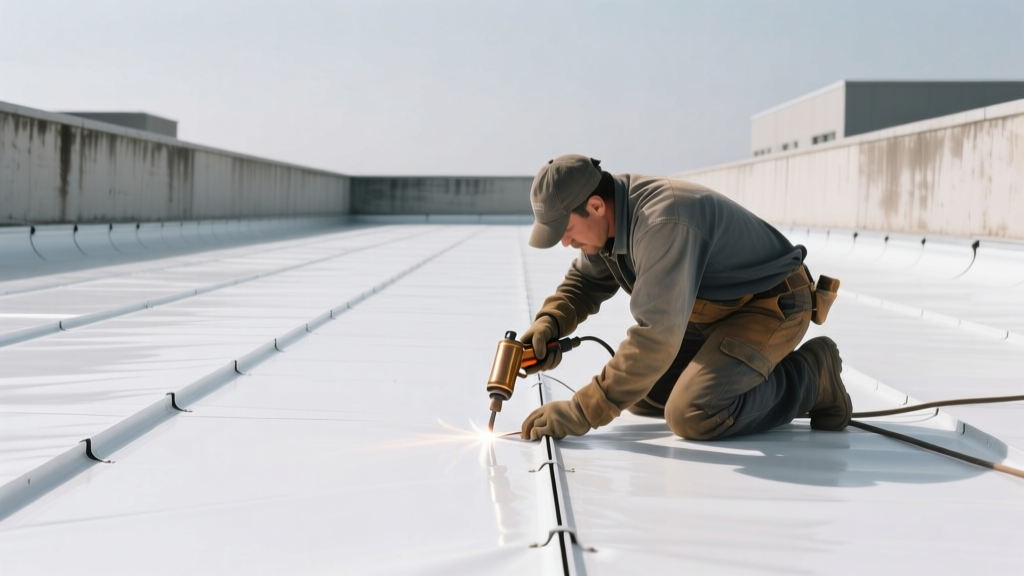
Thermoplastic Polyolefin (TPO) and Polyvinyl Chloride (PVC) are highly reflective, energy-efficient options. The Department of Energy notes that cool roofs like white TPO can reduce peak cooling demand by 10-15%. Installation relies on hot-air welding rather than chemical adhesives.
Mechanically Attached TPO/PVC Protocol
For a 60-mil TPO membrane (ASTM D6878), use a mechanically attached system for wind uplift resistance up to FM 1-120. Secure the membrane using #14 or #15 corrosion-resistant screws and 3-inch barbed plates. Fastener spacing is critical: place fasteners 12 inches on center (o.c.) in the perimeter and corner zones, and 24 inches o.c. in the field zone.
Weld the seams using an automatic hot-air welder set between 1,000°F and 1,150°F, traveling at 10 to 12 feet per minute. The overlap must be a minimum of 1.5 inches. After the weld cools for 5 minutes, perform adestructive probe test using a blunt-nosed awl along the entire seam edge; any snagging indicates a cold weld that must be patched with a 6-inch cover strip.
Modified Bitumen (SBS): Torch-Down Application
Styrene-Butadiene-Styrene (SBS) modified bitumen combines the durability of built-up roofing with the flexibility of rubber. It is ideal for roofs with high foot traffic or complex penetrations.
Torch-Down Execution
Unroll the cap sheet (typically 4mm thick with granular surface) and align it over the base sheet. Using a propane roofing torch, apply heat to the bottom polyethylene film at a 45-degree angle. The goal is to melt the film until the asphalt glistens and flows slightly, creating a 1/4-inch bead of asphalt at the leading edge as the roll is pushed forward. Maintain 4-inch side laps and 6-inch end laps. The National Roofing Contractors Association (NRCA) strictly mandates that torch operators maintain a fire extinguisher within 10 feet and conduct a continuous fire watch for at least two hours post-torching to prevent smoldering deck fires.
2026 Installation Cost & Specification Matrix
When evaluating the types of flat roofing materials, contractors and facility managers must weigh initial installation costs against lifecycle durability. The following matrix reflects 2026 national average installed costs for commercial applications.
| Material Type | Standard Thickness | Primary Fastening Method | Installed Cost (per sq. ft.) | Expected Lifespan |
|---|---|---|---|---|
| EPDM (Reinforced) | 60-mil | Fully Adhered / Ballasted | $4.50 - $7.50 | 25 - 30 Years |
| TPO | 60-mil / 80-mil | Mechanically Attached | $5.50 - $9.00 | 20 - 25 Years |
| PVC (KEE) | 50-mil / 60-mil | Fully Adhered | $7.00 - $12.00 | 25 - 35 Years |
| SBS Mod-Bit | 4mm Cap + Base | Torch-Applied / Mopped | $5.00 - $8.50 | 20 - 25 Years |
| Built-Up (BUR) | 4-Ply Asphalt | Hot Mopped | $6.00 - $10.00 | 20 - 30 Years |
Troubleshooting Common Flat Roof Installation Failures
Even with premium materials, improper installation techniques lead to premature system failure. Below are the most frequent edge cases and their technical remedies.
Failure 1: Membrane Blistering on Adhered Systems
Cause: Trapped moisture in the substrate vaporizing under solar heat, or applying adhesive over a damp surface.
Fix: Cut an 'X' into the blister, allow the substrate to dry completely, inject specialized EPDM or TPO lap sealant, and patch with a 6-inch oversized piece of flashing membrane welded or adhered over the cut.
Failure 2: TPO Seam Delamination in High Winds
Cause: Welder temperature set too low, or welding speed too fast, resulting in a 'cold weld' that fails under FM 1-90 wind uplift pressures.
Fix: Conduct daily test welds on scrap material every morning and after any weather change. Perform destructive peel tests on the scrap. If the membrane tears before the weld breaks, the machine settings are correct; if the weld peels cleanly, increase the temperature by 25°F or slow the travel speed.
Failure 3: Mod-Bit Alligatoring and Brittleness
Cause: Over-torching the SBS membrane, which burns off the polymer modifiers and leaves raw, brittle asphalt exposed to UV degradation.
Fix: Ensure the torch operator maintains a consistent walking pace. The polyethylene backing should melt to a glossy sheen, not bubble, char, or smoke heavily. Apply a reflective aluminum roof coating (ASTM D2824) over the cap sheet to restore UV protection if minor surface scorching occurs.
Final Considerations for Drainage and Flashing
Regardless of which of the types of flat roofing materials you select, the system is only as strong as its flashing and drainage details. The Environmental Protection Agency (EPA) emphasizes that proper water management is critical for maintaining the thermal emittance and structural integrity of low-slope roofs. Ensure all internal drains are fitted with clamping rings and debris domes, and that the membrane is properly flashed up all parapet walls to a minimum height of 8 inches above the roof surface, terminated with a metal reglet and polyurethane sealant. By strictly adhering to manufacturer specifications and ASTM standards, you guarantee a watertight, durable assembly capable of withstanding decades of environmental stress.
Written by
Marcus ChenMarcus Chen is a licensed structural engineer (PE) and building materials analyst with over 12 years of experience across residential, commercial, and industrial construction. He holds a Master of Science in Civil Engineering from UC Berkeley and spent six years at Thornton Tomasetti before transitioning to independent consulting and technical writing. Marcus specializes in material selection for seismic-prone regions, concrete reinforcement strategies, and lifecycle cost analysis. His work has been cited by the American Concrete Institute (ACI) and the Structural Engineers Association of California (SEAOC). When he is not on a job site or at his desk, you will find him hiking the Sierra Nevada or restoring a 1920s craftsman bungalow in Oakland, CA.
More from Marcus Chen
View all
Construction Cost
How Much Did the Eiffel Tower Cost to Build?
How much did the Eiffel Tower cost to build in 1889? We adjust for inflation and compare its budget to modern skyscraper construction.
Aug 4, 2026

Fire Resistance
What Is a Fire Resistant Material? Testing & Certification Guide
Discover what is a fire resistant material through ASTM and UL testing. Learn how fire ratings, certifications, and assemblies work in construction.
Aug 4, 2026

Construction Cost
How Much Did the Burj Khalifa Cost to Build?
How much did the Burj Khalifa cost to build? We break down the $1.5B project and extract 5 money-saving strategies for your next build.
Jul 30, 2026