Torch Roofing Material Cost Breakdown: 2026 Square Foot Guide
Explore the 2026 torch roofing material cost breakdown. Compare SBS and APP modified bitumen pricing, labor rates, and hidden installation expenses.

The Economics of Torch-Down Roofing in 2026
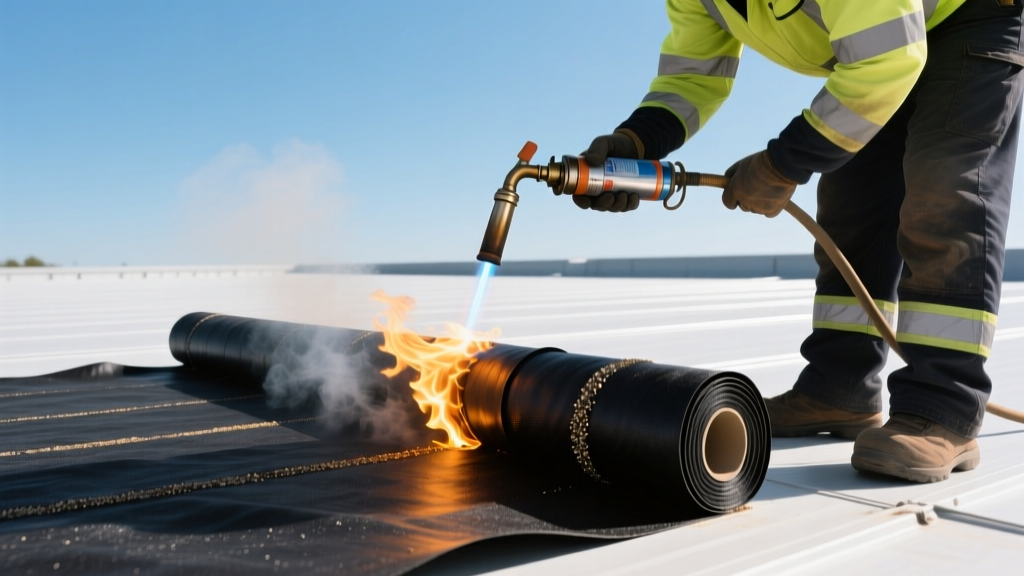
When commercial building owners and facility managers evaluate low-slope roofing options, torch roofing material—specifically modified bitumen (mod-bit) membranes—remains a premier choice for its durability and puncture resistance. Torch-down systems utilize a propane torch to melt the asphalt backing of the rolls, fusing them into a continuous, monolithic membrane. In 2026, the cost landscape for these systems has stabilized following recent petroleum market fluctuations, but labor shortages and stricter municipal fire codes have shifted the financial balance heavily toward installation expenses.
This guide provides a granular cost breakdown of torch roofing materials, differentiating between Styrene-Butadiene-Styrene (SBS) and Atactic Polypropylene (APP) polymers, while detailing the hidden expenses of hot-work permits and structural preparation.
Material Cost Matrix: SBS vs. APP Modified Bitumen
Modified bitumen is manufactured in two primary polymer formulations. SBS (rubberized) offers superior flexibility in freezing temperatures, while APP (plasticized) provides higher UV resistance and melts at a higher temperature. The choice of polymer directly impacts your material budget.
| System Configuration | Material Cost (Per Sq. Ft.) | Labor Cost (Per Sq. Ft.) | Total Installed Cost (Per Sq. Ft.) |
|---|---|---|---|
| 2-Ply SBS (Base + Granular Cap) | $1.80 - $2.40 | $3.50 - $4.80 | $5.30 - $7.20 |
| 2-Ply APP (Base + Smooth/Glaze Cap) | $1.60 - $2.10 | $3.20 - $4.50 | $4.80 - $6.60 |
| 3-Ply SBS (Premium Heavy-Duty) | $2.80 - $3.60 | $4.50 - $6.20 | $7.30 - $9.80 |
| Reflective Cool-Roof Cap Sheet Upgrade | +$0.40 - $0.75 | $0.00 (Included in cap install) | +$0.40 - $0.75 |
Deconstructing the Labor and "Hot Work" Premium
Unlike mechanically fastened TPO or fully adhered EPDM systems, torch roofing material requires specialized labor. The application process demands certified welders who can maintain a consistent flame temperature—typically between 500°F and 600°F at the membrane surface—to achieve a proper bleed-out without scorching the asphalt.
Fire Watch and Insurance Surcharges
The most significant non-material cost driver in 2026 is the "hot work" premium. Because open flames are used on the roof deck, contractors must comply with stringent safety protocols, often dictated by the NFPA 241 standard for safeguarding construction operations. This requires:
- Dedicated Fire Watch Personnel: A minimum of one hour of continuous monitoring after the last torch is extinguished, adding 1.5 to 2.5 billable labor hours per day.
- Hot Work Permits: Municipal fees ranging from $150 to $450 per project phase.
- Insurance Surcharges: Contractors carrying specialized hot-work liability riders typically pass a 4% to 8% insurance surcharge onto the final bid.
Hidden Cost Variables: Decking, Tear-Off, and Flashing
The per-square-foot matrix above assumes a clean, ready-to-install substrate. Real-world commercial projects rarely fit this ideal. Budget for the following edge cases:
1. Substrate Preparation and Insulation
Torch-down membranes cannot be applied directly to wood decking or bare concrete without a mechanical fastener base or a separation layer. Installing a 1/2-inch high-density fiberglass cover board or a layer of polyisocyanurate (polyiso) insulation is mandatory. Expect to add $1.20 to $2.50 per square foot for insulation and cover board materials, plus $0.80 per square foot for mechanical fastening labor.
2. Existing Roof Tear-Off
If the existing roof has reached its weight limit or is saturated with moisture, a complete tear-off is required. Disposal costs in 2026 average $1.50 to $3.00 per square foot, heavily dependent on local landfill tipping fees and the number of existing layers. If the existing single-ply membrane is dry and securely adhered, a retrofit overlay may be possible, saving up to 30% on prep costs.
3. Parapet Walls and Edge Metal
Modified bitumen excels at wrapping parapet walls, but this requires additional membrane yardage and meticulous detailing. Base flashing and cap metal installation typically add $15 to $28 per linear foot to the project perimeter.
Technical Specifications and Product Selection
Not all torch roofing material is manufactured equally. When reviewing contractor bids, verify the specific product lines being proposed. The industry standard requires membranes to meet specific ASTM criteria:
- SBS Membranes: Must meet ASTM D6164 (for polyester-reinforced) or ASTM D6163 (for fiberglass-reinforced).
- APP Membranes: Must meet ASTM D6222 (polyester) or ASTM D6223 (fiberglass).
Leading manufacturers dominate the 2026 market with distinct product lines:
- GAF Ruberoid® Torch: Features a heavy-duty polyester mat and is widely specified for high-traffic commercial roofs. Known for consistent asphalt bleed-out during installation.
- CertainTeed Flintlastic® GTA/GTS: Offers premium granular surfacing options. According to the U.S. Department of Energy, upgrading to their highly reflective cool-roof cap sheets can reduce peak cooling demand by up to 15%, easily justifying the $0.60/sq. ft. material upgrade.
- IKO Carrara®: An SBS membrane that incorporates smog-reducing granules, a popular choice for LEED-certified commercial builds in dense urban environments.
Torch-Down vs. Single-Ply: A Decision Framework
Deciding whether to invest in torch roofing material over single-ply alternatives like TPO or EPDM requires evaluating the building's operational environment. Use this framework to finalize your material choice:
- Choose Torch-Down (Mod-Bit) If: The roof experiences high foot traffic (HVAC maintenance, rooftop patios), is located in a climate with extreme temperature cycling, or features complex penetrations where the moldability of heated asphalt provides superior waterproofing.
- Choose TPO If: The budget is strictly capped (TPO is generally 15-20% cheaper installed), the building requires high solar reflectance without granular surfacing, and the roof deck is strictly wood or steel where hot work is prohibited by fire marshals.
- Choose EPDM If: The building is in a consistently cold, northern climate where black membrane heat absorption is beneficial, and the roof geometry is simple with minimal penetrations.
Summary of Investment and Longevity
A properly installed 2-ply SBS torch-down roof represents a mid-tier capital expenditure in the commercial roofing sector, averaging $6.50 per square foot fully installed. However, its true value lies in its lifecycle. While standard TPO systems often require replacement or major membrane repairs at the 15-year mark due to seam degradation, a well-maintained torch roofing material system routinely achieves a 20- to 25-year service life. The asphalt seams are thermally fused, eliminating the adhesive failures and tape delamination that plague single-ply systems. When evaluating bids, prioritize contractors who provide detailed hot-work safety plans and specify ASTM-compliant, polyester-reinforced membranes to ensure the longevity of your investment.
Written by
Sarah WhitfieldSarah Whitfield is a chartered quantity surveyor (MRICS) and construction cost analyst with 15 years of experience in material pricing, procurement strategy, and project budgeting. She earned her degree in Construction Management from the University of Reading (UK) and has worked on projects ranging from $2M custom homes to $180M mixed-use developments across North America and Europe. Sarah currently leads cost estimating for BuildMat Insight, maintaining a proprietary database of 4,000+ material price points updated quarterly. She is a frequent contributor to RSMeans cost data panels and has presented at the International Cost Engineering Council (ICEC) congress. Based in Denver, CO, Sarah is an avid trail runner and volunteer mentor for Women in Construction.
More from Sarah Whitfield
View all
Wood & Lumber
What Are the Different Types of Wood? A Builder's Guide
Compare structural softwoods, finish hardwoods, and engineered lumber. Analyze Janka ratings, MOE values, and 2026 pricing for construction.
Aug 4, 2026

Walls & Panels
Steel Framing vs Wood Framing: Corrosion and Moisture Defense
Compare steel framing vs wood framing for moisture resistance. Learn about galvanized coatings, condensation risks, and corrosion protection strategies.
Jul 21, 2026

Stone & Masonry
How to Cut Stone Veneer: Wet Saw vs Grinder Comparison
Compare the best tools for cutting stone veneer. We review wet saws, angle grinders, and chop saws to help you achieve clean, chip-free cuts.
Jul 21, 2026