Complete Material List for Metal Roofing: 2026 Comparison
Compare substrates, underlayments, fasteners, and sealants with our comprehensive 2026 material list for metal roofing systems and installations.

The Core Panel Matrix: Comparing Metal Substrates
Building a comprehensive material list for metal roofing begins with selecting the primary substrate. The panel material dictates the fastener type, underlayment requirement, and overall thermal expansion parameters. As of 2026, supply chain stabilization has normalized pricing, making premium substrates more accessible for residential and light commercial projects.
| Substrate Material | Standard Thickness/Gauge | Material Cost (per sq. ft.) | Lifespan | Best Application |
|---|---|---|---|---|
| Galvalume Steel (AZ55) | 24-gauge (0.0239") | $4.50 - $6.50 | 40-60 Years | Standard residential, agricultural, commercial |
| Aluminum | 0.032" or 0.040" | $6.00 - $8.50 | 50+ Years | Coastal regions (salt-spray resistance) |
| Zinc | 0.7mm or 0.8mm | $14.00 - $18.00 | 80-100 Years | High-end architectural, historic restorations |
| Copper | 16 oz or 20 oz | $22.00 - $30.00 | 100+ Years | Accents, dormers, premium architectural estates |
For most standard installations, 24-gauge Galvalume steel coated with a Kynar 500 (PVDF) paint system offers the highest ROI. Avoid 29-gauge steel for residential roofing; it lacks the structural rigidity to span standard purlin spacing (typically 24" on center) without oil-canning (visible rippling).
Underlayment Selection: Synthetic vs. Self-Adhered vs. Felt
Metal roofs reach extreme surface temperatures, frequently exceeding 180°F in direct summer sun. Standard asphalt-saturated #30 felt is entirely inappropriate for metal roofing; the asphalt will soften, melt, and adhere to the back of the metal panels, voiding manufacturer warranties and causing severe tearing during thermal expansion cycles.
1. High-Temp Synthetic (The Standard)
Woven polypropylene synthetics, such as Titanium UDL30 or Owens Corning ProArmor, are the baseline for 2026 metal roof material lists. They withstand temperatures up to 240°F, provide excellent slip resistance for installers, and will not degrade if left exposed to UV for up to 6 months during construction delays.
2. High-Temp Peel-and-Stick (Ice & Water Shield)
Self-adhered membranes must be specifically rated for high heat. Standard ice and water shield will melt and run down the roof deck under metal panels. You must specify high-temp formulations like Grace Ice & Water Shield HT, which utilizes a rubberized asphalt compound engineered to remain stable up to 240°F. Use this in valleys, eaves, and around all penetrations.
Fastener and Clip Specifications: The Hidden Failure Points
The most common cause of metal roof failure is not the panel itself, but the fasteners. Your material list must specify exact fastener types based on the panel profile.
- Concealed Clip Systems (Standing Seam): Requires 18-gauge or 16-gauge galvanized steel sliding clips. These clips allow the panel to expand and contract up to 1.5 inches without stressing the fastener holes. Fasten the clips to the deck using #10 x 1" pancake-head screws to maintain a low profile under the next panel.
- Exposed Fastener Systems (Corrugated/R-Panel): Requires #10 or #12 x 1" hex-washer-head screws. The washer material is critical: specify EPDM rubber washers. Never use neoprene washers, which dry-rot and crack within 5-7 years under UV exposure.
Sealants and Tapes: Completing the Material List
Sealants in metal roofing serve as secondary water barriers at laps and flashings. The chemical composition of the sealant must match the application.
Butyl Tape (For Lap Seams)
For panel end-laps and ridge cap seams, your material list must include 1/4" x 1/2" butyl tape. Unlike liquid sealants, butyl tape never fully cures; it remains a pliable, non-hardening putty that stretches and compresses as the metal panels expand and contract daily. According to the Metal Construction Association (MCA), butyl is the only approved sealant for concealed panel lap joints.
Polyurethane Sealant (For Exterior Flashings)
For exterior flashing intersections (such as where a sidewall flashing meets a brick chimney), use a high-quality polyurethane sealant like OSI Quad Max or Geocel ProFlex. Polyurethanes offer superior UV resistance and adhesion to painted metal surfaces.
The "No Silicone" Rule: Never include silicone sealant on a metal roofing material list. While silicone has high UV resistance, nothing adheres to cured silicone—not even more silicone. If a flashing needs repair or repainting in the future, the presence of silicone residue will cause paint and new sealants to fail catastrophically.
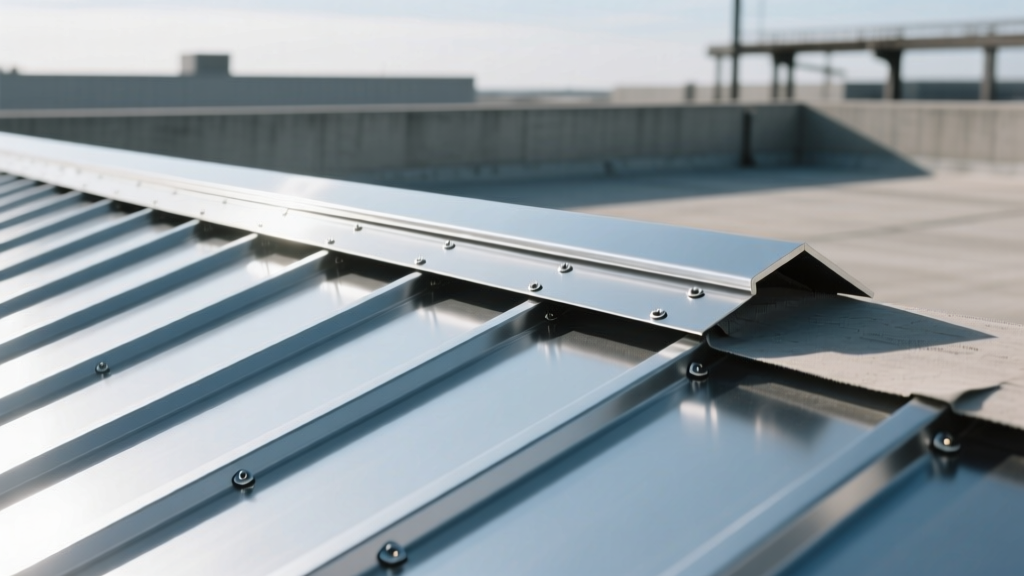
Flashings, Closures, and Trim Components
A watertight assembly relies on precision trim. When ordering from your coil supplier or fabricator, ensure your material list includes the following specific components:
- Drip Edge (Eave Trim): Must feature a hemmed bottom edge to provide rigidity and direct water into the gutters. Un-hemmed drip edges will warp under the weight of ice or ladder placement.
- Z-Flashing: Used for headwall transitions (where the roof meets a vertical wall). Ensure the Z-flashing includes a 1" relief bend to accommodate the profile of the roof panel ribs.
- Foam Closure Strips: Required for exposed fastener panels and ridge caps. Specify cross-linked polyethylene (XLPE) foam closures rather than standard polyurethane foam. XLPE is closed-cell, meaning it will not absorb water if driven rain bypasses the ridge cap, and it resists crushing under the weight of the screwed-down ridge cap.
- Pipe Boots: Standard rubber pipe boots degrade quickly under metal roof temperatures. Specify EPDM pipe boots with an aluminum base ring (such as the Master Flash brand), which can be molded directly to the corrugated panel profile.
Material Takeoff Baseline: Per Square (100 Sq. Ft.)
To assist with estimating, here is a baseline material list for one "square" (100 square feet) of a standard 24-gauge exposed fastener metal roof with a 3:12 pitch. This data aligns with standard waste factors recommended by the National Roofing Contractors Association (NRCA).
| Material Category | Quantity per Square (Includes 10% Waste) | Specification Notes |
|---|---|---|
| Metal Panels | 110 sq. ft. | Accounts for side-laps and end-laps |
| Synthetic Underlayment | 1.2 rolls (approx. 120 sq. ft. coverage) | Assumes standard 4' x 25' rolls with 2" overlaps |
| Panel Fasteners | 85 - 90 screws | Based on 16" o.c. framing and standard lap patterns |
| Stitch Screws (Laps) | 15 - 20 screws | #10 x 3/4" hex washer head for side-laps |
| Butyl Tape | 15 linear feet | For end-laps and ridge cap sealing |
| Foam Closures | 25 linear feet | For ridge cap and eave trim (top and bottom closures) |
By specifying exact gauges, coating types, and chemical compositions for every accessory, you eliminate the variables that lead to premature roof degradation. A metal roof is only as durable as the weakest fastener or sealant in the assembly.
Written by
Marcus ChenMarcus Chen is a licensed structural engineer (PE) and building materials analyst with over 12 years of experience across residential, commercial, and industrial construction. He holds a Master of Science in Civil Engineering from UC Berkeley and spent six years at Thornton Tomasetti before transitioning to independent consulting and technical writing. Marcus specializes in material selection for seismic-prone regions, concrete reinforcement strategies, and lifecycle cost analysis. His work has been cited by the American Concrete Institute (ACI) and the Structural Engineers Association of California (SEAOC). When he is not on a job site or at his desk, you will find him hiking the Sierra Nevada or restoring a 1920s craftsman bungalow in Oakland, CA.
More from Marcus Chen
View all
Construction Cost
How Much Did the Eiffel Tower Cost to Build?
How much did the Eiffel Tower cost to build in 1889? We adjust for inflation and compare its budget to modern skyscraper construction.
Aug 4, 2026

Fire Resistance
What Is a Fire Resistant Material? Testing & Certification Guide
Discover what is a fire resistant material through ASTM and UL testing. Learn how fire ratings, certifications, and assemblies work in construction.
Aug 4, 2026

Construction Cost
How Much Did the Burj Khalifa Cost to Build?
How much did the Burj Khalifa cost to build? We break down the $1.5B project and extract 5 money-saving strategies for your next build.
Jul 30, 2026