PVC Roofing Material: A Climate-Specific Performance Guide
Discover how PVC roofing material performs in extreme heat, heavy snow, and coastal winds. Get climate-specific installation and cost insights.

The Chemistry of PVC: Why Climate Dictates Performance
Polyvinyl chloride (PVC) single-ply membranes dominate the commercial low-slope market due to their exceptional chemical resistance and heat-welded seams. However, treating PVC roofing material as a universal, one-size-fits-all solution ignores critical regional variables. The polymer's reliance on plasticizers for flexibility, combined with its thermal expansion coefficient, means that a membrane engineered for a humid subtropical environment may fail prematurely in a high-altitude alpine climate if the wrong thickness, fastening pattern, or underlayment is specified.
Unlike EPDM, which relies on adhesives or tape, PVC seams are fused using hot air welding at temperatures exceeding 1,000°F. This creates a monolithic bond that is physically stronger than the membrane itself. Yet, the membrane's surface and structural integrity react distinctly to UV radiation, thermal shock, and sub-freezing temperatures. According to the Single Ply Roofing Industry (SPRI), improper climate-specific detailing accounts for the majority of premature single-ply failures, rather than material defects.
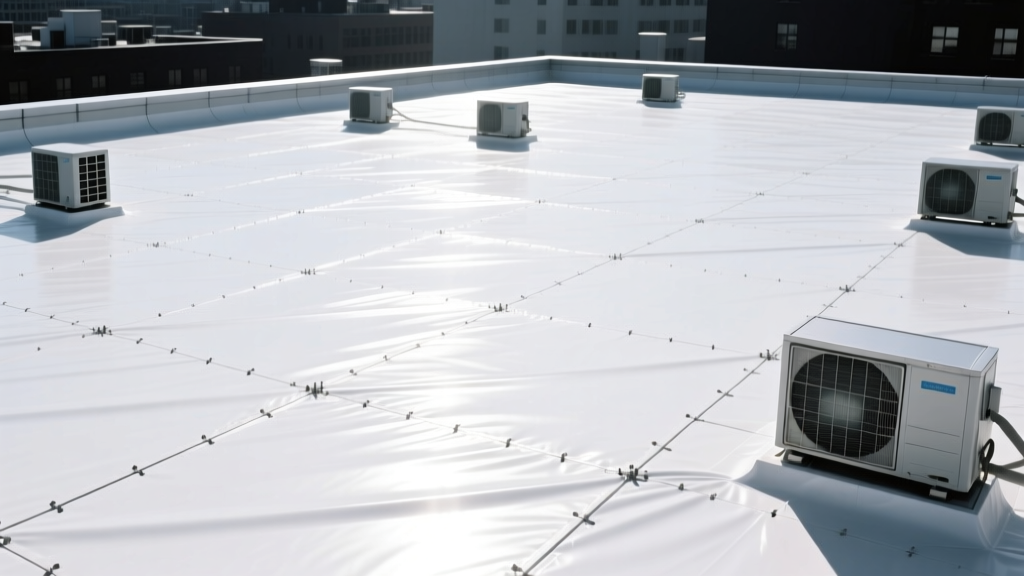
Hot & Arid Climates: UV Resistance and Thermal Shock
In regions like the American Southwest, roofs face relentless UV exposure and extreme thermal shock—where surface temperatures can swing from 160°F at midday to 70°F at night. PVC roofing material excels here primarily through its high Solar Reflectance Index (SRI).
- Initial SRI: 109 (Exceeds LEED and Energy Star minimums)
- 3-Year Aged SRI: 92 (Assuming standard atmospheric soiling)
- Thermal Expansion: ~1 inch per 100 feet per 100°F temperature change
To mitigate thermal shock in arid climates, the membrane must be allowed to move. Fully adhered systems using low-rise polyurethane adhesives are preferred over mechanically fastened systems in extreme heat zones, as they distribute thermal stress evenly across the substrate. Furthermore, specifying an 80-mil thickness rather than the standard 60-mil provides a thicker weathering layer, protecting the scrim reinforcement from long-term UV degradation. The U.S. Department of Energy notes that cool roofs like white PVC can reduce peak cooling demand by 10% to 15% in hot climates, significantly lowering HVAC lifecycle costs.
Cold & Snowy Regions: Flexibility and Cold-Weather Welding
Cold climates introduce two major threats to PVC: plasticizer migration and cold-weather welding failures. PVC relies on liquid plasticizers to remain flexible. If the membrane comes into direct contact with incompatible materials like expanded polystyrene (EPS) insulation, asphalt, or certain coal-tar pitch products, the plasticizers will leach out of the PVC. Once depleted, the membrane undergoes a glass transition, becoming brittle and shattering under the weight of snow removal equipment or foot traffic.
Installation in sub-freezing temperatures requires strict protocols. When ambient temperatures drop below 40°F, hot air welders must be recalibrated. Welding temperatures often need to increase to 1,150°F–1,250°F, and welder speed must decrease to ensure the heat penetrates the cold membrane. Roofers must perform destructive test welds every morning and after any weather change, using a silicone-tipped seam probe to verify the peel strength of the weld.
Coastal & High-Wind Zones: Salt Tolerance and Uplift Ratings
PVC is inherently immune to salt spray corrosion, making it vastly superior to metal roofing in coastal environments. However, coastal zones are synonymous with high wind uplift. The National Roofing Contractors Association (NRCA) emphasizes that wind uplift resistance is a function of the fastening pattern and edge detailing, not just the membrane's tensile strength.
| Zone | FM 1-90 (Standard Inland) | FM 1-120 (Coastal/Hurricane) | Structural Requirement |
|---|---|---|---|
| Field | 12 inches on center (o.c.) | 9 inches o.c. | Standard steel deck (Min 22 ga) |
| Perimeter | 8 inches o.c. | 6 inches o.c. | Enhanced edge securement |
| Corner | 6 inches o.c. | 4 inches o.c. (or fully adhered) | Reinforced parapet anchoring |
For FM 1-120 ratings in hurricane-prone regions, relying solely on mechanical fasteners in the corner zones is risky due to point-loading stress. The best practice is to transition to a fully adhered PVC system in the perimeter and corner zones, utilizing a high-tensile strength fleece-backed PVC membrane (such as Sika Sarnafil G or Carlisle SynTec) that distributes uplift forces across the entire surface area.
2026 Climate-Specific Cost Breakdown
The cost of PVC roofing material varies significantly based on the climate adaptations required. The baseline national average for a standard 60-mil mechanically attached PVC system is $10.50 to $13.00 per square foot installed. Below is the 2026 pricing matrix adjusted for regional climate requirements.
| Climate Zone | Required System Modifications | Estimated Installed Cost (per sq. ft.) |
|---|---|---|
| Moderate / Inland | 60-mil PVC, standard polyiso, mechanical fasteners | $10.50 - $12.50 |
| Hot / Arid (Southwest) | 80-mil PVC, fully adhered, high-SRI coatings | $13.00 - $15.50 |
| Cold / Alpine (Northeast) | 60-mil PVC, HDPE cover board, heavy snow guards | $12.50 - $14.75 |
| Coastal / Hurricane | Fleece-backed PVC, fully adhered corners, FM 1-120 | $15.00 - $18.50 |
Decision Matrix: Is PVC Right for Your Region?
Use this framework to determine if PVC roofing material is the optimal choice for your specific building envelope and regional climate.
- If your roof vents animal fats, oils, or grease (e.g., restaurants): Choose PVC. It is the only single-ply membrane chemically resistant to lipid degradation. TPO and EPDM will dissolve and fail.
- If you are in a region with severe hail (e.g., Texas, Midwest): Choose an 80-mil or 90-mil reinforced PVC, or pivot to a modified bitumen system. Standard 60-mil PVC will puncture under FM 4473 Class 3 or 4 hail impacts.
- If your building experiences significant structural settling or vibration: Choose a mechanically attached PVC system with loose-laid field sheets. The heat-welded seams will accommodate structural movement without tearing, whereas rigid adhered systems may delaminate.
- If you are retrofitting over an existing asphalt BUR roof: Choose PVC, but you MUST budget for a separation slip sheet or cover board. Direct contact with the old asphalt will destroy the PVC's plasticizers within 24 months.
Selecting the correct PVC formulation, thickness, and attachment method based on your local climate data ensures the membrane will achieve its projected 20- to 30-year lifecycle without catastrophic environmental failure.
Written by
David NakamuraDavid Nakamura is a licensed architect (AIA) and construction technology writer focused on sustainable building methods, mass timber engineering, and high-performance building envelopes. He holds a Master of Architecture from the University of Washington and is a certified Passive House Consultant (CPHC). David spent eight years at the Seattle firm Mithun, where he led the design of three LEED Platinum projects, before founding his own practice specializing in net-zero residential design. He serves on the editorial advisory board of GreenBuilder Magazine and has authored peer-reviewed papers on cross-laminated timber (CLT) connections for the Journal of Structural Engineering. In his spare time, David teaches woodworking at Pratt Fine Arts Center and kayaks the Puget Sound.
More from David Nakamura
View all
Construction Cost
Labor Cost to Build a Deck Per Sq Ft: 2026 Installation Guide
Discover the exact labor cost to build a deck per sq ft in 2026. This installation guide breaks down contractor rates, complexity factors, and hidden fees.
Aug 4, 2026

Construction Cost
How Much Does It Cost to Build a 3 Bedroom House? Financing Guide
Learn exactly how much it costs to build a 3 bedroom house and explore 2026 financing options, construction loan types, and budget frameworks for your build.
Aug 4, 2026

Construction Cost
Cost to Build a Tennis Court: 2026 Guide
How much does it cost to build a tennis court in 2026? Breakdowns for asphalt, concrete, and synthetic surfaces plus fencing and lighting.
Jul 30, 2026