Best Roof Material for Flat Roofs: 2026 Cost Guide
Compare 2026 costs for TPO, EPDM, PVC, and modified bitumen. Find the best roof material for flat roofs with our detailed pricing and lifespan guide.

The True Cost of Flat Roofing in 2026
Selecting the right roof material for flat roofs (technically classified as low-slope roofs with a pitch under 3:12) requires balancing upfront material costs, installation labor, and long-term lifecycle maintenance. Unlike steep-slope asphalt shingles that rely on gravity for water shedding, flat roofs demand continuous, watertight membranes. As of 2026, material prices have stabilized following post-pandemic supply chain fluctuations, but specialized roofing labor rates have increased by an average of 8% nationwide.
This cost breakdown analyzes the four primary commercial and residential flat roof systems: TPO, EPDM, PVC, and Modified Bitumen. All pricing reflects fully installed costs per square foot (100 square feet = 1 roofing square) for a standard 10,000 sq. ft. commercial or large residential footprint, including tear-off of one existing layer, standard polyiso insulation, and membrane installation.
TPO (Thermoplastic Polyolefin): The Commercial Standard
TPO dominates the North American low-slope market due to its balance of affordability, heat-welded seams, and reflective white surface. The Department of Energy notes that highly reflective cool roofs like white TPO can reduce peak cooling demand by 10-15%, directly impacting HVAC operational costs.
Material and Installation Costs
- Material Cost: $1.50 – $2.80 per sq. ft. (60-mil to 80-mil thickness)
- Labor & Installation: $3.00 – $5.50 per sq. ft.
- Total Installed Cost: $4.50 – $8.30 per sq. ft.
For premium applications, specify an 80-mil membrane like GAF EverGuard Extreme. The thicker scrim provides superior puncture resistance against hail and foot traffic from HVAC maintenance crews. Mechanically attached TPO is the cheapest installation method, but fully adhered TPO (using bonding adhesive) adds $1.50 per sq. ft. while eliminating wind billowing and providing a firmer substrate for hail impact.
Failure Modes and Edge Cases
Early-generation TPO (pre-2015) suffered from UV degradation and seam splitting. Modern formulations include enhanced UV stabilizers. However, TPO remains vulnerable to ponding water if the roof deck lacks adequate taper. If your roof has areas that hold water for more than 48 hours after rainfall, TPO warranties are often voided by the manufacturer.
EPDM (Ethylene Propylene Diene Monomer): The Budget Membrane
EPDM is a synthetic rubber membrane renowned for its extreme temperature tolerance and longevity. It is available in black (which absorbs heat, beneficial in northern climates) and white (which reflects heat but costs roughly 20% more due to specialized titanium dioxide coatings).
Pricing Breakdown
- Material Cost: $1.20 – $2.20 per sq. ft. (45-mil to 60-mil thickness)
- Labor & Installation: $2.80 – $4.80 per sq. ft.
- Total Installed Cost: $4.00 – $7.00 per sq. ft.
A 60-mil Firestone RubberGard EPDM system is the industry benchmark. While the membrane itself is the cheapest on the market, the labor cost can escalate depending on the seaming method. Liquid-applied seam tapes and primers require meticulous surface preparation; rushed seam work is the number one cause of EPDM leaks.
Seam Vulnerabilities
Unlike TPO and PVC, which are heat-welded into a monolithic surface, EPDM seams are chemically bonded with tape and adhesive. Over a 20-year lifespan, thermal expansion and contraction can fatigue these taped seams. To mitigate this, specify a fully adhered 60-mil system and budget an extra $0.60 per linear foot for EPDM cover tape over all primary seams.
PVC (Polyvinyl Chloride): Premium Chemical Resistance
PVC membranes are the undisputed choice for flat roofs over restaurants, commercial kitchens, and chemical processing facilities. The material is inherently resistant to animal fats, oils, and industrial exhaust, which will rapidly degrade TPO and EPDM.
Cost vs. ROI
- Material Cost: $3.50 – $6.00 per sq. ft. (50-mil to 80-mil thickness)
- Labor & Installation: $4.00 – $6.50 per sq. ft.
- Total Installed Cost: $7.50 – $12.50 per sq. ft.
Premium PVC systems like Sika Sarnafil G 410 or Johns Manville PVC utilize hot-air welding that creates seams actually stronger than the membrane itself. While the upfront cost is 30-40% higher than TPO, the lifecycle cost in grease-heavy environments is vastly lower because the membrane will not blister or dissolve when exposed to lipid exhaust.
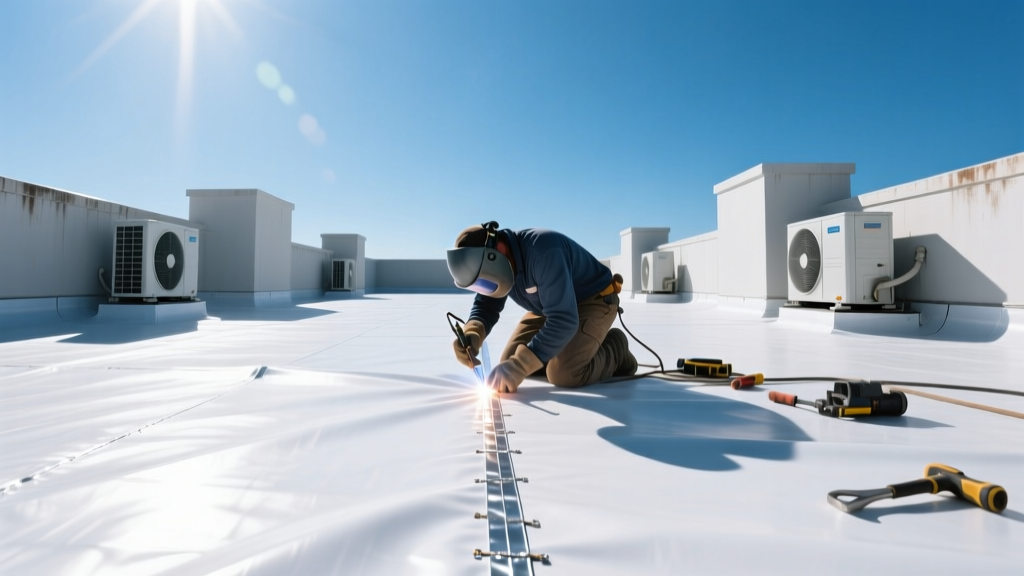
Modified Bitumen (Mod-Bit): The Heavy-Duty Overlay
Modified bitumen bridges the gap between traditional built-up roofing (BUR) and single-ply membranes. It consists of asphalt modified with either SBS (synthetic rubber) for cold-weather flexibility or APP (plastic) for high-temperature flow resistance, typically reinforced with polyester or fiberglass mats.
Torch-Down vs. Peel-and-Stick Pricing
- Material Cost: $1.80 – $3.50 per sq. ft. (Base ply + Granular Cap Sheet)
- Labor & Installation: $3.50 – $6.00 per sq. ft.
- Total Installed Cost: $5.30 – $9.50 per sq. ft.
SBS torch-applied systems (like GAF GlenGuard SBS) offer exceptional puncture resistance due to their multi-ply thickness, often exceeding 160 mils when combined. However, torch applications require specialized insurance and carry a fire risk during installation. Cold-process adhesives or self-adhered (peel-and-stick) Mod-Bit systems eliminate the fire hazard but add $0.80 to $1.20 per sq. ft. in material costs and require strict ambient temperature minimums (usually 40°F and rising) for proper adhesion.
Hidden Cost Variables: Decking, Insulation, and Cover Boards
Amateur cost estimators often quote only the membrane and insulation, leading to severe budget overruns. A professional 2026 flat roof specification must include the following hidden structural components:
1. Polyiso Insulation and Tapering
Standard flat polyiso board (R-6.5 per inch) costs roughly $0.40 per sq. ft. per inch of thickness. However, if your structural deck lacks a natural slope, you must install tapered polyiso to create a minimum 1/4:12 pitch for drainage. Tapered insulation systems require complex layout engineering and can increase insulation costs by 40-60% compared to flat stock.
2. Cover Boards
A cover board is a thin, high-density substrate installed between the insulation and the membrane. Using a 1/4-inch Georgia-Pacific DensDeck Prime (gypsum) or HD Polyiso cover board adds $0.85 to $1.30 per sq. ft. Do not skip this step. Cover boards protect the fragile polyiso insulation from hail, provide a fire-resistant barrier, and create a smooth, stable surface for fully adhered membranes. Most premium manufacturer warranties (e.g., 20-year NDL) mandate a cover board.
3. Edge Metal and Drainage
According to the National Roofing Contractors Association (NRCA), up to 60% of flat roof leaks occur at the perimeters and penetrations. Budget $6.00 to $12.00 per linear foot for heavy-gauge aluminum or steel edge coping, and $450 to $800 per interior roof drain for proper plumbing tie-ins and lead flashing.
Decision Framework: Which Material Fits Your Budget?
Use the matrix below to align your specific building requirements with the most cost-effective roof material for flat roofs in your scenario.
| Material | Avg. Installed Cost (Sq. Ft.) | Expected Lifespan | Best Application Scenario |
|---|---|---|---|
| TPO (60-80 mil) | $4.50 - $8.30 | 15 - 25 Years | Standard commercial boxes, retail, warehouses with good drainage. |
| EPDM (60 mil) | $4.00 - $7.00 | 20 - 30 Years | Budget-conscious projects, northern climates (black EPDM), simple geometries. |
| PVC (50-80 mil) | $7.50 - $12.50 | 20 - 30+ Years | Restaurants, chemical plants, roofs exposed to grease or jet fuel. |
| Mod-Bit (SBS/APP) | $5.30 - $9.50 | 15 - 25 Years | High foot-traffic roofs, residential flat additions, heavy hail zones. |
When soliciting bids, require contractors to itemize the membrane brand and thickness, insulation R-value and tapering strategy, cover board inclusion, and the specific attachment method (mechanically attached vs. fully adhered). The lowest bid almost always omits the cover board and utilizes 45-mil membranes with mechanically attached plates, which will drastically reduce the roof's hail rating and wind uplift resistance. Investing in an 80-mil fully adhered system with a high-density cover board yields the highest long-term ROI by preventing catastrophic interior water damage and delaying full replacement by a decade or more. For further reading on mitigating urban heat islands through reflective membrane selection, consult the EPA's Heat Island Effect guidelines.
Written by
Elena RodriguezElena Rodriguez is a civil engineer and technical writer specializing in concrete technology, masonry systems, and ASTM/ACI compliance. She earned her B.S. in Civil Engineering from Texas A&M University and spent a decade at a materials testing laboratory, performing over 2,000 concrete compressive strength tests and masonry prism evaluations. Elena is an ACI-certified Field Testing Technician (Grade I) and a member of ASTM Committee C12 on Natural Building Stone. She currently consults on forensic engineering cases involving concrete failures and moisture intrusion. Based in San Antonio, TX, Elena is a proud member of the Society of Women Engineers (SWE) and coaches her daughter's FIRST Robotics team.
More from Elena Rodriguez
View all
Walls & Panels
Cost Analysis: Light Gauge Steel Framing Advantages and Disadvantages
Evaluate light gauge steel framing advantages and disadvantages through a strict cost analysis lens, comparing material, labor, and lifecycle expenses.
Aug 4, 2026

Walls & Panels
Gypsum Board Types: Exact Specifications, Thickness & Dimensions
Compare standard, Type X, and moisture-resistant gypsum board types. Get exact specifications, thicknesses, dimensions, and ASTM standards for your project.
Aug 4, 2026

Fire Resistance
Best Fire-Resistant Outdoor Decking Materials: 2026 Buyer Guide
Discover the best fire-resistant outdoor decking materials for 2026. Compare Class A PVC, aluminum, and hardwood options for WUI compliance and safety.
Aug 4, 2026