What Is PVC Roofing Material? Costs, Pros, and Installation
Discover what PVC roofing material is, including 2026 costs, hot-air welding installation steps, and how it compares to TPO and EPDM for flat roofs.

The Molecular and Physical Anatomy of PVC Membranes
When commercial architects and facility managers ask, "what is PVC roofing material," they are referring to Polyvinyl Chloride, a highly engineered thermoplastic single-ply membrane designed specifically for low-slope and flat commercial roofs. Unlike thermoset membranes (such as EPDM) that cure and cannot be re-melted, PVC is thermoplastic. This means it can be repeatedly softened with heat and hardened upon cooling, a property that makes its seams inherently stronger than the membrane itself when hot-air welded.
A high-quality commercial PVC membrane is not a single sheet of plastic; it is a complex, multi-layered composite. According to the National Institute of Building Sciences, modern reinforced PVC membranes consist of three distinct layers:
- Top Ply (Weathering Layer): Formulated with high concentrations of UV stabilizers, biocides, and titanium dioxide (TiO2) to reflect solar radiation and resist microbial growth. This layer is typically highly reflective, meeting Department of Energy standards for cool roofing.
- Reinforcement Scrim (Core): A woven polyester or fiberglass mat encapsulated in the center. This scrim provides dimensional stability, preventing the membrane from shrinking or expanding wildly with temperature fluctuations, and offers high tensile strength to resist wind uplift.
- Bottom Ply (Welding Layer): Formulated to be highly receptive to heat. It contains a higher concentration of plasticizers to ensure it melts uniformly and fuses completely with adjacent sheets during installation.
PVC vs. TPO vs. EPDM: Commercial Flat Roof Matrix
Understanding PVC requires comparing it to its primary competitors in the single-ply market: TPO (Thermoplastic Polyolefin) and EPDM (Ethylene Propylene Diene Monomer). Each material has distinct chemical properties that dictate its ideal use case.
| Feature | PVC (Polyvinyl Chloride) | TPO (Polyolefin) | EPDM (Rubber) |
|---|---|---|---|
| Seam Integrity | Excellent (Hot-air welded, monolithic) | Good (Hot-air welded, but sensitive to temperature) | Fair (Tape or adhesive, prone to failure over time) |
| Chemical Resistance | Superior (Resists animal fats, oils, grease) | Moderate (Can degrade with heavy oil exposure) | Poor (Oils and grease cause severe swelling) |
| Average Lifespan | 25 to 30+ years | 15 to 25 years | 20 to 30 years |
| Ponding Water | Highly resistant | Resistant, but seams may wick | Highly resistant |
The Restaurant Factor: Why PVC Dominates Food Service
The most critical differentiator for PVC is its chemical resistance to hydrocarbons, animal fats, and vegetable oils. Exhaust vents from commercial kitchens expel aerosolized grease that settles on the roof. When this grease accumulates on TPO or EPDM membranes, it breaks down the molecular bonds, causing the roof to blister, soften, and eventually leak. PVC is practically immune to these lipids. If you are roofing a restaurant, food processing plant, or any facility with kitchen exhaust hoods, PVC is not just an option; it is the required specification.
Hot-Air Welding: The Secret to Leak Resistance
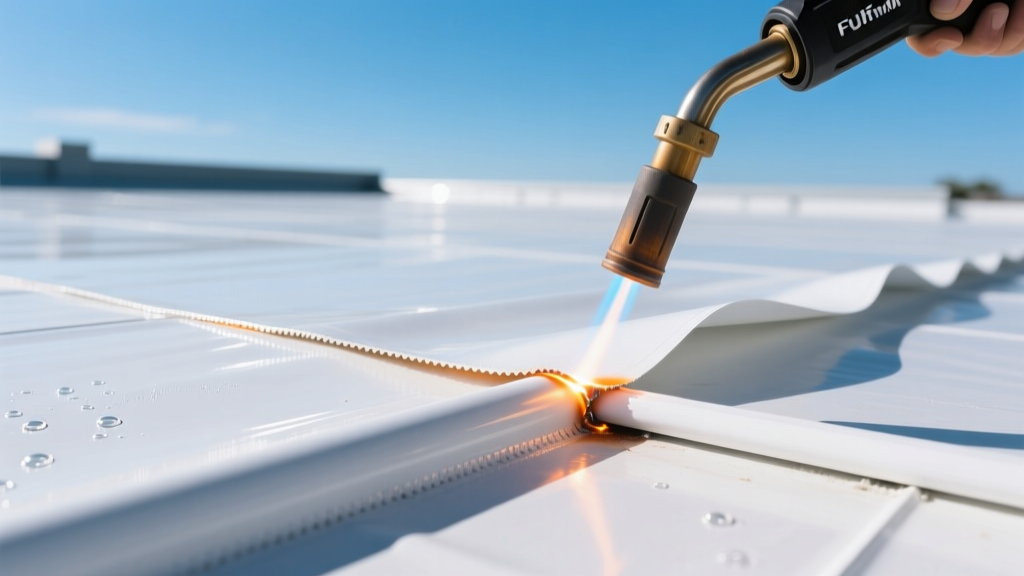
The installation methodology for PVC is what guarantees its long-term watertight performance. Instead of using chemical adhesives or double-sided tapes, contractors use specialized hot-air welders (such as the Leister VARIMAT V2 for field seams and Leister Triac for detail work) to fuse the sheets together.
- Surface Preparation: The seam area (typically a 3-inch overlap) must be completely free of dust, moisture, and plasticizer exudation. Installers wipe the seam with a specialized PVC cleaner before welding.
- Thermal Fusion: The automatic welder blows air heated between 900°F and 1,100°F directly into the seam while a silicone pressure roller immediately compresses the molten layers together.
- Seam Verification: After the seam cools (which takes seconds), the installer performs a "probe test" using a blunt cotter pin or specialized seam probe, dragging it along the edge of the weld. If the probe catches, it indicates a void or cold weld that must be patched immediately.
Hot-air welding parameters must be adjusted based on the weather. Welding at 900°F on a 40°F morning will result in a "cold weld" that will peel apart. Conversely, using the same heat on a 95°F afternoon will scorch and burn the membrane, destroying the top ply's UV stabilizers. Roofers must perform test welds every morning and after any significant temperature shift.
Real-World Costs and ROI Breakdown
PVC is generally the most expensive of the three major single-ply membranes, but its lifecycle cost often justifies the initial premium. Below is a breakdown of typical installed costs for a standard commercial flat roof in 2026, assuming a 60-mil mechanically attached system over polyisocyanurate insulation.
- PVC Membrane (60-mil): $1.80 – $2.60 per sq. ft.
- Polyiso Insulation (2 layers, R-25): $1.20 – $1.80 per sq. ft.
- Fasteners, Plates, and Flashing: $0.60 – $0.90 per sq. ft.
- Labor and Equipment: $2.50 – $3.50 per sq. ft.
- Total Installed Cost: $6.10 – $8.80 per sq. ft.
While TPO might save $1.00 to $1.50 per square foot upfront, the Environmental Protection Agency (EPA) notes that highly reflective white PVC roofs can reduce peak cooling energy demand by up to 15%. Over a 25-year lifespan, the energy savings and the avoidance of seam-failure repairs easily eclipse the initial material premium.
Critical Failure Modes and Incompatibilities
Despite its strengths, PVC has specific vulnerabilities that must be managed during the design and installation phases. Ignoring these will lead to catastrophic membrane failure.
1. Plasticizer Migration and Polystyrene Insulation
PVC requires chemical plasticizers to remain flexible. Expanded Polystyrene (EPS) and Extruded Polystyrene (XPS) insulation boards act as a sponge for these plasticizers. If PVC is installed directly over EPS or XPS, the insulation will extract the plasticizers from the membrane. Within a few years, the PVC will lose its flexibility, become brittle, and shatter under foot traffic or thermal movement. Rule: Never install PVC directly over polystyrene insulation. Always use a separation layer, such as a fleece-backed membrane or a fiberglass mat slip sheet, or stick to Polyiso insulation.
2. Asphalt and Bitumen Incompatibility
PVC is chemically incompatible with asphalt, coal tar, and bitumen. If you are re-covering an existing built-up roof (BUR) or modified bitumen roof, the old asphalt must be completely removed, or a thick separation board (like high-density polyiso or gypsum cover board) must be installed to prevent the bitumen oils from migrating into the PVC and causing it to degrade.
3. Wind Uplift at Perimeters
Because PVC is often mechanically attached (screwed and plated into the deck), the edges and corners of the roof are highly susceptible to wind uplift. Contractors must increase the fastener density in the perimeter and corner zones according to ANSI/SPRI RP-4 standards to prevent the roof from peeling off during severe storms.
Strategic Selection: When to Specify PVC
PVC roofing material is the undisputed champion for commercial facilities with high chemical, grease, or oil exposure, as well as for buildings prioritizing high-reflectivity cool roof metrics and monolithic seam integrity. While the upfront material cost is higher than TPO, the proven track record of hot-air welded seams and chemical resistance makes it the most reliable, low-maintenance choice for complex commercial flat roofs.
Written by
James ThorntonJames Thornton is a construction industry veteran with 25 years of hands-on experience in wood framing, lumber grading, and residential building codes. He started as a framing carpenter in rural Oregon, earned his ICC Residential Building Inspector certification, and eventually became a senior plan reviewer for the City of Portland Bureau of Development Services. James holds a B.S. in Wood Science & Technology from Oregon State University and is a certified lumber grader through the West Coast Lumber Inspection Bureau (WCLIB). He has inspected over 3,000 residential construction sites and authored the city's internal guide on advanced framing techniques (2x6 at 24" O.C.). James lives in Bend, OR, where he builds custom timber-frame cabins and competes in lumberjack sports.
More from James Thornton
View all
Insulation
Best Home Insulation Materials: Complete 2026 Guide
Compare top home insulation materials for 2026. Find R-values, installed costs per square foot, and best uses for fiberglass, spray foam, and mineral wool.
Aug 4, 2026

Sustainable Building
Certify Your Green Building Material for LEED and WELL
Step-by-step guide to certifying a green building material for LEED v5 and WELL v2. Master EPDs, HPDs, and VOC limits for 2026 project specifications.
Aug 4, 2026

Stone & Masonry
Veneer Stacked Stone Panels: Interior Design & Style Showcase
Discover how veneer stacked stone panels transform interiors. Explore modern design profiles, material pairings, and technical installation specs.
Aug 4, 2026