How to Choose PVC Roofing Materials: A Commercial Selection Guide
Master our PVC roofing materials selection framework. Compare mil thicknesses, reinforcement types, and attachment methods for commercial flat roofs.

The PVC Roofing Materials Selection Matrix
Selecting the correct polyvinyl chloride (PVC) single-ply membrane requires moving beyond basic color choices and evaluating the structural demands of the building envelope. PVC membranes are engineered for low-slope and flat commercial roofs, offering superior resistance to punctures, chemicals, and fire. However, specifying the wrong thickness or reinforcement scrim can lead to premature membrane failure, particularly in high-wind or high-thermal-shock environments. According to the National Roofing Contractors Association (NRCA), proper material selection must align with the building's geographic wind zone, deck type, and intended roof traffic.
The foundational decision in any PVC specification is membrane thickness, measured in mils (thousandths of an inch). While 45-mil membranes exist for budget-conscious light commercial projects, the industry standard for durable, warrantable commercial applications has shifted heavily toward 60-mil and 80-mil profiles.
| Mil Thickness | Tensile Strength (ASTM D4434) | Primary Application Profile | Warrantable Life Expectancy |
|---|---|---|---|
| 45-Mil | ~200 lbf/in | Light commercial, low-traffic, budget-restricted retrofits | 10 - 15 Years |
| 50-Mil | ~220 lbf/in | Standard commercial, moderate roof traffic | 15 - 20 Years |
| 60-Mil | ~250 lbf/in | Heavy commercial, high wind uplift, standard new construction | 20 - 25 Years |
| 80-Mil | ~300+ lbf/in | Severe hail zones, heavy HVAC maintenance traffic, critical facilities | 25 - 30+ Years |
Reinforcement Scrim: Polyester vs. Fiberglass
The internal reinforcement layer, or scrim, dictates how the PVC membrane handles dimensional stability and tensile stress. Specifying the correct scrim is entirely dependent on your chosen attachment method and local thermal fluctuation ranges.
Polyester Reinforced (PAC)
Polyester scrims provide high tensile strength and elongation properties. This makes polyester-reinforced PVC the mandatory choice for mechanically attached systems. When wind uplift creates negative pressure, the membrane billows between fastener rows; the polyester scrim absorbs this dynamic stress without tearing at the fastener plates. It is also highly forgiving during installation in varying temperatures, allowing the material to relax and lay flat.
Fiberglass Reinforced (PIB)
Fiberglass scrims offer near-zero thermal expansion and contraction. If your design specifies a fully adhered system (glued directly to the substrate), fiberglass-reinforced PVC is superior. It prevents the membrane from wrinkling or pulling away from parapet walls and penetrations during extreme summer heat or winter freezes. However, fiberglass lacks the elongation of polyester, making it unsuitable for mechanical attachment where billowing occurs.
Attachment Method Decision Framework
The attachment method bridges the membrane to the roof deck. Your selection must satisfy local building codes for wind uplift, often calculated using the Single-Ply Roofing Industry (SPRI) ANSI/SPRI WD-1 wind design standard.
Fully Adhered Systems
Mechanism: Membrane is bonded to the insulation or deck using low-VOC water-based or solvent-based adhesives, or fleece-backed self-adhering technologies.
Best For: Buildings with strict height restrictions (no ballast allowed), complex roof geometries with numerous penetrations, and structures requiring the highest wind uplift ratings (up to 150+ psf in coastal zones).
Trade-off: Highest material and labor cost; highly dependent on ambient temperature and humidity during adhesive curing.
Mechanically Attached Systems
Mechanism: Membrane is secured using engineered screws and barbed plates along the seams, with the subsequent sheet overlapping and heat-welding over the fasteners.
Best For: Large, open, rectangular roof planes (e.g., big-box retail, warehouses) where speed of installation is critical. Steel or wood decks that can reliably hold fastener pull-out loads.
Trade-off: Susceptible to billowing; requires precise fastener spacing calculations based on perimeter vs. field wind zones.
Ballasted Systems
Mechanism: Membrane is laid loose over the substrate and held in place by river-washed stone or concrete pavers (typically 10 to 15 lbs per square foot).
Best For: Roofs with high load-bearing capacity, minimal slope, and a desire to protect the membrane from UV and physical damage. Excellent for creating rooftop amenity decks.
Trade-off: Adds immense dead load to the building structure; makes leak detection and repair significantly more difficult as the ballast must be moved.
Formulation Nuances: Standard PVC vs. KEE
Not all PVC roofing materials are chemically identical. Standard PVC relies on liquid plasticizers to maintain flexibility. Over 15 to 20 years, these liquid plasticizers can migrate out of the membrane, leading to embrittlement, shrinkage, and seam failure. To counter this, advanced formulations utilize Ketone Ethylene Ester (KEE) polymers, governed by ASTM D6754.
KEE is a solid-state polymer modifier (used prominently in premium lines like Sika Sarnafil) that replaces liquid plasticizers. KEE-modified PVC membranes retain their flexibility indefinitely, resist plasticizer extraction from standing water or chemical exposure, and offer vastly superior long-term weldability. When specifying for critical infrastructure, hospitals, or buildings where a 30-year lifecycle is expected, mandating a KEE-modified PVC formulation provides a massive return on investment despite a 15-25% higher upfront material cost.
Environmental & Chemical Exposure Profiling
PVC's molecular structure makes it uniquely suited for specific hostile rooftop environments where other single-ply membranes (like EPDM or TPO) degrade rapidly.
- Animal Fats and Oils: Restaurants with rooftop grease exhaust vents must use PVC. Hydrocarbon-based fats and oils cause EPDM rubber to swell, dissolve, and fail. PVC is chemically inert to these compounds.
- Jet Fuel and Hydrocarbons: Facilities near airports or with helipads require PVC or KEE-PVC, as aviation fuel will instantly compromise the integrity of standard rubber membranes.
- High Solar Reflectance: White PVC membranes inherently reflect solar radiation. According to the U.S. Department of Energy, cool roofs with high Solar Reflectance Index (SRI) values significantly reduce urban heat island effects and lower peak cooling loads by up to 15%. PVC naturally maintains a high SRI over its lifespan compared to materials that yellow or chalk excessively.
Installation & Welding Tolerances
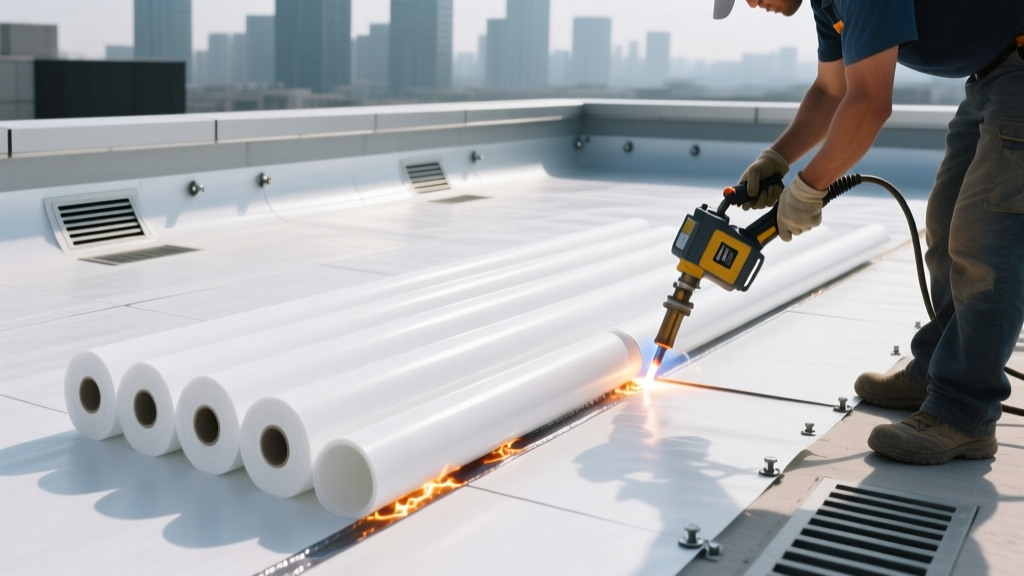
The primary advantage of PVC roofing materials is the hot-air welded seam, which creates a monolithic, continuous bond that is physically stronger than the membrane itself. However, this requires strict adherence to welding parameters.
Automatic robotic welders must be calibrated daily to maintain air temperatures between 950°F and 1,150°F, depending on ambient conditions and wind speed. The welding speed typically ranges from 8 to 12 feet per minute. Hand-welding at penetrations and inside corners requires a wedge nozzle and a silicone pressure roller, applying consistent downward force while the PVC is in its semi-liquid state. Quality assurance mandates that every linear foot of seam be tested with a blunt-nosed seam probe; any catch or void requires an immediate patch weld. Properly executed PVC seams will not wick moisture, eliminating the primary failure point found in taped or adhered seam systems.
Written by
Marcus ChenMarcus Chen is a licensed structural engineer (PE) and building materials analyst with over 12 years of experience across residential, commercial, and industrial construction. He holds a Master of Science in Civil Engineering from UC Berkeley and spent six years at Thornton Tomasetti before transitioning to independent consulting and technical writing. Marcus specializes in material selection for seismic-prone regions, concrete reinforcement strategies, and lifecycle cost analysis. His work has been cited by the American Concrete Institute (ACI) and the Structural Engineers Association of California (SEAOC). When he is not on a job site or at his desk, you will find him hiking the Sierra Nevada or restoring a 1920s craftsman bungalow in Oakland, CA.
More from Marcus Chen
View all
Construction Cost
How Much Did the Eiffel Tower Cost to Build?
How much did the Eiffel Tower cost to build in 1889? We adjust for inflation and compare its budget to modern skyscraper construction.
Aug 4, 2026

Fire Resistance
What Is a Fire Resistant Material? Testing & Certification Guide
Discover what is a fire resistant material through ASTM and UL testing. Learn how fire ratings, certifications, and assemblies work in construction.
Aug 4, 2026

Construction Cost
How Much Did the Burj Khalifa Cost to Build?
How much did the Burj Khalifa cost to build? We break down the $1.5B project and extract 5 money-saving strategies for your next build.
Jul 30, 2026