Rubber RV Roof Material Selection Framework: EPDM vs TPO
Compare EPDM, TPO, and PVC rubber RV roof materials. Use our selection framework to choose the right membrane, liquid coating, and adhesive.

The Dynamics of RV Roofing: Why Material Selection is Critical
Unlike residential roofing, an RV roof operates in a highly dynamic environment. It must withstand continuous flexing during highway transit at 65 mph, extreme thermal expansion from direct UV exposure, and the structural twisting of a chassis on uneven campgrounds. Selecting the correct rubber RV roof material is not merely about waterproofing; it is about matching the membrane's physical properties to your specific travel profile, climate, and maintenance tolerance.
This framework evaluates the three primary single-ply membranes—EPDM, TPO, and PVC—alongside liquid rubber overlays, providing actionable specifications, 2026 market pricing, and failure-mode analysis to guide your purchase and installation decisions.
Membrane Contenders: Technical Specifications and Performance
The RV industry relies almost exclusively on single-ply synthetic rubber and thermoplastic membranes. While often grouped colloquially as 'rubber roofs,' their chemical compositions dictate vastly different lifespans and installation methodologies.
| Material | Chemical Base | Standard Thickness | Seam Method | Expected Lifespan | UV & Heat Resistance |
|---|---|---|---|---|---|
| EPDM | Ethylene Propylene Diene Monomer | 0.027' to 0.040' | Lap sealant / Tape | 10-15 years | Moderate (Black oxidizes/chalks) |
| TPO | Thermoplastic Polyolefin | 0.045' to 0.060' | Heat-welded | 15-20+ years | High (Highly reflective white) |
| PVC | Polyvinyl Chloride | 0.040' to 0.050' | Heat-welded / Solvent | 15-20+ years | High (Retains cold flexibility) |
EPDM: The Traditional Workhorse
EPDM remains the most common OEM rubber RV roof material due to its low manufacturing cost and high puncture resistance. However, traditional black EPDM sheds carbon black as it cures, leading to the infamous 'black streaks' on RV sidewalls. While white EPDM exists, it features a black backing that can absorb heat and transfer it into the RV interior if the lamination is thin. EPDM seams rely on chemical bonding via primers and lap sealants (like Dicor 501LSW-1), which remain the primary failure point over time.
TPO: The Modern Standard for Thermal Efficiency
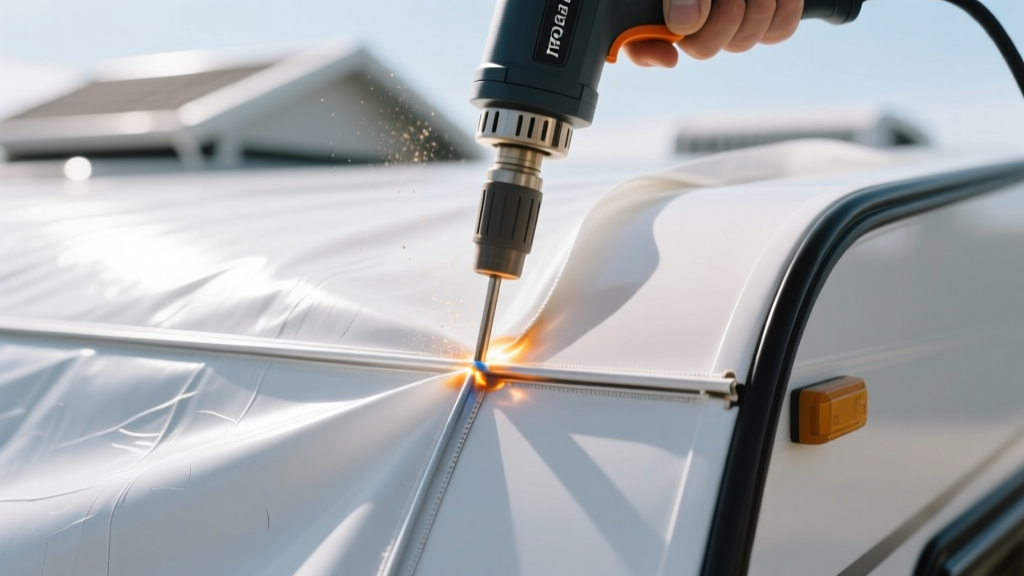
TPO (such as Alpha Systems SuperFlex) has largely replaced EPDM in mid-to-high-tier RV manufacturing. Its primary advantage is the heat-welded seam. Using a hot air gun at 900°F to 1,100°F, TPO seams fuse into a single monolithic piece, eliminating the reliance on chemical sealants for longitudinal joins. Furthermore, TPO's high solar reflectance index (SRI) meets EPA Energy Star cool roof criteria, reducing interior cooling loads by up to 15% in summer months.
PVC: The Extreme Climate Specialist
PVC membranes utilize plasticizers to maintain flexibility. While TPO can become brittle in sub-zero temperatures, PVC remains pliable well below 0°F, making it the superior choice for RVers who frequently camp in extreme winter conditions or store their rigs in unheated northern climates.
Decision Tree: Matching Material to Your RV Profile
Use the following framework to select the optimal rubber RV roof material based on your operational parameters.
Profile A: Budget-Conscious / Weekend Warrior
Recommendation: 0.027' EPDM with an acrylic UV topcoat.
Rationale: If your RV is stored under cover and used less than 30 days a year, the premium for TPO is difficult to justify. Standard EPDM provides adequate waterproofing. Apply a liquid ceramic or acrylic coating every 4-5 years to halt UV oxidation and prevent the chalky degradation.
Profile B: Full-Timer / Hot Climate / Solar Heavy
Recommendation: 0.060' TPO (Fully Adhered).
Rationale: Full-timers in the Southwest subject their roofs to relentless UV and thermal cycling. TPO's heat-welded seams will not melt or degrade under the intense heat that softens EPDM lap sealants. The thicker 0.060' gauge provides the necessary puncture resistance for walking on the roof to service solar panels and HVAC units. Source TPO from specialized suppliers like Alpha Systems RV to ensure you receive UV-stabilized formulations designed specifically for vehicular flexing, rather than commercial building TPO.
Profile C: Four-Season / Extreme Cold Weather
Recommendation: PVC Membrane or TPO with a specialized cold-weather liquid overlay.
Rationale: Standard TPO can suffer from micro-cracking if walked on or subjected to heavy snow loads at temperatures below 10°F. PVC's plasticizer matrix prevents this cold-cracking, ensuring the roof remains pliable during winter deployments.
Liquid Rubber Coatings: The Overlay Alternative
If your existing rubber RV roof material is structurally sound but suffering from micro-leaks, oxidized EPDM, or failing lap sealants, a complete tear-off is unnecessary. Liquid rubber coatings provide a seamless, monolithic barrier.
- Budget Option (Acrylic/Elastomeric): Products like Heng's Rubber Roof Coating cost approximately $1.20 per square foot. They require strict surface preparation (cleaning with TSP and etching) and must be reapplied every 3-5 years. They are breathable, allowing trapped moisture to escape.
- Premium Option (True Liquid EPDM/Polyurethane): Products like Liquid Rubber EPDM Primer and Topcoat cost $2.50 to $3.50 per square foot. These require a specialized primer to bond to existing silicone or oxidized surfaces but offer a permanent, 20-year waterproof seal that cures into a thick, flexible rubber mat.
2026 Cost Analysis and Lifecycle ROI
Pricing for RV roofing materials has stabilized following the supply chain disruptions of the early 2020s, though specialized adhesives and TPO resins remain at a premium. The following table outlines the material and professional installation costs per square foot for a standard 30-foot travel trailer (approx. 300 sq. ft. roof area).
| Material System | Material Cost (per sq. ft.) | Adhesive & Sealant Cost | Professional Labor (per sq. ft.) | Total Project Cost (300 sq. ft.) |
|---|---|---|---|---|
| 0.027' EPDM | $1.40 - $1.80 | $0.60 | $2.50 - $3.50 | $1,350 - $1,770 |
| 0.045' TPO | $2.20 - $2.80 | $0.85 | $3.50 - $4.50 | $1,965 - $2,445 |
| 0.060' TPO | $2.90 - $3.50 | $0.85 | $3.50 - $4.50 | $2,175 - $2,655 |
| Liquid Rubber Overlay | $1.50 - $3.00 | $0.20 (Primer) | $1.50 - $2.50 | $960 - $1,710 |
Note: DIY installation eliminates the labor cost but requires precision. A 30-foot TPO roof requires approximately 4 gallons of water-based contact adhesive (e.g., Alpha Systems 8011) and 12-15 tubes of self-leveling lap sealant for the perimeter and penetrations.
Critical Failure Modes and Edge Cases
Understanding how rubber RV roof materials fail is essential for preventative maintenance. Avoid these common pitfalls:
1. The 'Ponding Water' Vulnerability
RV roofs are rarely perfectly flat; they feature intentional crowns or subtle slopes. However, sagging between roof trusses can create low spots. EPDM is highly susceptible to ponding water if the underlying scrim is exposed or if the membrane is stretched too thin during installation. Over time, standing water degrades the EPDM polymers. TPO and PVC are virtually impervious to standing water, making them mandatory for older RVs with compromised roof decking.
2. Adhesive Delamination (The 'Balloon' Effect)
When driving at highway speeds, air flows over the roof, creating uplift. If a fully adhered roof is installed using the wrong adhesive, or if the adhesive is applied in high humidity without proper flash-off time, the membrane can detach. This creates a 'balloon' effect, where the roof lifts while driving, eventually tearing at the seams. Fix: Always use water-based contact adhesives specifically formulated for RV membranes (like Dicor Water-Based Adhesive or Apollo 9000). Apply adhesive to BOTH the roof deck and the back of the membrane, allow it to flash off until tacky, and use a heavy weighted roller to ensure microscopic bonding.
3. Incompatible Sealants
Using silicone-based sealants on an EPDM or TPO roof is a catastrophic error. Silicone does not chemically bond to these membranes; it merely sits on the surface and will eventually peel, allowing water ingress. Furthermore, once silicone is applied, no other sealant or liquid coating will stick to that area. Rule: Only use sealants approved by the membrane manufacturer. For Dicor and Alpha membranes, this means using butyl-based or specialized polyurethane/acrylic formulations like Dicor 501LSW-1 (horizontal) and 551LSW-1 (vertical).
Installation Standards and Sourcing
When sourcing your rubber RV roof material, avoid commercial roofing suppliers unless you can verify the membrane's formulation. Commercial EPDM often contains fire retardants and lacks the specific UV stabilizers required for the vehicular market. Always source through certified RV distributors or direct from OEM manufacturers like Alpha Systems or Carlisle (Syntec division). Ensure your roof decking (usually 3/8' or 1/2' exterior-grade plywood or OSB) is completely dry, sanded smooth, and free of oils or old butyl tape residue before applying the new membrane. A flawless substrate is the prerequisite for a 20-year roof lifecycle.
Written by
Marcus ChenMarcus Chen is a licensed structural engineer (PE) and building materials analyst with over 12 years of experience across residential, commercial, and industrial construction. He holds a Master of Science in Civil Engineering from UC Berkeley and spent six years at Thornton Tomasetti before transitioning to independent consulting and technical writing. Marcus specializes in material selection for seismic-prone regions, concrete reinforcement strategies, and lifecycle cost analysis. His work has been cited by the American Concrete Institute (ACI) and the Structural Engineers Association of California (SEAOC). When he is not on a job site or at his desk, you will find him hiking the Sierra Nevada or restoring a 1920s craftsman bungalow in Oakland, CA.
More from Marcus Chen
View all
Construction Cost
How Much Did the Eiffel Tower Cost to Build?
How much did the Eiffel Tower cost to build in 1889? We adjust for inflation and compare its budget to modern skyscraper construction.
Aug 4, 2026

Fire Resistance
What Is a Fire Resistant Material? Testing & Certification Guide
Discover what is a fire resistant material through ASTM and UL testing. Learn how fire ratings, certifications, and assemblies work in construction.
Aug 4, 2026

Construction Cost
How Much Did the Burj Khalifa Cost to Build?
How much did the Burj Khalifa cost to build? We break down the $1.5B project and extract 5 money-saving strategies for your next build.
Jul 30, 2026