How to Identify and Manage Asbestos Roofing Material Safely
Learn how to identify, test, encapsulate, and safely remove asbestos roofing material. Includes cost breakdowns, EPA regulations, and expert safety tips.

The Legacy of Asbestos in Roofing Systems
Between the 1930s and the late 1970s, asbestos was heavily integrated into roofing systems due to its exceptional fire resistance, tensile strength, and insulation properties. While the manufacturing of new asbestos roofing material ceased in the United States decades ago, millions of square feet of these materials remain on residential, commercial, and agricultural structures today. The primary danger arises when these materials become friable—meaning they can be crumbled or reduced to a powder by hand pressure—releasing microscopic silicate fibers into the air that can cause mesothelioma and asbestosis when inhaled.
Visual Identification: Spotting Asbestos Roofing Material
Visual inspection alone cannot confirm the presence of asbestos, but it can identify high-probability materials that require testing. Roofing contractors and building inspectors look for specific profiles, brands, and wear patterns.
Corrugated Cement Panels (Transite)
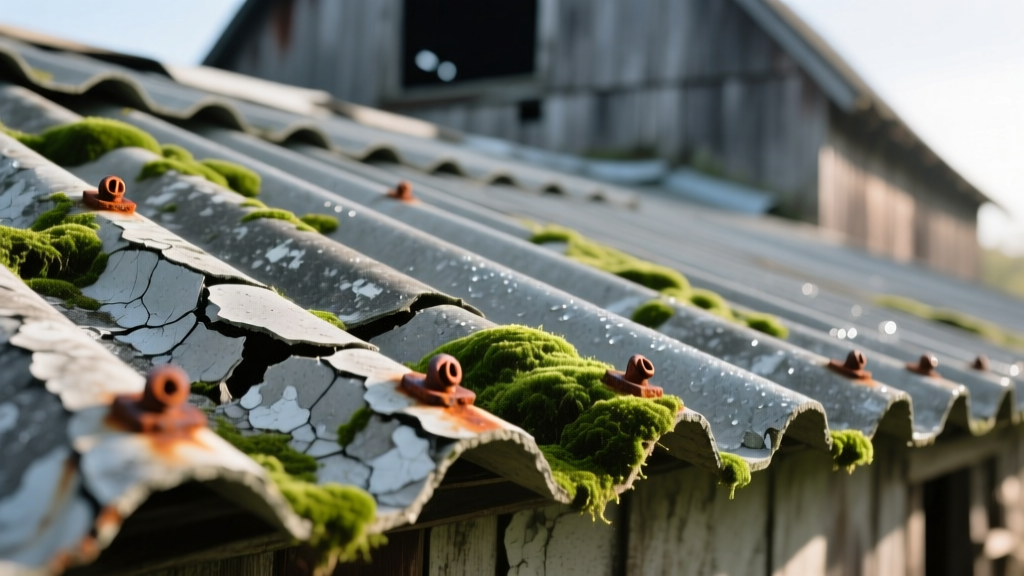
Often referred to generically by the Johns-Manville brand name 'Transite', these panels are typically 5/16-inch to 1/2-inch thick, heavily textured, and feature a corrugated or flat profile. They contain anywhere from 10% to 30% chrysotile asbestos mixed with Portland cement. As they weather, they develop a distinct chalky, gray patina and often show exposed, rusted nail heads where the cement has eroded around the fasteners.
Asphalt Asbestos Shingles
Manufactured primarily between 1950 and 1980, these shingles differ from modern fiberglass mat shingles. They feature an organic felt backing heavily saturated with asphalt and asbestos fibers. They are notably more rigid, brittle, and heavier than modern architectural shingles. If a broken piece reveals a dense, fibrous, grayish-white cross-section rather than a black fiberglass mesh, it is highly likely to contain asbestos.
Roof Flashing, Mastic, and Coatings
Asbestos was frequently added to roof cements, flashing compounds, and bituminous mastics used to seal around chimneys, vents, and valleys. These materials appear as thick, black, tar-like trowel marks. When dried and aged, they crack in a distinct 'alligator skin' pattern and reveal white fibrous strands when fractured.
The Testing Protocol: Confirming Asbestos Presence
Before planning any roof repair, gutter cleaning, or full replacement, you must confirm the material composition. The only legally and scientifically recognized method for confirmation is Polarized Light Microscopy (PLM) testing performed by an NVLAP-accredited laboratory.
- Hire a Certified Inspector: While DIY sampling kits exist, the Environmental Protection Agency (EPA) strongly recommends hiring a licensed asbestos building inspector. Professionals use specialized HEPA-filtered vacuums and wet-sampling techniques to prevent fiber release.
- Sample Collection: The inspector will extract a small, 1-inch by 1-inch core sample from an inconspicuous area, immediately sealing the breach with a wet patching compound or duct tape.
- Laboratory Analysis: Samples are sent to an accredited lab. Standard PLM testing typically costs between $30 and $60 per sample, with results returned in 3 to 5 business days. Rush testing (24 hours) usually incurs a 50% surcharge.
- Report Generation: The lab report will detail the exact percentage and type of asbestos (e.g., 15% Chrysotile). Materials containing less than 1% asbestos are generally classified as non-asbestos-containing material (NACM) under federal guidelines, though local state regulations may vary.
Management Strategies: Encapsulation vs. Removal
Once confirmed, building owners face a critical decision matrix. If the roof is intact, undamaged, and not leaking, federal regulations do not mandate removal. In fact, leaving an intact asbestos roof in place is often safer than disturbing it.
| Feature | Encapsulation (Sealing) | Full Abatement (Removal) |
|---|---|---|
| Average Cost | $3.00 - $8.00 per sq. ft. | $12.00 - $25.00+ per sq. ft. |
| Fiber Release Risk | Very Low (if applied correctly) | High (requires strict containment) |
| Expected Lifespan | 10 - 15 Years | Permanent Solution |
| Permitting | Minimal (standard roof coating permits) | Strict (EPA NESHAP & State DEP permits) |
| Best Use Case | Intact roofs with minor surface wear | Severely damaged, leaking, or pre-demolition |
The Encapsulation Process
Encapsulation involves applying a specialized, high-build elastomeric coating that binds the asbestos fibers to the substrate. Products like Fiberlock or AsbestoSafe are engineered to penetrate porous cement and cure into a flexible, monolithic membrane. The process requires low-pressure washing (under 500 PSI) with a biodegradable surfactant, followed by a primer and two topcoats of UV-resistant acrylic or silicone roof coating. This adds 15 to 20 years of waterproofing life while safely locking the fibers in place.
Asbestos Roof Removal: Costs and Contractor Requirements
If the roof decking is rotted, the panels are highly friable, or the building is slated for demolition, full abatement is required. The removal of asbestos roofing material is strictly governed by the Occupational Safety and Health Administration (OSHA) and the EPA's National Emission Standards for Hazardous Air Pollutants (NESHAP).
Abatement contractors must follow rigorous protocols:
- Wetting Agents: Materials must be continuously sprayed with 'amended water' (water mixed with a surfactant, typically 1 teaspoon of liquid dish soap per gallon) to prevent fibers from becoming airborne during extraction.
- Careful Lowering: Corrugated panels cannot be dropped or thrown from the roof. They must be carefully lowered to the ground using ropes or mechanical lifts to prevent shattering.
- Containment and Disposal: Removed materials are immediately sealed in 6-mil thick, leak-tight polyethylene disposal bags or lined dumpsters. These are labeled with OSHA-mandated hazard warnings and transported to specialized, EPA-approved landfills equipped to handle hazardous waste.
- Air Monitoring: Independent third-party air sampling is often required during and after the removal to ensure ambient fiber counts remain below the clearance threshold of 0.01 fibers per cubic centimeter (f/cc).
Expect to pay a premium for this specialized labor. While standard asphalt shingle removal costs roughly $1.50 to $3.00 per square foot, asbestos cement panel removal ranges from $12.00 to $25.00 per square foot. Steep roof pitches, multi-story buildings, and limited site access for heavy machinery will push costs toward the higher end of that spectrum.
Modern Alternatives for Roof Replacement
Once the asbestos material is safely removed and disposed of, the underlying decking often requires partial replacement due to age and fastener pull-through. When selecting a replacement material, consider options that mimic the durability of the original roof without the toxicity:
- Standing Seam Metal Roofing: Offers a 40- to 60-year lifespan, Class A fire rating, and excellent shedding capabilities. Galvalume steel panels cost between $9.00 and $14.00 per square foot installed.
- Fiber Cement Corrugated Panels: Modern fiber cement (such as Eternit or James Hardie profiles) uses cellulose fibers instead of asbestos, providing the exact same aesthetic and structural profile as legacy Transite panels but entirely safe and code-compliant.
- Synthetic Slate/Shake: Made from recycled rubber and engineered polymers, these provide high impact resistance and replicate traditional textures for residential applications.
Frequently Asked Questions
Can I install a new metal roof directly over my existing asbestos cement panels?
While some contractors suggest 'roofing over' asbestos to avoid removal costs, this is highly discouraged and often illegal under local building codes. Driving screws through the old asbestos panels to secure the new metal furring strips will instantly pulverize the material, creating a severe exposure hazard. Furthermore, the added weight may exceed the structural load capacity of the original roof trusses. Proper abatement is the only legally and structurally sound path forward.
Does homeowner's insurance cover asbestos roof removal?
Standard homeowner's insurance policies explicitly exclude pollution and hazardous material abatement. However, if the roof is destroyed by a covered peril (such as a tornado or severe hail), the policy will typically cover the cost of the new roof and standard debris removal. The specific surcharge for hazardous asbestos handling and specialized landfill tipping fees will usually fall out-of-pocket to the homeowner unless a specific pollution liability rider was purchased.
How long does an asbestos roof last if left undisturbed?
Asbestos cement roofing is incredibly durable and can easily last 50 to 80 years if maintained. The primary failure point is not the panel itself, but the corrosion of the metal fasteners and the degradation of the underlying wood purlins or decking. Regular inspections of the fastener seals and flashings can extend the functional life of an encapsulated asbestos roof indefinitely.
Written by
Sarah WhitfieldSarah Whitfield is a chartered quantity surveyor (MRICS) and construction cost analyst with 15 years of experience in material pricing, procurement strategy, and project budgeting. She earned her degree in Construction Management from the University of Reading (UK) and has worked on projects ranging from $2M custom homes to $180M mixed-use developments across North America and Europe. Sarah currently leads cost estimating for BuildMat Insight, maintaining a proprietary database of 4,000+ material price points updated quarterly. She is a frequent contributor to RSMeans cost data panels and has presented at the International Cost Engineering Council (ICEC) congress. Based in Denver, CO, Sarah is an avid trail runner and volunteer mentor for Women in Construction.
More from Sarah Whitfield
View all
Wood & Lumber
What Are the Different Types of Wood? A Builder's Guide
Compare structural softwoods, finish hardwoods, and engineered lumber. Analyze Janka ratings, MOE values, and 2026 pricing for construction.
Aug 4, 2026

Walls & Panels
Steel Framing vs Wood Framing: Corrosion and Moisture Defense
Compare steel framing vs wood framing for moisture resistance. Learn about galvanized coatings, condensation risks, and corrosion protection strategies.
Jul 21, 2026

Stone & Masonry
How to Cut Stone Veneer: Wet Saw vs Grinder Comparison
Compare the best tools for cutting stone veneer. We review wet saws, angle grinders, and chop saws to help you achieve clean, chip-free cuts.
Jul 21, 2026