Repair and Maintenance for Common Types of Flat Roof Materials
Master the repair and maintenance of all types of flat roof materials. Learn specific patching protocols for EPDM, TPO, PVC, and Mod-Bit systems.

The Diagnostic Framework: Identifying Flat Roof Failure Modes
Flat and low-slope roofing systems fail differently than pitched roofs. Because they rely on continuous membrane integrity rather than gravity-driven water shedding, the primary enemies are ponding water, thermal shock, and UV degradation. According to the Whole Building Design Guide (WBDG), the vast majority of leaks in low-slope systems occur within 3 feet of a penetration, flashing, or membrane seam. Before selecting a repair method, facility managers must identify the specific membrane chemistry, as applying an incompatible patching compound (like asphalt-based cement on single-ply thermoplastics) will cause catastrophic chemical breakdown.
Material-Specific Repair Protocols
Understanding the exact chemical makeup of your roof is non-negotiable. The Single Ply Roofing Industry (SPRI) categorizes these membranes into thermosets and thermoplastics, which dictates entirely different repair methodologies.
1. EPDM (Thermoset Rubber Membranes)
EPDM (Ethylene Propylene Diene Monomer) is highly resistant to UV and ozone but is prone to shrinkage over its 20-to-30-year lifespan. This shrinkage pulls the membrane taut, causing seam separation and flashing pull-away at parapet walls.
- Primary Failure Mode: Seam tape degradation and flashing shrinkage.
- Required Chemistry: Uncured EPDM flashing tape and specialized splice primers.
- Repair Protocol: Never use standard roofing tar on EPDM. Clean the failing seam with a specialized primer like Firestone Splice Wash SW-100 or Carlisle Splice Wash to remove oxidation and carbon black. Once the primer flashes off (becomes tacky), apply a 3-inch to 6-inch wide strip of uncured EPDM flashing tape. Use a hard silicone seam roller to apply 50 lbs of pressure, ensuring a vulcanized bond. For edge terminations, apply a bead of EPDM-compatible lap sealant (e.g., Dicor or Carlisle Sure-Seal) over the tape edges.
2. TPO and PVC (Thermoplastic Membranes)
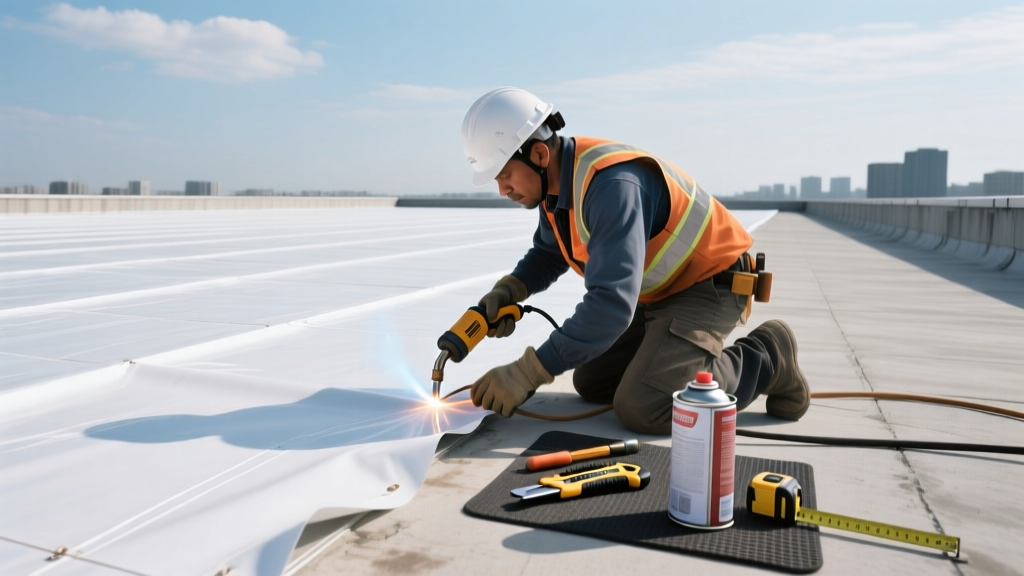
Thermoplastics like TPO (Thermoplastic Polyolefin) and PVC (Polyvinyl Chloride) are heat-welded at the seams. While they don't shrink like EPDM, older TPO formulations (pre-2011) suffered from premature cracking due to UV instability, and PVC can suffer from plasticizer migration, making the membrane brittle.
- Clean the Area: Wipe the repair zone with a TPO/PVC weathering cleaner to remove dirt and oxidized plasticizers.
- Prepare the Patch: Cut a patch of matching membrane (minimum 60-mil thickness) with rounded corners to prevent peeling. Ensure a minimum 2-inch overlap on all sides of the puncture.
- Heat Welding: Use a hot-air welding tool (such as a Leister Triac S). Set the nozzle temperature between 500°C and 600°C (930°F - 1110°F), adjusting for ambient temperature and wind.
- Test the Weld: After cooling for 5 minutes, use a blunt-nosed seam probe to check the perimeter. If the probe catches or penetrates the seam, re-weld the defective section.
3. Modified Bitumen (Mod-Bit)
Mod-Bit systems are asphalt-based and reinforced with either SBS (Styrene-Butadiene-Styrene) rubber or APP (Atactic Polypropylene) plastic. The Asphalt Roofing Manufacturers Association (ARMA) notes that misidentifying SBS and APP is a leading cause of repair failure. SBS is flexible and can be torched or cold-adhered; APP is rigid and strictly requires torching.
- Primary Failure Mode: Blistering (trapped moisture expanding) and alligatoring (surface asphalt drying out).
- Repair Protocol for Blisters: Cut an 'X' across the blister. Peel back the flaps and allow the trapped moisture to dry completely (use a heat gun if necessary). Apply a layer of SBS-modified flashing cement, press the flaps back down, and cover with a polyester-reinforced Mod-Bit patch. Torch the patch until the asphalt bleeds out slightly at the edges, creating a waterproof seal.
Maintenance Matrix: Inspection and Upkeep Schedule
Reactive repairs are exponentially more expensive than proactive maintenance. Use this matrix to schedule facility upkeep based on your specific membrane type.
| Membrane Type | Inspection Frequency | Critical Checkpoints | Preventative Action |
|---|---|---|---|
| EPDM | Bi-annually (Spring/Fall) | Seam integrity, parapet flashings, pipe boots. | Re-seal termination bars; check for membrane tenting. |
| TPO / PVC | Annually + Post-Storm | Heat-welded seams, HVAC curb flashings, fastener back-out. | Re-weld lifted seams; tighten or replace backing-out screws. |
| Mod-Bit (SBS/APP) | Bi-annually | Granule loss, blistering, drain scuppers. | Apply aluminum roof coating to restore UV reflectivity. |
| BUR (Built-Up) | Annually | Alligatoring, bare spots, gravel displacement. | Re-flood bare spots with bitumen and re-apply aggregate. |
Advanced Diagnostics: Infrared Moisture Scanning
Visual inspections only reveal surface damage. By the time a leak manifests on the interior ceiling, the underlying polyiso or EPS insulation is often completely saturated. Professional roof maintenance now relies heavily on Infrared (IR) thermography. Because wet insulation retains heat longer than dry insulation, an IR camera used at dusk will highlight trapped moisture as glowing 'hot spots' against the cooler, dry roof surface. If an IR scan reveals that more than 25% of the roof area has wet insulation, spot repairs are no longer financially viable; a full tear-off or recover is required to prevent structural deck degradation.
Frequently Asked Questions (FAQ)
Can I use silicone roof coating to repair a leaking TPO roof?
Yes, but only as a temporary emergency measure or for broad-surface restoration, not for seam repair. High-solids silicone coatings (like GacoRoof or APOC) adhere well to cleaned TPO and PVC, creating a seamless monolithic layer. However, silicone does not fix structural seam failures or saturated insulation. The membrane must be power-washed and primed with a manufacturer-approved bleed-tracker primer before application to prevent asphalt or plasticizer stains from ruining the coating.
Why is my EPDM roof shrinking and pulling away from the edges?
EPDM shrinkage is a natural aging process caused by the evaporation of the oils used during the vulcanization manufacturing process. As the membrane loses these oils over 15 to 20 years, it physically contracts. This is why modern EPDM installations require loose-laid, ballasted, or fully adhered methods with deliberate 'relaxation' periods before final termination. To repair severe shrinkage, the perimeter flashing must be detached, a new piece of uncured EPDM spliced in to bridge the gap, and the termination bar re-secured.
What is the difference between APP and SBS Modified Bitumen repairs?
APP (Atactic Polypropylene) is a plastic modifier that requires high heat (torch-down) to melt and fuse. You cannot use cold adhesives on APP. SBS (Styrene-Butadiene-Styrene) is a rubber modifier that offers greater flexibility in freezing temperatures and can be torched, hot-mopped, or applied using cold-process adhesives. Applying a torch to a cold-adhered SBS membrane designed specifically for solvent-based installation can cause the membrane to blister and delaminate.
Written by
Elena RodriguezElena Rodriguez is a civil engineer and technical writer specializing in concrete technology, masonry systems, and ASTM/ACI compliance. She earned her B.S. in Civil Engineering from Texas A&M University and spent a decade at a materials testing laboratory, performing over 2,000 concrete compressive strength tests and masonry prism evaluations. Elena is an ACI-certified Field Testing Technician (Grade I) and a member of ASTM Committee C12 on Natural Building Stone. She currently consults on forensic engineering cases involving concrete failures and moisture intrusion. Based in San Antonio, TX, Elena is a proud member of the Society of Women Engineers (SWE) and coaches her daughter's FIRST Robotics team.
More from Elena Rodriguez
View all
Walls & Panels
Cost Analysis: Light Gauge Steel Framing Advantages and Disadvantages
Evaluate light gauge steel framing advantages and disadvantages through a strict cost analysis lens, comparing material, labor, and lifecycle expenses.
Aug 4, 2026

Walls & Panels
Gypsum Board Types: Exact Specifications, Thickness & Dimensions
Compare standard, Type X, and moisture-resistant gypsum board types. Get exact specifications, thicknesses, dimensions, and ASTM standards for your project.
Aug 4, 2026

Fire Resistance
Best Fire-Resistant Outdoor Decking Materials: 2026 Buyer Guide
Discover the best fire-resistant outdoor decking materials for 2026. Compare Class A PVC, aluminum, and hardwood options for WUI compliance and safety.
Aug 4, 2026