Roofing Material Crossword Clue: A Durability & Lifespan Guide
Decode the ultimate roofing material crossword clue with our lifespan guide. Compare asphalt, metal, slate, and tile durability for your next project.

Decoding the Puzzle of Roof Longevity
When homeowners search for a "roofing material crossword clue" online, they are typically looking for a quick puzzle answer like SLATE, TAR, SHINGLE, or EAVE. But in the construction industry, decoding the true lifespan of these materials requires solving a much more complex puzzle. Manufacturer warranties often promise 50 years of protection, yet real-world environmental stressors, installation variables, and material science dictate a very different timeline.
To make an informed investment in 2026, you must look past the marketing gloss and evaluate the physical degradation mechanisms of each roofing system. Below, we break down the actual lifespans, failure modes, and annualized costs of the most common residential and commercial roofing materials.
The Crossword Grid: Roofing Materials by Lifespan
The following matrix translates common roofing terms into their real-world durability profiles, complete with current 2026 installation cost averages.
| Material (Clue Answer) | Real-World Lifespan | 2026 Avg. Cost (Per Square) | Primary Failure Mode |
|---|---|---|---|
| SHINGLE (3-Tab Asphalt) | 12 - 18 Years | $90 - $115 | Thermal shock & granule loss |
| ARCH (Architectural Asphalt) | 22 - 30 Years | $130 - $165 | UV oxidation & algae staining |
| STEEL (Exposed Fastener Metal) | 20 - 25 Years | $450 - $650 | Neoprene washer degradation |
| METAL (Standing Seam) | 40 - 60 Years | $950 - $1,400 | Galvanic corrosion at flashings |
| TILE (Clay / Concrete) | 50 - 75 Years | $800 - $1,200 | Freeze-thaw spalling & underlayment failure |
| SLATE (Natural Stone) | 75 - 100+ Years | $1,600 - $2,500 | Delamination & nail fatigue |
| EPDM (Rubber Membrane) | 20 - 30 Years | $350 - $550 | Seam shrinkage & puncture |
Short-Lived Options: The 15-to-25 Year Bracket
3-Tab Asphalt Shingles (ASTM D3462)
While 3-tab shingles are the most budget-friendly option upfront, their thin, single-layer construction makes them highly susceptible to thermal cycling. In regions with extreme diurnal temperature shifts, the asphalt matrix expands and contracts daily. Over 15 years, this causes the volatile oils in the asphalt to evaporate, leading to brittleness. According to the InterNACHI Standard Home Inspection Lifespan Chart, 3-tab shingles rarely exceed 20 years in harsh climates, regardless of the 25-year manufacturer warranty.
Exposed Fastener Metal Roofing
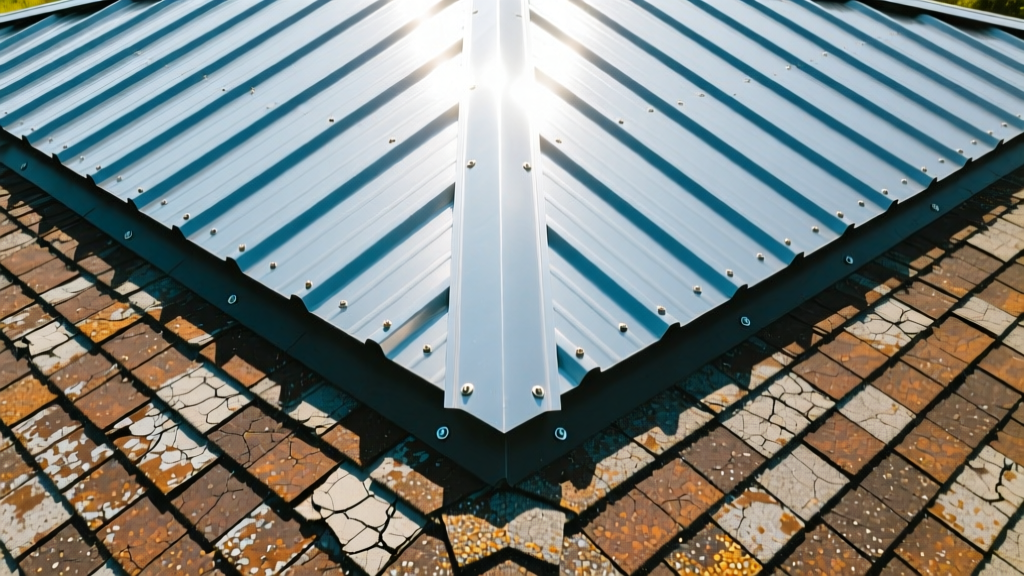
Corrugated or ribbed metal panels secured with exposed screws offer excellent water shedding, but their lifespan is artificially capped by the fasteners. The neoprene or EPDM washers sealing the screw heads undergo continuous UV exposure. By year 15 to 20, these washers dry-rot and crack, allowing water infiltration long before the steel or aluminum panels themselves fail. Upgrading to standing seam systems eliminates this vulnerability by concealing the fasteners beneath the panel ribs.
Mid-Range Contenders: The 30-to-50 Year Bracket
Architectural (Dimensional) Shingles
Manufactured to meet ASTM D7158 wind resistance standards, architectural shingles feature a multi-layered fiberglass mat that provides superior tear strength. The primary enemy of these roofs is not wind, but biological growth and UV oxidation. In humid climates, Gloeocapsa magma (blue-green algae) can consume the limestone filler in the shingles, causing premature degradation. Specifying shingles with copper-infused ceramic granules provides a 10- to 15-year algae resistance window, preserving the roof's structural integrity.
Standing Seam Metal (Galvalume AZ50/AZ55)
A properly engineered standing seam roof utilizing 24-gauge Galvalume steel (coated with an aluminum-zinc alloy) will easily last 50 years. The critical failure point in metal roofing is rarely the field of the roof; it is the flashings and penetrations. Dissimilar metal corrosion (galvanic action) occurs when copper flashings are used against steel panels without proper isolation. To achieve a 50-year lifespan, all flashings, cleats, and reglets must be fabricated from the exact same alloy as the primary panels.
The Annualized Roof Cost Framework
Stop evaluating roofing costs by the initial invoice. To find the true value, divide the total installed cost by the expected real-world lifespan to find your Cost Per Year of Shelter.
- 3-Tab Asphalt ($100/sq): $100 ÷ 15 years = $6.66 per square / year
- Standing Seam Metal ($1,100/sq): $1,100 ÷ 50 years = $22.00 per square / year
- Natural Slate ($2,000/sq): $2,000 ÷ 90 years = $22.22 per square / year
Insight: While metal and slate cost significantly more upfront, their annualized cost over a century is remarkably competitive when factoring in the avoided tear-off and disposal fees of replacing asphalt roofs every two decades.
Legacy Answers: The 75-to-100+ Year Bracket
Natural Slate (ASTM C406)
Not all slate is created equal. The ASTM C406 standard classifies slate into three grades based on water absorption and modulus of rupture. S1 Grade slate (water absorption < 0.25%) is the only variant suitable for a century-long lifespan. S2 and S3 grades will absorb moisture, leading to delamination and spalling within 40 years, especially in freeze-thaw climates. When sourcing slate, demand the S1 certification from quarries in regions like Vermont, Virginia, or specific high-grade imports from Spain.
Clay and Concrete Tile
The tiles themselves can last a century, but the underlying waterproofing layer cannot. The U.S. Department of Energy notes that tile roofs create a ventilated air space that significantly reduces cooling loads, but the asphalt or synthetic underlayment beneath the tiles typically degrades after 30 to 40 years. Homeowners must budget for a "lift and relay" procedure—removing the heavy tiles, replacing the underlayment, and reinstalling the original tiles—midway through the roof's life cycle.
Environmental Modifiers: How Climate Alters the Grid
A material's baseline lifespan is merely a starting point. Local environmental stressors act as multipliers or divisors on the durability grid:
- Coastal Salt Spray: Accelerates galvanic corrosion in metal roofs. Aluminum or copper standing seam systems are mandatory within 1,500 feet of the ocean; steel will rust prematurely even with Kynar 500 paint finishes.
- High-Altitude UV Exposure: At elevations above 6,000 feet, UV radiation thins asphalt shingle binders up to 30% faster. Metal or slate is highly recommended in mountainous regions.
- Severe Hail Zones (Texas, Colorado, Midwest): Standard asphalt shingles will suffer matrix fracturing from 1.5-inch hail. Specify UL 2218 Class 4 impact-resistant shingles or stone-coated steel to prevent immediate insurance write-offs.
Flat Roof Systems: The Commercial Crossword
For low-slope applications, the crossword clues shift from shingles to membranes. TPO (Thermoplastic Polyolefin) and EPDM (Ethylene Propylene Diene Monomer) dominate the market. While EPDM has a proven 30-year track record, its black surface absorbs massive amounts of heat, accelerating building cooling costs. Modern 60-mil or 80-mil white TPO membranes reflect solar radiation and feature heat-welded seams that are physically stronger than the membrane itself, eliminating the primary failure point of older chemically adhered EPDM systems.
Quick Reference: Roofing Crossword Clues & Durability Facts
For the puzzle solvers and the practical planners alike, here is a quick-reference glossary of common roofing terms, their typical crossword hints, and a critical durability fact for each.
Clue: "Roofing resin" (3 letters)
Answer: TAR
Fact: Coal tar pitch is highly resistant to chemical degradation and ponding water, making it superior to asphalt for dead-flat commercial roofs, though its use is declining due to VOC regulations.
Clue: "Roof edge" (4 letters)
Answer: EAVE
Fact: Eaves are the most vulnerable point for ice damming. Installing a minimum of two layers of self-adhering ice and water shield (ASTM D1970) extending 24 inches past the interior warm wall line is critical in northern climates.
Clue: "Roofing metal" (6 letters)
Answer: COPPER
Fact: Copper roofs develop a protective green patina (verdigris) within 15 to 20 years. This patina actually halts further corrosion, allowing copper roofs to easily exceed 100 years with zero maintenance.
Final Assessment: Solving Your Specific Puzzle
There is no universal "best" answer to the roofing material crossword clue. The correct solution depends entirely on your structural load capacity, local microclimate, and capital allocation strategy. If your framing cannot support the 800-1,000 lbs per square of natural slate, standing seam metal offers a comparable 50-year lifespan at a fraction of the weight. Always verify that your chosen contractor holds specific manufacturer certifications for the exact product line being installed, as improper fastening patterns will void even the most robust material warranties.
Written by
Marcus ChenMarcus Chen is a licensed structural engineer (PE) and building materials analyst with over 12 years of experience across residential, commercial, and industrial construction. He holds a Master of Science in Civil Engineering from UC Berkeley and spent six years at Thornton Tomasetti before transitioning to independent consulting and technical writing. Marcus specializes in material selection for seismic-prone regions, concrete reinforcement strategies, and lifecycle cost analysis. His work has been cited by the American Concrete Institute (ACI) and the Structural Engineers Association of California (SEAOC). When he is not on a job site or at his desk, you will find him hiking the Sierra Nevada or restoring a 1920s craftsman bungalow in Oakland, CA.
More from Marcus Chen
View all
Construction Cost
How Much Did the Eiffel Tower Cost to Build?
How much did the Eiffel Tower cost to build in 1889? We adjust for inflation and compare its budget to modern skyscraper construction.
Aug 4, 2026

Fire Resistance
What Is a Fire Resistant Material? Testing & Certification Guide
Discover what is a fire resistant material through ASTM and UL testing. Learn how fire ratings, certifications, and assemblies work in construction.
Aug 4, 2026

Construction Cost
How Much Did the Burj Khalifa Cost to Build?
How much did the Burj Khalifa cost to build? We break down the $1.5B project and extract 5 money-saving strategies for your next build.
Jul 30, 2026