Choosing the Best RV Rubber Roofing Material: EPDM vs TPO Guide
Compare EPDM and TPO RV rubber roofing material. Get exact SKU recommendations, 2026 pricing, adhesive warnings, and step-by-step repair protocols.

The Chemistry of RV Rubber: EPDM vs. TPO Membranes
When RV owners and technicians refer to RV rubber roofing material, they are almost exclusively talking about two distinct synthetic polymers: EPDM (Ethylene Propylene Diene Monomer) and TPO (Thermoplastic Polyolefin). While both serve as flexible, waterproof barriers for travel trailers, fifth wheels, and motorhomes, their chemical structures, installation requirements, and aging characteristics differ vastly. Understanding these differences is critical for avoiding premature delamination, seam failures, and structural decking rot.
EPDM (Ethylene Propylene Diene Monomer)
EPDM is a vulcanized, thermoset rubber. Once manufactured and cured, its chemical bonds are permanently cross-linked. This makes EPDM highly resistant to extreme temperature fluctuations and UV degradation. However, traditional black EPDM contains carbon black, which absorbs heat, while white EPDM relies on titanium dioxide. As white EPDM ages and undergoes UV exposure, it oxidizes and sheds a chalky residue. This 'chalking' is a normal sacrificial process that protects the underlying membrane, but it requires regular cleaning and the application of UV protectants to prevent the membrane from drying out and cracking over a 10 to 15-year lifespan.
TPO (Thermoplastic Polyolefin)
TPO is a thermoplastic blend of polypropylene and ethylene-propylene rubber. Unlike EPDM, TPO is not vulcanized; it can be melted and reformed. This property allows TPO seams to be heat-welded, creating a bond that is physically stronger than the membrane itself. TPO does not oxidize or chalk, making it a lower-maintenance option that retains its bright white, highly reflective surface for its entire 15 to 20-year lifespan. According to the U.S. Department of Energy, highly reflective white roofs like TPO can significantly reduce cooling loads, a major advantage for RVs parked in southern climates.
Material Comparison Matrix
| Feature | EPDM Membrane | TPO Membrane |
|---|---|---|
| Base Chemistry | Vulcanized Thermoset Rubber | Thermoplastic Polyolefin Blend |
| Seam Method | Contact Adhesive + Lap Sealant | Heat Welding + Lap Sealant |
| UV Aging Trait | Chalks over time (sacrificial) | Non-chalking, retains color |
| Cold Weather Flex | Excellent (remains pliable at -40°F) | Good (can stiffen below 0°F) |
| Puncture Resistance | High (elastic recovery) | Moderate (rigid compared to EPDM) |
| Average Lifespan | 10 - 15 Years | 15 - 20+ Years |
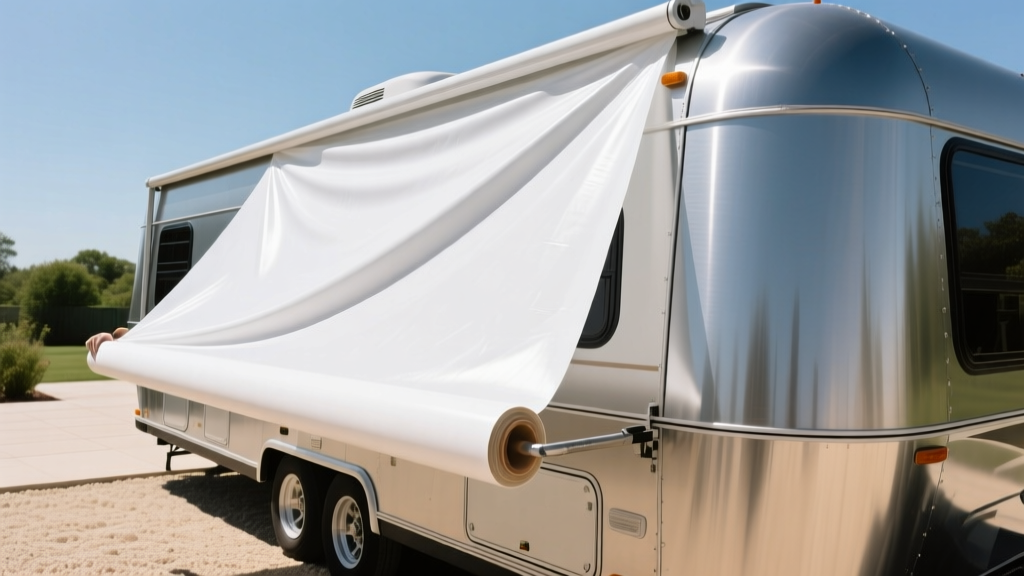
Thickness Specifications: 40-Mil vs. 60-Mil
Commercial flat roofs typically utilize 60-mil (0.060-inch) membranes. However, the RV industry prioritizes weight reduction. Most factory-installed RV rubber roofing material is 27-mil to 40-mil thick.
- 27-Mil to 30-Mil: Found on budget travel trailers. Highly susceptible to puncture from dropped tools, tree branches, or heavy foot traffic. Not recommended for full-time RVers or those who frequently boondock in wooded areas.
- 40-Mil (0.040-inch): The industry standard for quality travel trailers and fifth wheels. Provides an optimal balance of weight, flexibility, and puncture resistance. Brands like Alpha Systems and RecPro heavily utilize 40-mil TPO.
- 60-Mil (0.060-inch): Reserved for Class A motorhomes or custom fifth wheels where roof traffic (for solar panel maintenance or satellite dish servicing) is frequent. The added weight is negligible on heavy-duty chassis but provides superior impact resistance.
The Hidden Danger: Adhesives and EPS Foam Degradation
⚠️ CRITICAL WARNING: Solvent-Based Adhesives
RV roof decking is typically constructed of luan plywood bonded to EPS (Expanded Polystyrene) foam insulation. If you use a standard solvent-based contact adhesive to glue down your EPDM or TPO membrane, the solvents will seep through the plywood micro-fissures and instantly melt the EPS foam. This causes catastrophic delamination, creating voids where water can pool and rot the decking from the inside out. Always use water-based RV roofing adhesives or specifically formulated RV bonding adhesives (like Dicor's water-based bonding adhesive) that flash off safely without attacking polystyrene.
Step-by-Step Seam and Puncture Repair Protocol
When repairing RV rubber roofing material, using the wrong sealant is the leading cause of secondary leaks. The Dicor Products technical data sheets explicitly differentiate between self-leveling and non-leveling lap sealants. Using self-leveling sealant on a vertical surface will result in it running down the side of your RV, while using non-leveling on a flat seam will leave ridges that pool water.
- Surface Preparation: Clean the repair area with a dedicated RV rubber roof cleaner (e.g., B.E.S.T. Rubber Roof Cleaner or Spic and Span). Never use petroleum distillates or citrus-based degreasers, as they will swell and destroy EPDM.
- Abrasion: Lightly scuff the membrane and the existing sealant with a Scotch-Brite pad to remove oxidation and create a mechanical bond.
- Priming (For Patches): If applying an EPDM patch or Eternabond tape, apply a coat of EPDM primer and let it flash off until tacky (usually 10-15 minutes).
- Sealant Application:
- Use Dicor 501LSW (Self-Leveling) for all horizontal seams, vent flanges, and flat patches. Apply a continuous bead at least 3/8-inch thick.
- Use Dicor 551LSW (Non-Leveling) for vertical seams, screw heads on sidewalls, and the vertical edges of roof caps.
- Curing: Allow 24 hours for skin-over and up to 30 days for full vulcanization, depending on ambient humidity and temperature.
2026 Cost Estimates for RV Roof Replacement
Pricing for RV rubber roofing material and professional installation has stabilized following the supply chain disruptions of the early 2020s. The costs below reflect 2026 market averages for a standard 30-foot travel trailer (approximately 240 to 300 square feet of roof area, including front and rear cap overlaps).
| Cost Category | EPDM (40-Mil) | TPO (40-Mil) |
|---|---|---|
| Material Only (Membrane) | $220 - $280 | $260 - $340 |
| Adhesives & Sealants | $120 - $150 | $120 - $150 |
| Professional Labor (Full Tear-Off) | $2,200 - $3,000 | $2,400 - $3,200 |
| Total Professional Replacement | $2,540 - $3,430 | $2,780 - $3,690 |
Note: If the underlying luan decking is rotted, expect an additional $400 to $800 in decking replacement labor and materials. The RV Industry Association (RVIA) strongly recommends having certified technicians handle full tear-offs to ensure warranty compliance and proper structural integrity.
Liquid Rubber vs. Sheet Membranes: The Coating Debate
Many RV owners encounter 'liquid rubber' products (elastomeric acrylics or liquid EPDM coatings) marketed as cheap alternatives to full roof replacement. It is vital to understand that liquid coatings are restorative treatments, not structural replacements.
If your existing 40-mil EPDM membrane is structurally sound but suffering from minor micro-cracking and severe chalking, a high-quality liquid EPDM coating (like Heng's Rubber Roof Coating) can extend its life by 3 to 5 years. However, if the membrane is brittle, torn, or delaminating from the decking, applying a liquid coating will trap moisture against the wood decking, accelerating rot. Liquid coatings should only be applied to thoroughly dried, structurally sound membranes as a UV-protective topcoat.
Preventative Maintenance: Chemical Compatibility
The longevity of your RV rubber roofing material is heavily dependent on the chemicals you use to clean it. EPDM is highly sensitive to hydrocarbon solvents.
- Approved Cleaners: Mild detergents, Spic and Span, or proprietary RV roof washes (Dicor, Camco, B.E.S.T.).
- Prohibited Chemicals: Mineral spirits, Varsol, citrus-based degreasers (d-Limonene), and harsh abrasive powders. These will extract the essential oils and plasticizers from the EPDM, causing it to shrink, pull away from the roof edges, and crack.
- Protectants: After cleaning, apply a water-based UV protectant (such as 303 Aerospace Protectant). Avoid silicone-based shine products, as they create a slippery hazard and prevent future lap sealants from adhering to the membrane.
By selecting the correct membrane thickness, utilizing EPS-safe adhesives, and adhering to strict chemical compatibility guidelines, you can ensure your RV rubber roof provides decades of leak-free performance.
Written by
Marcus ChenMarcus Chen is a licensed structural engineer (PE) and building materials analyst with over 12 years of experience across residential, commercial, and industrial construction. He holds a Master of Science in Civil Engineering from UC Berkeley and spent six years at Thornton Tomasetti before transitioning to independent consulting and technical writing. Marcus specializes in material selection for seismic-prone regions, concrete reinforcement strategies, and lifecycle cost analysis. His work has been cited by the American Concrete Institute (ACI) and the Structural Engineers Association of California (SEAOC). When he is not on a job site or at his desk, you will find him hiking the Sierra Nevada or restoring a 1920s craftsman bungalow in Oakland, CA.
More from Marcus Chen
View all
Construction Cost
How Much Did the Eiffel Tower Cost to Build?
How much did the Eiffel Tower cost to build in 1889? We adjust for inflation and compare its budget to modern skyscraper construction.
Aug 4, 2026

Fire Resistance
What Is a Fire Resistant Material? Testing & Certification Guide
Discover what is a fire resistant material through ASTM and UL testing. Learn how fire ratings, certifications, and assemblies work in construction.
Aug 4, 2026

Construction Cost
How Much Did the Burj Khalifa Cost to Build?
How much did the Burj Khalifa cost to build? We break down the $1.5B project and extract 5 money-saving strategies for your next build.
Jul 30, 2026