Asbestos: The Fire Resistant Material No Longer Used Due to Its Carcinogenicity
Discover why asbestos is the fire resistant material no longer used due to its carcinogenicity, plus safe modern alternatives and abatement protocols.

The Rise and Fall of Asbestos in Fireproofing
For much of the 20th century, asbestos was the undisputed king of passive fire protection. Prized for its exceptional tensile strength, chemical resistance, and ability to withstand temperatures exceeding 1,000°C (1,832°F), it was integrated into over 3,000 building products. However, asbestos is the definitive fire resistant material no longer used due to its carcinogenicity. When asbestos-containing materials (ACMs) degrade or are disturbed, they release microscopic fibrils into the air. Inhalation of these fibers causes severe, latent respiratory diseases, including asbestosis, lung cancer, and mesothelioma.
Despite its thermal superiority, the catastrophic health toll led to sweeping bans. The U.S. EPA initiated heavy restrictions in the 1970s, culminating in the 1989 partial ban and subsequent total bans on chrysotile asbestos (the most commonly used type in construction) finalized in early 2024. Today, managing legacy asbestos and selecting modern, non-toxic fireproofing alternatives are critical components of commercial and residential fire safety compliance.
Identifying Legacy Asbestos Fireproofing in Pre-1990 Structures
If you are managing, renovating, or demolishing a structure built before 1990, you must assume materials contain asbestos until proven otherwise via laboratory analysis. Asbestos fireproofing generally falls into two categories based on their potential to release fibers:
Friable Asbestos Fireproofing (High Risk)
Friable materials can be crumbled, pulverized, or reduced to powder by hand pressure when dry. These pose the highest inhalation risk.
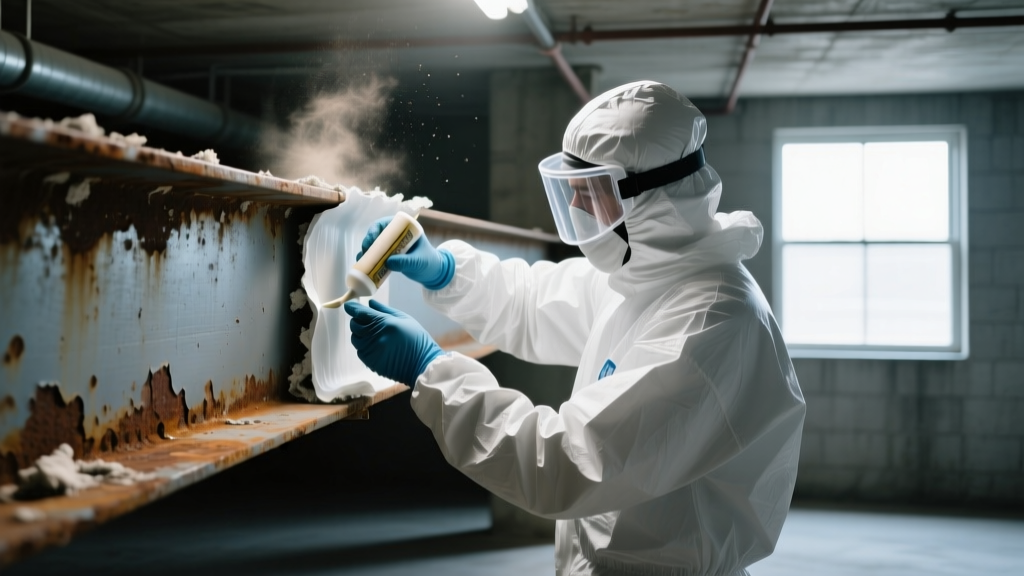
- Spray-Applied Fireproofing (SFRM): Commonly found on structural steel beams, columns, and concrete decks. Often appears as a lumpy, grayish-white or off-white fibrous coating.
- Asbestos Insulating Board (AIB): Rigid panels used in fire doors, partition walls, and ceiling tiles. Often mistaken for standard calcium silicate or gypsum.
- Pipe Lagging and Boiler Insulation: Corrugated paper or plaster-like wraps used on HVAC ducts and steam pipes.
Non-Friable Asbestos Fireproofing (Lower Risk, Condition-Dependent)
Non-friable materials have asbestos fibers tightly bound in a matrix (like cement or resin). They are low risk if intact but become highly hazardous if cut, drilled, or sanded.
- Transite Panels: Asbestos-cement boards used for exterior cladding, roofing, and fire walls.
- Intumescent Mastics and Sealants: Legacy firestop caulking used around pipe penetrations and electrical conduits.
Definitive identification requires Polarized Light Microscopy (PLM) or Transmission Electron Microscopy (TEM) testing conducted by an NVLAP-accredited laboratory. Visual inspection alone is legally and scientifically insufficient.
Modern, Safe Alternatives to Asbestos Fireproofing
The construction industry has developed highly effective, non-carcinogenic alternatives that meet or exceed the fire ratings previously achieved by asbestos. When upgrading a building's passive fire protection, specify materials tested to OSHA and ASTM E119 standards.
| Material Type | Fire Rating (ASTM E119) | Primary Application | Est. Cost (2026) |
|---|---|---|---|
| Intumescent Coatings (e.g., Nullifire SC902) |
Up to 120 minutes | Exposed structural steel; expands up to 50x its thickness when heated to form an insulating char. | $6.50 - $11.00 / sq ft |
| Calcium Silicate Boards (e.g., Promat PROMATECT) |
Up to 240 minutes | Duct encasement, fire walls, and structural column boxing. Highly moisture resistant. | $4.00 - $7.50 / sq ft |
| Cementitious Sprays (e.g., Monokote MK-10) |
Up to 4 hours | Concealed structural steel and concrete decks. Direct, non-toxic replacement for spray-on ACMs. | $2.50 - $5.00 / sq ft |
| Mineral Wool Firestops (e.g., Rockwool Firestop) |
Up to 3 hours | Penetration seals, curtain wall edge slabs, and cavity barriers. Withstands up to 1,177°C. | $1.80 - $3.50 / sq ft |
Abatement and Encapsulation: What to Do If You Find It
Discovering asbestos does not always mandate immediate removal. The EPA's National Emission Standards for Hazardous Air Pollutants (NESHAP) dictates that intact, non-friable ACMs that will not be disturbed by renovation can often be managed in place. However, if the material is damaged or will be impacted by construction, you must choose between removal and encapsulation.
Decision Framework: Remove vs. Encapsulate
- Assess Condition: Is the fireproofing friable, crumbling, or water-damaged? If yes, removal is required. Encapsulation is only viable for structurally sound materials.
- Evaluate Future Renovations: Will the space undergo heavy mechanical upgrades in the next 5-10 years? If yes, proactive removal is more cost-effective than paying for abatement containment during future projects.
- Consider Structural Load: Encapsulation (via penetrating sealers or bridging membranes) adds weight to ceiling decks. Verify the structural load capacity before applying heavy elastomeric encapsulants.
The Abatement Protocol (For Certified Professionals)
If removal is necessary, it must be executed by licensed asbestos abatement contractors following strict negative-pressure containment protocols:
- Containment Setup: Erecting 6-mil polyethylene barriers and establishing negative air pressure machines (NAPs) with HEPA filtration to prevent fiber migration.
- Wet Removal: Continuously misting the ACM with amended water (water mixed with a surfactant) to suppress airborne dust during detachment.
- Waste Disposal: Sealing debris in leak-tight, labeled 6-mil plastic bags and transporting it to designated hazardous waste landfills.
- Clearance Testing: Conducting aggressive final air sampling using AHERA protocols. The area cannot be reoccupied until airborne fiber counts fall below 0.01 fibers per cubic centimeter (f/cc).
Code Compliance and Legal Mandates
Building owners and general contractors bear strict liability for asbestos exposure on their job sites. Under OSHA regulations (29 CFR 1926.1101), a thorough asbestos survey by a certified building inspector is legally required before any demolition or renovation of pre-1990 commercial structures. Failure to comply can result in fines exceeding $160,000 per violation in 2026, alongside severe criminal penalties for willful negligence.
Frequently Asked Questions
Can I paint over asbestos fireproofing to make it safe?
Standard architectural latex or alkyd paints do not constitute legal encapsulation. To encapsulate ACMs, you must use specialized, fire-rated elastomeric bridging encapsulants (such as Childers CP-120) applied at specific mil thicknesses to penetrate and bind the fibers. This must be documented in the facility's Asbestos Operations and Maintenance (O&M) plan.
Are modern fiber-cement boards dangerous like asbestos?
No. Modern fiber-cement boards (like James Hardie or GAF products) use cellulose or synthetic PVA fibers, not asbestos. While cutting modern fiber-cement generates nuisance silica dust that requires standard N95/P100 respiratory protection to prevent silicosis, it does not carry the carcinogenic mesothelioma risk associated with amphibole or chrysotile asbestos fibers.
Where can I find certified testing and abatement professionals?
Consult your state's environmental protection or health department directory for licensed asbestos inspectors and abatement contractors. Ensure the laboratory analyzing your bulk samples holds current accreditation from the National Voluntary Laboratory Accreditation Program (NVLAP) or the American Association for Laboratory Accreditation (A2LA). For comprehensive global health data on asbestos elimination, refer to the World Health Organization's guidelines.
Written by
James ThorntonJames Thornton is a construction industry veteran with 25 years of hands-on experience in wood framing, lumber grading, and residential building codes. He started as a framing carpenter in rural Oregon, earned his ICC Residential Building Inspector certification, and eventually became a senior plan reviewer for the City of Portland Bureau of Development Services. James holds a B.S. in Wood Science & Technology from Oregon State University and is a certified lumber grader through the West Coast Lumber Inspection Bureau (WCLIB). He has inspected over 3,000 residential construction sites and authored the city's internal guide on advanced framing techniques (2x6 at 24" O.C.). James lives in Bend, OR, where he builds custom timber-frame cabins and competes in lumberjack sports.
More from James Thornton
View all
Insulation
Best Home Insulation Materials: Complete 2026 Guide
Compare top home insulation materials for 2026. Find R-values, installed costs per square foot, and best uses for fiberglass, spray foam, and mineral wool.
Aug 4, 2026

Sustainable Building
Certify Your Green Building Material for LEED and WELL
Step-by-step guide to certifying a green building material for LEED v5 and WELL v2. Master EPDs, HPDs, and VOC limits for 2026 project specifications.
Aug 4, 2026

Stone & Masonry
Veneer Stacked Stone Panels: Interior Design & Style Showcase
Discover how veneer stacked stone panels transform interiors. Explore modern design profiles, material pairings, and technical installation specs.
Aug 4, 2026