Safest Decking Material for Wildfire Zones: Complete Application Guide
Discover the safest decking material for wildfire zones. Compare Class A composites, cellular PVC, and FRT wood with installation tips for WUI compliance.

Understanding WUI Code Requirements for Decking
Building a deck in a high-risk fire area requires moving beyond standard aesthetic choices and focusing strictly on ignition resistance. In the Wildland-Urban Interface (WUI), the primary threat to decking is not a direct wall of flame, but rather wind-blown embers that can travel up to a mile ahead of the fire front. According to the Insurance Institute for Business & Home Safety (IBHS), embers accumulate in deck gaps, ignite organic debris, and compromise the substructure, leading to total structural failure even if the deck boards themselves are fire-rated.
To comply with stringent regulations like California Building Code (CBC) Chapter 7A and NFPA 1144, decking materials must be classified as 'ignition-resistant.' This generally requires a Class A flame spread rating (0-25) when tested under ASTM E84, or passing specific WUI product approval testing that exposes the material to direct flame and ember showers. Standard wood-plastic composites (WPCs) often fail these tests because they contain wood flour, which readily ignites when exposed to trapped embers.
Material Comparison Matrix: Class A vs. Class B vs. Untreated
Selecting the right material requires balancing fire performance, structural integrity under heat, and budget. The matrix below breaks down the top contenders for the safest decking material for wildfire zones.
| Material Type | Fire Rating | Ember Resistance | Avg. Cost (2026) | Max Joist Spacing |
|---|---|---|---|---|
| Mineral-Based Composite (MBC) | Class A | Excellent (No organic wood flour) | $9 - $12 / lin. ft. | 16" O.C. |
| Capped Cellular PVC | Class A | Excellent (100% synthetic) | $12 - $15 / lin. ft. | 12" to 16" O.C. |
| Fire-Retardant Treated (FRT) Wood | Class A | Good (Chemical char barrier) | $5 - $7 / lin. ft. | 16" O.C. |
| Standard WPC (Wood-Plastic) | Class C / Untested | Poor (Wood flour ignites) | $7 - $10 / lin. ft. | 16" O.C. |
| Untreated Pressure-Treated Pine | Class C | Very Poor | $3 - $5 / lin. ft. | 16" O.C. |
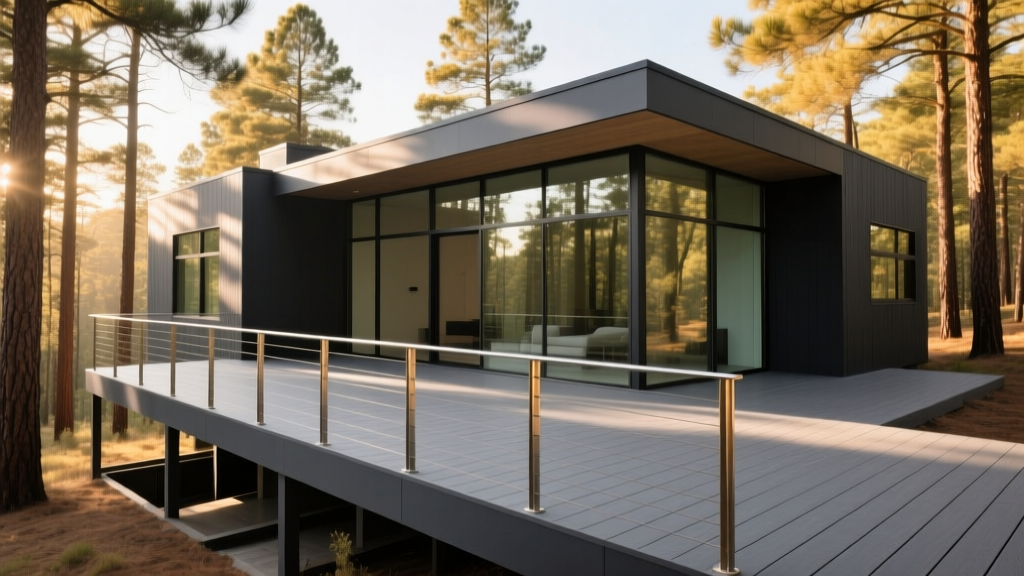
Top 3 Safest Decking Materials for Wildfire Zones
1. Mineral-Based Composite (MBC)
Mineral-based composites represent the current pinnacle of WUI-compliant decking. Unlike traditional WPCs that mix polyethylene with wood sawdust, MBC technology (pioneered by brands like Deckorators) replaces the organic wood flour with calcium carbonate (limestone) and polypropylene. Because there is zero organic material in the core, embers cannot ignite the board from within.
- Pros: Impervious to rot, zero water absorption (prevents freeze-thaw cracking), and maintains structural rigidity under high heat better than PVC.
- Cons: Limited color options compared to PVC; slightly heavier, requiring robust substructures.
- Application Note: Use hidden fastener systems to minimize top-down gaps where embers could lodge. Ensure a minimum 1/8-inch side gap for thermal expansion.
2. Capped Cellular PVC
Cellular PVC, such as AZEK's Vintage line, is entirely synthetic. The cellular foam core is wrapped in a dense polymer cap that resists scratching and moisture. Because it contains no wood fibers, it will not sustain combustion from wind-blown embers.
- Pros: Lightweight, highly workable, and available in a wide array of realistic wood-grain textures.
- Cons: Vulnerable to thermal sagging. Under the intense radiant heat of a nearby wildfire, PVC softens.
- Application Note: To prevent sagging during extreme heat events, you must reduce the joist spacing to a maximum of 12 inches on-center (O.C.) for diagonal installations and 16 inches O.C. for straight installations, strictly following the manufacturer's WUI guidelines.
3. Fire-Retardant Treated (FRT) Wood
For homeowners who demand the authentic look and feel of natural timber, FRT wood (like Fireline by Koppers) is the only code-compliant option. The wood is pressure-treated with fire-retardant chemicals that, when exposed to heat, release water vapor and form a non-combustible char layer, starving the fire of oxygen.
- Pros: Authentic wood aesthetic, lower upfront material cost, and can be cut and routed without losing fire resistance at the cut edges (unlike surface-coated woods).
- Cons: Requires annual maintenance and resealing to prevent the chemical treatment from leaching out due to weather exposure.
- Application Note: Never use FRT wood in direct ground contact. It must be elevated and properly ventilated to prevent moisture accumulation, which degrades the fire-retardant salts over time.
Installing a Class A deck board over a standard, untreated wood joist system creates a false sense of security. The California Office of the State Fire Marshal (OSFM) notes that embers frequently pass through the gaps between deck boards, accumulating on the wooden joists below. If the substructure ignites, the Class A deck boards will collapse. Always protect the substructure or use non-combustible steel joists in severe WUI zones.
Step-by-Step Application & Substructure Protection
To ensure your deck survives an ember shower, follow this application sequence during construction:
- Install Non-Combustible Joists: Swap traditional lumber for light-gauge steel joists (e.g., Fortress Steel Joists). If wood joists are mandated by budget, wrap the top and sides of the joists with a self-adherized fire-resistant flashing tape (like DeckWise JoistTape) to prevent ember ignition on the wood surface.
- Enclose the Under-Deck Zone: If the deck is elevated, enclose the perimeter. Use non-combustible skirting such as fiber cement boards, metal mesh (with a maximum 1/8-inch aperture to block embers), or horizontal fire-rated siding. Never use lattice, which easily traps dry leaves and ignites.
- Manage Board Gaps: Maintain a strict 3/16-inch gap between composite or PVC boards. This allows water drainage but is narrow enough to prevent large embers from passing through to the substructure. Use spacer tools during installation to guarantee uniformity.
- Secure with Stainless Steel Fasteners: Use stainless steel hidden clips. Galvanized screws can corrode, expanding the hole and creating wider gaps over time where embers can penetrate.
Maintenance and Ember-Proofing Your Existing Deck
Even the safest decking material for wildfire zones will fail if poorly maintained. Implement these protocols annually, especially before the local fire season:
- Clear the Gaps: Use a putty knife or specialized deck gap tool to clear pine needles, dry leaves, and dirt from between the boards. Accumulated organic debris acts as a wick for embers.
- Establish a 5-Foot Non-Combustible Zone: The area immediately adjacent to the deck must be free of combustible mulch, dried grass, and shrubs. Replace wood chips with crushed rock, gravel, or pavers extending at least 5 feet from the deck edge.
- Remove Under-Deck Storage: Never store firewood, propane tanks, gasoline, or combustible lawn equipment beneath a deck. WUI codes strictly prohibit this, as a single ember blown under the deck will ignite these materials and destroy the structure from below.
- Inspect Flashing and Skirting: Check the perimeter skirting for gaps caused by soil settling or animal burrowing. Seal any openings wider than 1/8-inch with metal mesh or fire-rated caulk.
By prioritizing mineral-based or cellular synthetic materials and treating the substructure with the same rigor as the surface boards, you can build a deck that not only meets stringent WUI codes but actively defends your home against the unpredictable nature of modern wildfires.
Written by
Marcus ChenMarcus Chen is a licensed structural engineer (PE) and building materials analyst with over 12 years of experience across residential, commercial, and industrial construction. He holds a Master of Science in Civil Engineering from UC Berkeley and spent six years at Thornton Tomasetti before transitioning to independent consulting and technical writing. Marcus specializes in material selection for seismic-prone regions, concrete reinforcement strategies, and lifecycle cost analysis. His work has been cited by the American Concrete Institute (ACI) and the Structural Engineers Association of California (SEAOC). When he is not on a job site or at his desk, you will find him hiking the Sierra Nevada or restoring a 1920s craftsman bungalow in Oakland, CA.
More from Marcus Chen
View all
Construction Cost
How Much Did the Eiffel Tower Cost to Build?
How much did the Eiffel Tower cost to build in 1889? We adjust for inflation and compare its budget to modern skyscraper construction.
Aug 4, 2026

Fire Resistance
What Is a Fire Resistant Material? Testing & Certification Guide
Discover what is a fire resistant material through ASTM and UL testing. Learn how fire ratings, certifications, and assemblies work in construction.
Aug 4, 2026

Construction Cost
How Much Did the Burj Khalifa Cost to Build?
How much did the Burj Khalifa cost to build? We break down the $1.5B project and extract 5 money-saving strategies for your next build.
Jul 30, 2026