Specifier's Fire-Resistant Materials List for Rated Wall Assemblies
Access the definitive fire-resistant materials list for rated assemblies. Compare Type X gypsum, intumescents, and firestops with 2026 costs and specs.

The Core Fire-Resistant Materials List for Rated Assemblies
Specifying the correct materials for fire-rated construction requires moving beyond generic categories and selecting products tested to specific ASTM E119 or UL 263 assembly standards. The NFPA Codes and Standards dictate that fire resistance is a property of the entire assembly—not just the individual material. Below is the foundational fire-resistant materials list categorized by assembly type, complete with current 2026 market pricing and performance thresholds.
| Material Category | Specific Product Type | Max Fire Rating | Est. Material Cost (2026) | Primary Application |
|---|---|---|---|---|
| Gypsum Board | 5/8" Type X (e.g., USG Firecode) | 1 to 2 Hours | $0.65 - $0.85 / sq ft | Interior shaft walls, corridor partitions |
| Gypsum Board | 5/8" Type C (Enhanced Core) | 2 to 4 Hours | $0.90 - $1.15 / sq ft | Area separation walls, ceiling membranes |
| Cementitious Board | Fiber-reinforced calcium silicate | 2 to 4 Hours | $3.50 - $5.00 / sq ft | Exterior fire walls, high-moisture shafts |
| Intumescent Coating | Water-based thin-film (e.g., FIRETEX) | Up to 2 Hours | $9.00 - $14.00 / sq ft | Exposed architectural structural steel |
| Firestop Sealant | Intumescent acrylic (e.g., Hilti CP 653) | 1 to 4 Hours | $12.00 - $18.00 / tube | Through-penetrations, blank openings |
Gypsum and Cementitious Boards: Beyond Basic Type X
Gypsum board remains the workhorse of passive fire protection due to its chemically bound water (calcium sulfate dihydrate). When exposed to fire, the calcination process releases this water as steam, actively delaying heat transmission to the unexposed side. However, treating all gypsum as equal is a critical specification error.
Standard Type X gypsum contains glass fibers to hold the calcined core together. Type C gypsum (such as USG Sheetrock Brand Firecode C) incorporates significantly more glass fibers alongside vermiculite. This prevents the core from shrinking and cracking when temperatures exceed 1,000°F (538°C). For 2-hour and 3-hour rated shaft walls, specifying Type C reduces the required number of board layers from three to two, offsetting the higher per-sheet cost with reduced labor and framing weight.
For environments where fire resistance intersects with high humidity or exterior exposure, cementitious boards like calcium silicate or fiber cement are mandatory. Unlike gypsum, calcium silicate does not degrade when wet. When detailing these boards, use stainless steel or hot-dipped galvanized fasteners spaced exactly 8 inches on center at the edges and 12 inches in the field to prevent board edge blowout during a fire event.
Intumescent Coatings: Mil Thickness and Substrate Rules
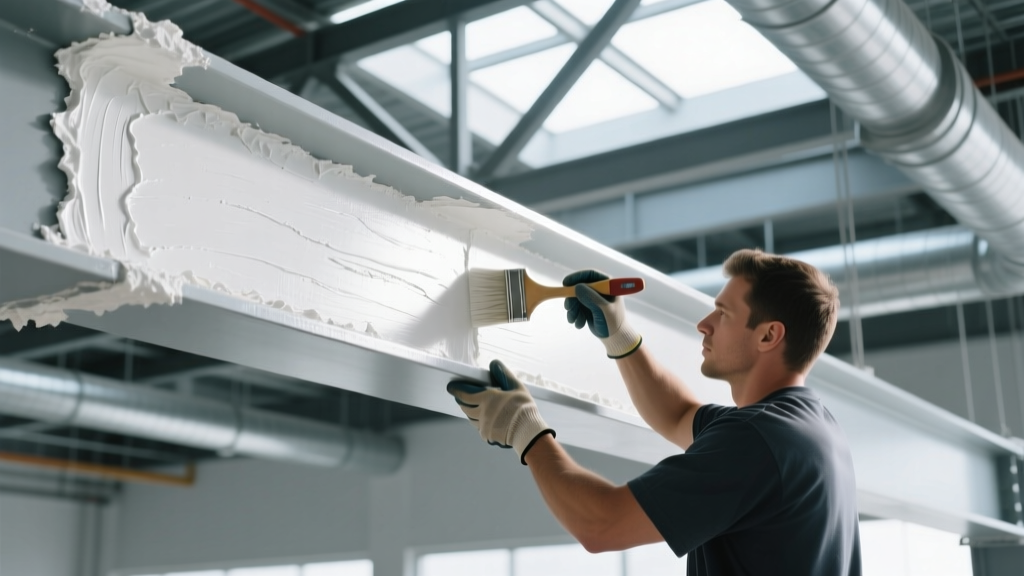
When architectural designs require exposed structural steel, spray-applied fire-resistive materials (SFRM) or intumescent paints are the standard. Intumescent coatings contain ammonium polyphosphate, which triggers a chemical reaction at approximately 392°F (200°C), causing the coating to expand up to 50 times its original thickness and form an insulating carbonaceous char.
According to UL Solutions Fire Testing protocols, the efficacy of an intumescent coating is entirely dependent on its Dry Film Thickness (DFT). A common application failure is measuring Wet Film Thickness (WFT) and assuming the correct DFT will follow. Because water-based intumescents can contain up to 40% water by volume, a 30-mil WFT application will shrink to roughly 18 mils DFT, potentially dropping the assembly's fire rating from 2 hours to less than 1 hour.
Steel vs. Wood Application Nuances
- Structural Steel: Requires a zinc-rich primer or specific epoxy tie-coat before intumescent application to prevent flash rust and delamination. Topcoats must be compatible; applying a high-solids polyurethane topcoat over a water-based intumescent can trap solvents and blister the fireproofing layer.
- Heavy Timber / Mass Timber: Intumescents for wood (like Sherwin-Williams FIRETEX M71) are formulated differently than those for steel. They are designed to delay the charring rate of the timber rather than insulate a melting metal substrate. Do not interchange steel and wood intumescent formulations.
Firestopping: Sealing the Weak Points
A 2-hour rated wall assembly is instantly downgraded to a 0-hour assembly if a 4-inch HVAC duct or electrical cable tray penetrates it without proper firestopping. The Gypsum Association Technical Resources emphasize that firestop systems must be tested and listed for the exact combination of penetrating item, base material, and annular space.
Do not rely on generic 'fire-rated' expanding foams from hardware stores for commercial through-penetrations. Instead, utilize engineered systems:
- Metallic Pipe Penetrations: Use intumescent firestop collars (e.g., Hilti CFS-C EL) that crush the melting PVC pipe or seal the annular gap around copper/steel pipes. Cost: $25-$45 per collar.
- Electrical Outlet Boxes: Install intumescent putty pads on the back of the electrical boxes. When heated, the putty expands to fill the box cavity, preventing flame drafting into the wall cavity. Cost: $12-$18 per pad.
- Blank Openings: For unused conduit sleeves, pack the opening with mineral wool (minimum 4 pcf density) and cap both sides with a minimum 1/2-inch depth of intumescent sealant.
Application Decision Framework
Use this matrix to rapidly determine the optimal material selection based on your specific construction scenario:
IF you are building interior corridor walls in a Type I or II commercial building THEN specify 5/8" Type X gypsum on 3-5/8" 20-gauge metal studs with sound attenuation batts.
IF you are detailing an elevator shaft that borders a high-moisture parking garage THEN specify 1/2" fiber-reinforced calcium silicate board over galvanized framing.
IF you have exposed W12x26 steel beams in a ground-floor lobby atrium THEN specify a thin-film water-based intumescent coating at 22 mils DFT, sealed with a tinted acrylic topcoat.
IF you are penetrating a rated concrete floor with a 6-inch PVC drain line THEN specify a cast-in-place intumescent firestop device with a built-in water seal, not just surface-applied caulking.
Top 3 Application and Inspection Failures
Even with the perfect fire-resistant materials list, poor execution leads to failed municipal inspections and compromised life safety. Avoid these three documented failure modes:
- Over-tightening Gypsum Fasteners: Driving drywall screws too deep breaks the paper face of the gypsum board. A broken paper face loses its structural grip on the gypsum core, causing the board to pull off the framing during a fire. Set screw guns to dimple the paper without tearing it.
- Ignoring Annular Space Limits: Firestop sealants are only tested and listed for specific gap widths (usually between 1/2" and 2"). If a pipe penetration leaves a 4-inch gap, the sealant will slump, crack, and fail the hose-stream test. Use mineral wool to reduce the gap to the listed dimension before applying sealant.
- Missing the 'F' and 'T' Ratings: Specifiers often look only at the 'F' rating (Flame resistance) of a firestop system. In multi-story buildings, you must also verify the 'T' rating (Temperature transmission). If the T-rating is lower than the F-rating, heat will transfer through the sealed penetration and ignite combustibles on the unexposed floor, even if flames are blocked.
Written by
Elena RodriguezElena Rodriguez is a civil engineer and technical writer specializing in concrete technology, masonry systems, and ASTM/ACI compliance. She earned her B.S. in Civil Engineering from Texas A&M University and spent a decade at a materials testing laboratory, performing over 2,000 concrete compressive strength tests and masonry prism evaluations. Elena is an ACI-certified Field Testing Technician (Grade I) and a member of ASTM Committee C12 on Natural Building Stone. She currently consults on forensic engineering cases involving concrete failures and moisture intrusion. Based in San Antonio, TX, Elena is a proud member of the Society of Women Engineers (SWE) and coaches her daughter's FIRST Robotics team.
More from Elena Rodriguez
View all
Walls & Panels
Cost Analysis: Light Gauge Steel Framing Advantages and Disadvantages
Evaluate light gauge steel framing advantages and disadvantages through a strict cost analysis lens, comparing material, labor, and lifecycle expenses.
Aug 4, 2026

Walls & Panels
Gypsum Board Types: Exact Specifications, Thickness & Dimensions
Compare standard, Type X, and moisture-resistant gypsum board types. Get exact specifications, thicknesses, dimensions, and ASTM standards for your project.
Aug 4, 2026

Fire Resistance
Best Fire-Resistant Outdoor Decking Materials: 2026 Buyer Guide
Discover the best fire-resistant outdoor decking materials for 2026. Compare Class A PVC, aluminum, and hardwood options for WUI compliance and safety.
Aug 4, 2026