Best Fire Resistant Roofing Material for 2026: Class A Compared
Compare the best fire resistant roofing materials for 2026. We review Class A metal, tile, and asphalt options, costs, and WUI code compliance.

The Anatomy of a Class A Fire Rating (ASTM E108)
When evaluating the best fire resistant roofing material, the term 'Class A' is frequently marketed but rarely understood. Governed by the ASTM E108 and UL 790 testing standards, a Class A rating indicates that a roof assembly can withstand severe fire exposure. This is not just a test of the outer shingle or panel; it is a test of the entire roof system, including the underlayment and decking.
To achieve a Class A rating, the assembly must pass three specific gauntlets:
- Intermittent Flame Exposure: The roof must resist flame penetration for at least two hours without structural failure.
- Spread of Flame: Flames cannot travel more than 6 feet across the surface of the roof during a 10-minute wind-driven test (12 mph).
- Burning Brand Test: A massive 12-inch by 12-inch wooden lattice brand (weighing 2,000 grams) is placed on the roof and subjected to wind. The assembly must not allow the brand to burn through the decking or produce flying embers.
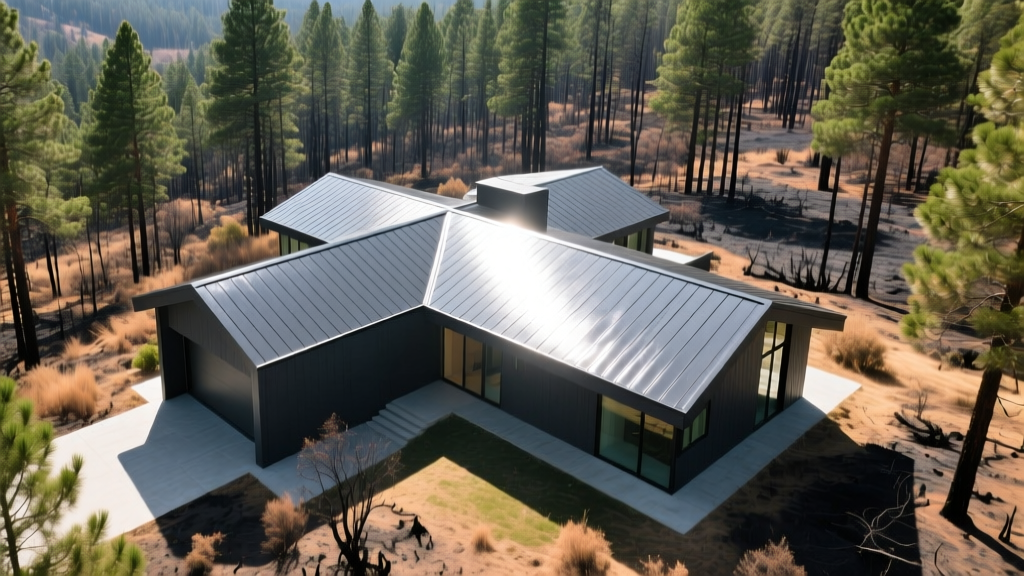
2026 Material Comparison Matrix
Pricing below reflects average installed costs per roofing square (100 sq. ft.) in 2026, factoring in recent supply chain stabilizations and labor rates. Weight metrics are crucial, as heavier materials require structural truss reinforcement.
| Material Type | Fire Rating | Avg. Installed Cost / Sq. | Weight (lbs/sq ft) | Ember Intrusion Risk |
|---|---|---|---|---|
| Standing Seam Metal | Class A | $950 - $1,450 | 1.0 - 1.5 | Extremely Low |
| Concrete / Clay Tile | Class A | $1,200 - $1,800 | 9.0 - 12.0 | Moderate (if gaps unsealed) |
| Synthetic Polymer Slate | Class A | $1,600 - $2,300 | 2.5 - 3.5 | Very Low |
| Fiberglass Asphalt (Class A) | Class A | $450 - $700 | 2.5 - 4.0 | Low (but vulnerable to direct flame) |
Deep Dive: Evaluating the Top Contenders
Standing Seam Metal: The Ember Shedder
For homes in high-risk WUI zones, standing seam metal roofing (such as profiles from ATAS International or Decra) is widely considered the best fire resistant roofing material available. Unlike corrugated panels that use exposed fasteners, standing seam systems feature concealed clips and a continuous, smooth surface. When wind-blown embers land on a metal roof, the lack of crevices prevents ember accumulation, and the non-combustible steel or aluminum simply dissipates the heat.
Failure Mode: The primary vulnerability is not the panel itself, but the valleys and eaves. If pine needles or dry leaves accumulate in roof valleys or gutters, an ember can ignite the debris. The resulting sustained heat can compromise the metal's protective coating and eventually ignite the underlying decking if a fire-rated underlayment was not used.
Concrete and Clay Tile: The Heavyweights
Products like Boral Roofing's Saxony 900 concrete tiles offer exceptional thermal mass and inherent non-combustibility. However, the curved profile of barrel tiles creates hollow channels beneath the roofing surface.
The 'Bird Stop' Requirement: Wind-blown embers can easily be sucked into these hollow channels via the eaves. To maintain WUI compliance, installers must use specialized 'bird stops' (metal closures at the eave) and fire-resistant mortar or foam to seal the gaps. If these secondary defenses fail, embers can ignite the battens or underlayment beneath the tiles, leading to a hidden roof fire that is incredibly difficult for firefighters to detect and extinguish.
Synthetic Polymer Slate: The Lightweight Alternative
Manufactured from engineered polymers and recycled rubber, synthetic slates (such as DaVinci Roofscapes) offer the aesthetic profile of natural slate or wood shake without the weight or combustibility. These materials are injected with fire-retardant chemicals during the extrusion process, earning a Class A rating. They are interlocking and lay flat, eliminating the ember-intrusion channels found in traditional tile roofs.
Class A Fiberglass Asphalt Shingles: The Budget Option
Modern fiberglass asphalt shingles (like CertainTeed Landmark IR) use a fiberglass mat base rather than organic felt, making them inherently more fire-resistant and capable of achieving a Class A rating. However, they remain the most vulnerable of the Class A options during a direct wildfire event. While they will resist a single burning brand, sustained radiant heat or direct flame impingement from a burning adjacent tree will melt the asphalt binder, exposing the decking to ignition.
The Underlayment Trap: Where Assemblies Fail
The most common mistake contractors make when installing fire-resistant roofs is pairing a premium Class A exterior material with a standard #15 or #30 asphalt felt underlayment. According to guidelines published by the Insurance Institute for Business & Home Safety (IBHS), the underlayment is your last line of defense if the outer layer is breached by a burning branch or accumulated debris.
For true fire resistance, especially in WUI zones, you must specify a non-combustible or specialized fire-rated underlayment. Options include:
- Grace Ice & Water Shield HT: While primarily a water barrier, high-temperature variants resist melting under metal roofs and provide a secondary sealed layer.
- FireShield or similar non-combustible underlayments: Specifically tested and listed for use in WUI assemblies to prevent ember penetration through the decking seams.
Expect to add $85 to $150 per square to your material budget when upgrading from standard felt to a premium WUI-compliant underlayment.
Navigating WUI Building Codes
If you are building or re-roofing in a designated Wildland-Urban Interface zone, local building codes will dictate your material choices. Chapter 7A of the California Building Code is widely considered the gold standard for WUI regulations across the western United States. The California Office of the State Fire Marshal maintains a strict directory of approved WUI materials. A product cannot simply claim a 'Class A' rating; it must pass the specific WUI testing protocols and be listed in the state's approved directory.
Furthermore, the NFPA Firewise USA program emphasizes that the roof is the most vulnerable part of a home during a wildfire. Their framework requires not just a Class A roof, but a 0-to-5-foot non-combustible zone immediately surrounding the home's perimeter to prevent ground fires from lapping up onto the eaves.
Final Decision Framework
Selecting the best fire resistant roofing material requires balancing your budget, your home's structural load capacity, and your specific wildfire risk profile.
Actionable Selection Guide
Choose Standing Seam Metal if: You live in a high-risk WUI zone with heavy tree cover. The smooth surface sheds embers and pine needles effortlessly, and the lightweight nature requires no structural reinforcement.
Choose Concrete Tile if: You are building in a region with high hail and wind risks alongside fire risks, and your home's trusses are engineered to support 1,000+ lbs per square. You must commit to rigorous annual maintenance of the eave closures.
Choose Synthetic Polymer if: You require the aesthetic of a historic slate or wood shake home in a fire zone, but your roof pitch or structural framing cannot support natural stone.
Choose Class A Asphalt Shingles if: You are in a moderate-risk zone, operating on a strict budget, and are willing to pair the shingles with a premium fire-rated underlayment to compensate for the material's thermal limitations.
Ultimately, the best fire resistant roofing material is only as effective as its installation. Ensure your contractor is certified in WUI assembly protocols, uses listed fire-rated underlayments, and seals all eaves, ridges, and valleys against ember intrusion.
Written by
James ThorntonJames Thornton is a construction industry veteran with 25 years of hands-on experience in wood framing, lumber grading, and residential building codes. He started as a framing carpenter in rural Oregon, earned his ICC Residential Building Inspector certification, and eventually became a senior plan reviewer for the City of Portland Bureau of Development Services. James holds a B.S. in Wood Science & Technology from Oregon State University and is a certified lumber grader through the West Coast Lumber Inspection Bureau (WCLIB). He has inspected over 3,000 residential construction sites and authored the city's internal guide on advanced framing techniques (2x6 at 24" O.C.). James lives in Bend, OR, where he builds custom timber-frame cabins and competes in lumberjack sports.
More from James Thornton
View all
Insulation
Best Home Insulation Materials: Complete 2026 Guide
Compare top home insulation materials for 2026. Find R-values, installed costs per square foot, and best uses for fiberglass, spray foam, and mineral wool.
Aug 4, 2026

Sustainable Building
Certify Your Green Building Material for LEED and WELL
Step-by-step guide to certifying a green building material for LEED v5 and WELL v2. Master EPDs, HPDs, and VOC limits for 2026 project specifications.
Aug 4, 2026

Stone & Masonry
Veneer Stacked Stone Panels: Interior Design & Style Showcase
Discover how veneer stacked stone panels transform interiors. Explore modern design profiles, material pairings, and technical installation specs.
Aug 4, 2026