Fire Resistant Wall Materials Cost Analysis: 2026 Price Breakdown
Compare the costs of top fire resistant wall materials in 2026. Detailed pricing for Type X gypsum, cement board, and intumescent coatings per square foot.
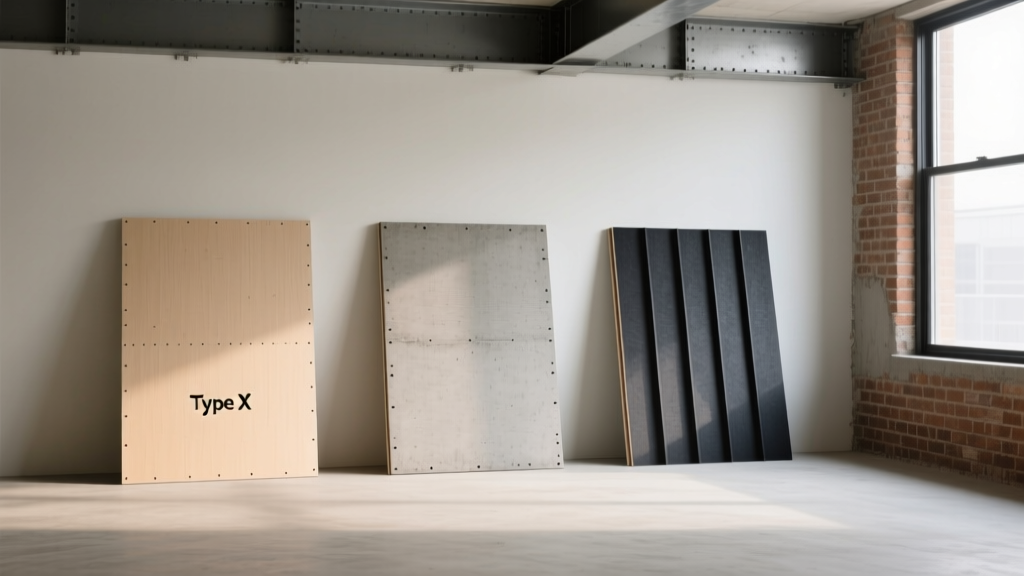
The True Cost of Fire-Rated Wall Assemblies
Specifying fire resistant wall materials requires balancing upfront assembly costs against long-term code compliance, spatial efficiency, and insurance benefits. In the 2026 construction market, raw material prices for fiberglass-faced gypsum and calcium silicate products have stabilized, but labor costs for specialized firestop detailing continue to rise. A fire-rated wall is not just a single material; it is a tested assembly governed by National Fire Protection Association (NFPA) standards and ASTM E119 testing protocols. Budgeting accurately means pricing the entire system: panels, framing, fasteners, joint treatment, and firestop sealants.
2026 Material & Installation Cost Matrix
The following matrix breaks down the average commercial costs per square foot for the most common fire resistant wall materials. Labor rates reflect national commercial averages for union and prevailing-wage contractors.
| Material Type | Typical Thickness | Fire Rating | Material Cost / Sq Ft | Labor Cost / Sq Ft | Total Installed / Sq Ft |
|---|---|---|---|---|---|
| Type X Gypsum Board | 1/2" | 1-Hour | $0.50 - $0.65 | $1.20 - $1.50 | $1.70 - $2.15 |
| Type C Gypsum Board | 5/8" | 2-Hour | $0.85 - $1.10 | $1.40 - $1.75 | $2.25 - $2.85 |
| Cement Board (e.g., Durock) | 1/2" | 1-Hour* | $1.80 - $2.40 | $2.50 - $3.20 | $4.30 - $5.60 |
| Calcium Silicate Board | 1" | 2-Hour | $3.50 - $4.80 | $4.00 - $5.50 | $7.50 - $10.30 |
| Intumescent Coating | N/A (Surface) | 1 to 2-Hour** | $4.50 - $7.00 | $3.00 - $4.50 | $7.50 - $11.50 |
**Note on Intumescent Coatings: Pricing varies wildly based on the required mil thickness to achieve the specified rating for the underlying substrate.
Deep Dive: Gypsum Board Variations
Gypsum remains the undisputed workhorse of interior fire-resistant construction. The core of the board contains calcium sulfate dihydrate. When exposed to fire, the water of crystallization turns to steam, actively retarding heat transfer. The Gypsum Association outlines strict manufacturing standards for the two primary fire-rated variants:
Type X vs. Type C Gypsum
- Type X (Standard Fire-Rated): Contains glass fibers to hold the calcined core together as it dehydrates. A single layer of 5/8" Type X on each side of steel studs typically yields a 1-hour rating. Material cost averages $0.60 per square foot.
- Type C (Enhanced Fire-Rated): Contains a higher density of glass fibers and often includes vermiculite to improve core cohesion and shrinkage resistance at extreme temperatures. Products like USG Sheetrock Brand Firecode C or National Gypsum Fire-Shield allow for thinner assemblies or higher ratings (e.g., achieving a 2-hour rating with fewer layers). Material cost averages $0.95 per square foot.
While Type C costs roughly 58% more in materials than Type X, it can reduce labor costs by eliminating the need for a second layer of drywall in 2-hour rated assemblies, often resulting in a net savings of $0.40 to $0.80 per square foot on the total installed wall.
High-Moisture & Shaft Applications: Cement and Calcium Silicate
Standard paper-faced gypsum fails in high-moisture environments, even when treated for mold resistance. For elevator shafts, stairwells, and exterior fire walls, builders must pivot to cementitious or calcium silicate panels.
Calcium Silicate Boards
Products like Promat PROMATECT or SkamoWall offer exceptional fire performance and structural stability without the paper facing that molds or delaminates. However, the cost premium is steep. A 1-inch calcium silicate board costs upwards of $4.00 per square foot just for the material. Furthermore, labor costs spike due to the board's density. Cutting calcium silicate requires specialized diamond-tipped blades and strict OSHA-compliant silica dust mitigation protocols, adding 20% to 30% to standard drywall labor rates.
Cement Board Assemblies
For areas requiring both fire resistance and impact/moisture resistance (such as commercial kitchen enclosures or mechanical rooms), fiberglass-mesh reinforced cement boards like USG Durock Brand are specified. Because cement board does not contain crystalline water, it relies on the assembly's mass and insulating air gaps (often filled with 3 lb/cu ft mineral wool) to achieve its fire rating.
Never substitute materials within a tested fire-rated assembly. If the UL design specifies a specific brand of cement board, stud gauge, and screw spacing, substituting a cheaper generic cement board voids the fire rating and violates the International Building Code (IBC). Always consult the manufacturer's published UL system designs before value-engineering a fire wall.
The Hidden Costs: Firestopping and Framing
Contractors frequently underestimate the ancillary costs required to make a fire resistant wall assembly legally compliant. The board is only one component of the system.
Firestop Sealants and Putties
Every penetration (electrical boxes, HVAC ducts, plumbing pipes) and every perimeter joint (where the wall meets the floor or ceiling deck) must be sealed with tested firestop materials.
- Elastomeric Sealants: Products like Hilti CP 606 or 3M Fire Barrier Caulk cost approximately $12 to $18 per 10.1 oz tube. A single tube covers roughly 15 linear feet of a 1/2" joint. For a 10,000 sq ft commercial buildout, firestop caulking alone can add $3,500 to $5,000 to the budget.
- Intumescent Wraps/Pillows: For plastic pipe penetrations that melt during a fire, intumescent wrap strips (e.g., Hilti CFS-BL) are required. These cost $40 to $80 per penetration, drastically driving up MEP (Mechanical, Electrical, Plumbing) coordination costs.
Steel Stud Framing Variables
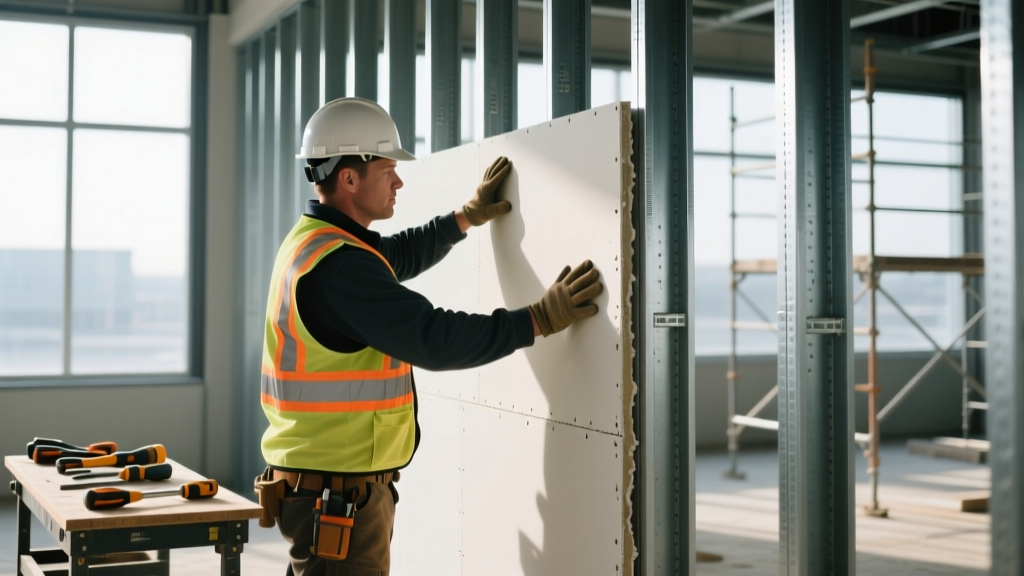
Fire ratings dictate framing specifications. A standard 1-hour partition might use 25-gauge steel studs at 24 inches on center (OC). However, a 2-hour or 3-hour area separation wall often requires 20-gauge or 16-gauge studs at 16 inches OC to support the massive weight of multiple layers of 5/8" Type X or Type C gypsum. Upgrading from 25-gauge to 16-gauge steel studs increases framing material costs by approximately 65%, adding $1.10 to $1.50 per square foot of wall area.
Retrofitting Existing Walls: Intumescent Coatings
In historic renovations or adaptive reuse projects, tearing out existing lath and plaster or legacy drywall to install modern fire-rated assemblies is often structurally or financially unfeasible. Intumescent paints and coatings offer a surface-applied alternative.
When exposed to heat, intumescent coatings swell to form a thick, insulating carbonaceous char, protecting the underlying substrate. Applying a product like Sherwin-Williams FIRETEX or Nullifire over an existing wall can upgrade its rating. However, this is the most expensive option per square foot. Material costs range from $4.50 to $7.00 per square foot, and application requires certified spray contractors, rigorous mil-thickness inspections, and a protective topcoat for aesthetic finishes. Total installed costs frequently exceed $10.00 per square foot.
Practical Decision Framework for Specifiers
Use this framework to select the most cost-effective fire resistant wall materials based on your specific project constraints:
- Standard Interior Partitions (Offices, Retail): Use 5/8" Type X gypsum on 25-gauge steel studs. It offers the lowest installed cost ($1.70 - $2.15/sq ft) and fastest installation time.
- Space-Constrained 2-Hour Walls (Corridors, Tenant Separations): Use 5/8" Type C gypsum. The higher material cost is offset by eliminating the need for a second layer of drywall, saving crucial floor space and reducing labor.
- Shaft Walls & High-Moisture Areas: Use 1" Calcium Silicate or specialized shaftliner panels. Accept the high material and labor costs as a mandatory requirement for moisture and structural integrity.
- Historic Retrofits: Use Intumescent Coatings only when demolition of existing walls is prohibited by preservation codes or structural limitations.
ROI & Insurance Considerations: While upgrading from a 1-hour to a 2-hour fire-rated assembly using Type C gypsum or calcium silicate may increase initial construction costs by 15% to 25%, commercial property owners frequently see a 5% to 12% reduction in annual property insurance premiums. For large multi-family or commercial assets, the upgraded fire resistant wall materials often pay for themselves within 3 to 5 years through insurance savings alone, while simultaneously increasing the building's overall valuation and safety profile.
Written by
Marcus ChenMarcus Chen is a licensed structural engineer (PE) and building materials analyst with over 12 years of experience across residential, commercial, and industrial construction. He holds a Master of Science in Civil Engineering from UC Berkeley and spent six years at Thornton Tomasetti before transitioning to independent consulting and technical writing. Marcus specializes in material selection for seismic-prone regions, concrete reinforcement strategies, and lifecycle cost analysis. His work has been cited by the American Concrete Institute (ACI) and the Structural Engineers Association of California (SEAOC). When he is not on a job site or at his desk, you will find him hiking the Sierra Nevada or restoring a 1920s craftsman bungalow in Oakland, CA.
More from Marcus Chen
View all
Construction Cost
How Much Did the Eiffel Tower Cost to Build?
How much did the Eiffel Tower cost to build in 1889? We adjust for inflation and compare its budget to modern skyscraper construction.
Aug 4, 2026

Fire Resistance
What Is a Fire Resistant Material? Testing & Certification Guide
Discover what is a fire resistant material through ASTM and UL testing. Learn how fire ratings, certifications, and assemblies work in construction.
Aug 4, 2026

Construction Cost
How Much Did the Burj Khalifa Cost to Build?
How much did the Burj Khalifa cost to build? We break down the $1.5B project and extract 5 money-saving strategies for your next build.
Jul 30, 2026