How Much Would It Cost to Build a Fireplace? 2026 Fire-Safe Cost Guide
Discover how much it costs to build a fireplace in 2026. Breakdown of fire-resistant materials, NFPA clearances, masonry vs. gas costs, and code compliance.

The True Cost of Building a Fire-Safe Fireplace (2026 Matrix)
When evaluating how much it would cost to build a fireplace, standard contractor estimates often obscure the premium required for strict fire code compliance. In 2026, building a fully compliant, fire-rated fireplace assembly costs between $4,500 and $15,500+, with fire-resistant materials and clearance framing accounting for 18% to 24% of the total material budget. Cutting corners on firestopping or using standard drywall instead of Type X gypsum is the primary reason for failed municipal inspections and catastrophic structural fires.
| Fireplace Type | Base Material Cost | Fire-Safety Adders (Clearances, Firestops) | Total Installed Range (2026) | Fire Risk Profile |
|---|---|---|---|---|
| Masonry Wood-Burning | $5,500 - $9,000 | $1,200 - $2,500 | $8,500 - $15,500+ | High (Requires strict NFPA 211 clearances) |
| Zero-Clearance Gas Insert | $2,500 - $5,000 | $600 - $1,200 | $4,500 - $9,000 | Moderate (Direct venting, Type B gas vent) |
| Electric Built-In | $800 - $2,000 | $150 - $400 | $1,500 - $3,500 | Low (No combustion, standard electrical firestopping) |
Mandatory Fire-Resistant Materials & Exact Specifications
The firebox and immediate surround endure extreme thermal cycling. Standard building materials will degrade, crack, or ignite. The following materials are non-negotiable for the inner assembly and immediate framing.
Firebrick and Refractory Mortar (ASTM C27 & ASTM C199)
The interior firebox must be lined with medium-duty firebrick rated for continuous exposure up to 2,500°F (ASTM C27). Standard clay bricks will spall and explode under direct flame impingement due to trapped moisture.
- Material Cost: $2.50 to $4.00 per firebrick.
- Refractory Mortar: Must be heat-resistant calcium aluminate mortar (ASTM C199). Standard Portland cement mortar will dehydrate and crumble after three heating cycles. Expect to pay $45 to $65 per 50 lb. bucket of premixed refractory mortar.
Type X Gypsum Board for Framing Enclosures
When framing the chimney chase or surround enclosure, standard 1/2-inch drywall is a code violation in most jurisdictions. You must use 5/8-inch Type X gypsum board (e.g., USG Firecode C). Type X contains glass fibers that maintain the structural integrity of the gypsum core when the paper facing burns away, providing a verified 1-hour fire rating per ASTM E119.
- Cost: $28 to $36 per 4x8 sheet.
- Application: Required on all interior walls separating the fireplace chase from living spaces, and often required in double layers for 2-hour rated assemblies in multi-family dwellings.
Combustible Clearances & Hearth Extensions (NFPA 211)
The most common cause of concealed framing fires is the violation of combustible clearance rules. According to NFPA 211 (Standard for Chimneys, Fireplaces, Vents, and Solid Fuel-Burning Appliances), specific air spaces must be maintained to prevent pyrophoric carbonization—the process where wood repeatedly exposed to low heat lowers its ignition temperature over time.
Non-Combustible Hearth Extensions
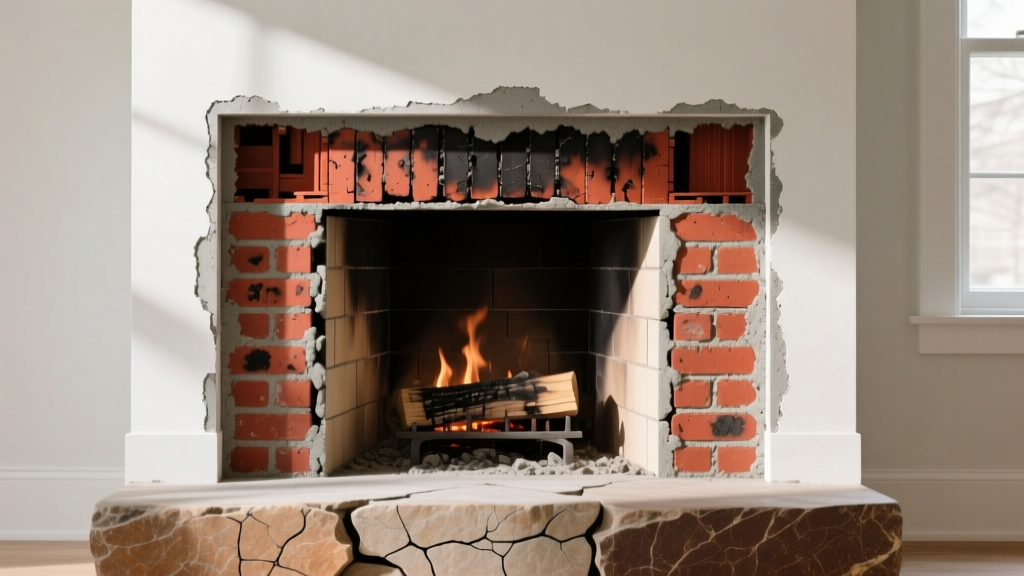
The hearth extension protects the subfloor from radiant heat and escaping embers. For fireplace openings smaller than 6 square feet, the hearth must extend at least 16 inches in front of the facing and 8 inches on each side.
- Substrate: Must be built on a non-combustible base. Use 1/2-inch cement backer board (e.g., Durock) over the wood subfloor, secured with alkali-resistant thinset.
- R-Value Requirement: In many 2026 IRC jurisdictions, the hearth extension must achieve a minimum thermal resistance (R-value) of 1.0 to prevent subfloor ignition. This often requires a specialized microporous insulation board (like Micore 160) beneath the final stone or tile layer, adding $120 to $250 to the material cost.
Hidden Costs: Firestopping, Draftstopping, and Inspections
Budgeting for a fireplace requires accounting for the concealed fire safety systems that municipal inspectors will verify before signing off on the final certificate of occupancy.
- Intumescent Firestop Sealants ($12 - $25 per tube): Where the chimney or gas vent penetrates floors or fire-rated walls, you must seal the annular gap with an intumescent sealant (e.g., 3M Fire Barrier Sealant FD 150+). This material expands up to 5x its volume when exposed to heat, choking off oxygen and preventing smoke migration.
- Chimney Flashing & Radiation Shields ($150 - $400): At the roof penetration, a listed radiation shield is required to maintain the 2-inch clearance between the Class A chimney pipe and the roof sheathing. Standard roofing tar and aluminum flashing are insufficient; you must use manufacturer-specific, UL-listed storm collars and flashing kits.
- Inspection Fees ($150 - $350): Most municipalities require a three-stage inspection for masonry fireplaces: footing/foundation, rough-in (framing and clearances before drywall), and final (flue draw and smoke test). Factor these administrative costs into your initial budget.
Wood vs. Gas vs. Electric: Fire Safety Cost Multipliers
The choice of fuel source drastically alters the fire safety budget. The EPA's Burn Wise program heavily regulates wood-burning appliances due to particulate emissions, which indirectly impacts the cost of certified, safe wood-burning units.
- Wood-Burning (Highest Safety Cost): Requires full masonry or UL-listed Class A insulated stainless steel chimney pipe ($75-$120 per linear foot). Requires spark arrestors, heavy-duty radiation shields, and strict combustible clearances. Adds roughly $2,500 in fire-safety specific materials compared to a basic structural build.
- Direct-Vent Gas (Moderate Safety Cost): Uses a coaxial venting system (exhaust inside, combustion air intake outside). Because the outer pipe remains relatively cool, clearance requirements are less stringent (often 1 inch to combustibles). Eliminates the need for a masonry chimney, saving $4,000+ in structural fireproofing.
- Electric (Lowest Safety Cost): Generates zero real combustion heat. The only fire-safety cost involves standard electrical firestopping where the dedicated 20-amp circuit penetrates top/bottom plates in the wall cavity.
Expert FAQ: Fireplace Construction & Fire Ratings
Can I use standard thinset mortar to install stone veneer on my fireplace surround?
No. Standard polymer-modified thinset can degrade under sustained thermal loads exceeding 180°F. For fireplace surrounds, use a high-heat, non-combustible mortar or a specialized latex-portland cement mortar explicitly rated for high-thermal applications. Additionally, the substrate must be cement board or metal lath over Type X gypsum, never standard drywall.
What is the difference between a "fire-rated" assembly and a "zero-clearance" fireplace?
A fire-rated assembly refers to the surrounding architectural structure (walls, floors) resisting fire spread for a specific duration (e.g., 1-hour or 2-hour rating per ASTM E119). A "zero-clearance" fireplace is a manufactured, UL-listed steel appliance designed with internal insulation and air-cooling channels, allowing its exterior metal jacket to be placed directly (zero inches) against wood framing. However, the connecting chimney pipe still requires strict clearances.
Do I need a firestop at every floor level for a gas fireplace vent?
Yes. According to the International Residential Code (IRC), any penetration through a floor/ceiling assembly or a fire-resistance-rated wall must be firestopped. For Type B gas vents, this requires a listed firestop spacer and intumescent sealant at every floor penetration to prevent the chimney chase from acting as a conduit for smoke and flames during a structural fire.
Written by
David NakamuraDavid Nakamura is a licensed architect (AIA) and construction technology writer focused on sustainable building methods, mass timber engineering, and high-performance building envelopes. He holds a Master of Architecture from the University of Washington and is a certified Passive House Consultant (CPHC). David spent eight years at the Seattle firm Mithun, where he led the design of three LEED Platinum projects, before founding his own practice specializing in net-zero residential design. He serves on the editorial advisory board of GreenBuilder Magazine and has authored peer-reviewed papers on cross-laminated timber (CLT) connections for the Journal of Structural Engineering. In his spare time, David teaches woodworking at Pratt Fine Arts Center and kayaks the Puget Sound.
More from David Nakamura
View all
Construction Cost
Labor Cost to Build a Deck Per Sq Ft: 2026 Installation Guide
Discover the exact labor cost to build a deck per sq ft in 2026. This installation guide breaks down contractor rates, complexity factors, and hidden fees.
Aug 4, 2026

Construction Cost
How Much Does It Cost to Build a 3 Bedroom House? Financing Guide
Learn exactly how much it costs to build a 3 bedroom house and explore 2026 financing options, construction loan types, and budget frameworks for your build.
Aug 4, 2026

Construction Cost
Cost to Build a Tennis Court: 2026 Guide
How much does it cost to build a tennis court in 2026? Breakdowns for asphalt, concrete, and synthetic surfaces plus fencing and lighting.
Jul 30, 2026