Fire Retardant Building Materials Cost Analysis & 2026 Pricing Guide
Compare 2026 costs for fire retardant building materials. Get exact pricing per square foot for drywall, coatings, and lumber to budget your build.

The True Cost of Fire Retardant Building Materials in 2026
Specifying fire retardant building materials requires balancing upfront capital expenditure against long-term risk mitigation, code compliance, and insurance premium reductions. While standard construction materials focus on structural load and thermal insulation, fire-rated assemblies must meet stringent ASTM E119 and UL 263 time-temperature curve standards. In 2026, supply chain stabilization has normalized the pricing of specialized chemical treatments and mineral-based boards, but labor premiums for certified installers remain a significant budget variable.
Before analyzing specific line items, it is critical to distinguish between fire-resistant materials (which possess inherent non-combustible properties, like concrete and masonry) and fire-retardant materials (which are chemically treated or coated to delay ignition and char formation, such as FRT lumber and intumescent paints). This cost analysis covers both categories as they are functionally specified together to achieve required fire-resistance ratings (FRR) under NFPA 220 Standard on Types of Building Construction.
2026 Executive Cost Summary
- Baseline Premium: Expect a 12% to 18% overall material cost increase for a fully fire-rated commercial assembly compared to standard code-minimum construction.
- Most Cost-Effective Upgrade: 5/8-inch Type X Gypsum Board (approx. $0.25/sq. ft. premium over standard 1/2-inch board).
- Highest Labor Variance: Intumescent steel coatings, where surface preparation and dry-film thickness (DFT) verification can double the installed price.
Material-by-Material Cost Breakdown
Type X and Type C Gypsum Board
Gypsum board is the backbone of passive fire protection. The core of Type X drywall (such as USG Sheetrock Firecode C) contains glass fibers and vermiculite that maintain structural integrity as the calcined gypsum dehydrates under extreme heat. According to the Gypsum Association, a single layer of 5/8-inch Type X provides a 1-hour fire rating on wood or steel studs, while Type C offers enhanced shrinkage resistance for multi-layer 2-hour to 4-hour assemblies.
- Material Cost (5/8" Type X): $0.48 – $0.62 per square foot.
- Installed Cost (Single Layer, Taped/Finished): $1.85 – $2.40 per square foot.
- Material Cost (5/8" Type C): $0.65 – $0.85 per square foot.
- Failure Mode / Edge Case: Using standard joint compound instead of fire-rated setting-type compound (e.g., USG Firecode) at the joints will void the UL assembly rating, leading to failed municipal inspections and costly tear-outs.
Intumescent Coatings for Structural Steel
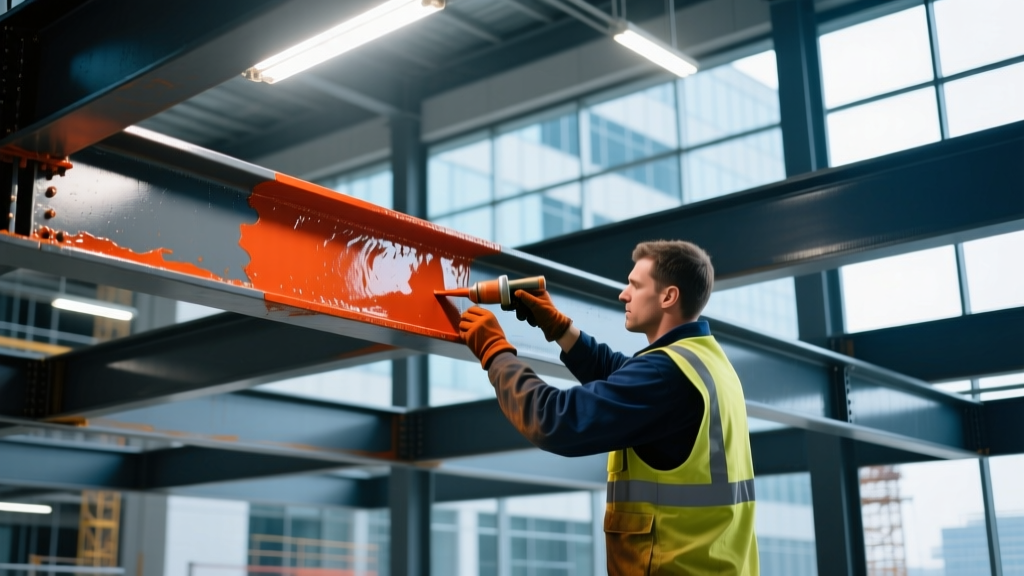
Unprotected structural steel loses 50% of its yield strength at 1,100°F (593°C), a temperature reached within 5 minutes of a standard flashover. Intumescent coatings react to heat by swelling up to 50 times their original thickness, forming an insulating carbonaceous char. Water-based acrylic intumescents (like Sherwin-Williams FIRETEX or Nullifire) are standard for interior commercial applications.
- Material Cost: $3.50 – $5.20 per square foot (based on required wet/dry mil thickness).
- Installed Cost: $7.50 – $12.00 per square foot.
- Technical Specificity: Achieving a 2-hour FRR on a W10x49 steel column typically requires 35 to 45 dry mils of coating. This necessitates multiple passes and strict ambient humidity controls (below 80% RH) during application.
Fire-Retardant-Treated (FRT) Lumber
FRT lumber is pressure-impregnated with water-soluble salts (like borates or diammonium phosphate) that release non-combustible gases and water vapor when heated, quenching the flame front. The American Wood Council notes that FRT wood is heavily mandated in Type III and Type V construction for roof assemblies and exterior wall framing in Wildland-Urban Interface (WUI) zones.
- Material Premium: 18% to 28% over untreated SPF (Spruce-Pine-Fir) or Southern Yellow Pine.
- Unit Cost (2x4x8 FRT Stud): $4.85 – $5.60 (compared to $3.40 for standard).
- Corrosion Warning: FRT chemicals are highly corrosive to standard zinc galvanized fasteners. You must budget for hot-dipped galvanized (ASTM A153) or stainless steel fasteners, adding roughly $0.15 to $0.25 per square foot to framing hardware costs.
2026 Pricing Matrix: Fire Retardant Building Materials
| Material Category | Specific Product / Type | Material Cost (per sq. ft.) | Fully Installed Cost (per sq. ft.) | Typical Fire Rating Achieved |
|---|---|---|---|---|
| Gypsum Board | 5/8" Type X (Standard) | $0.48 - $0.62 | $1.85 - $2.40 | 1 Hour (Single Layer) |
| Gypsum Board | 5/8" Type C (Enhanced) | $0.65 - $0.85 | $2.10 - $2.75 | 2-4 Hours (Multi-Layer) |
| Intumescent Paint | Water-Based Acrylic (Interior) | $3.50 - $5.20 | $7.50 - $12.00 | 1-2 Hours (Steel) |
| Intumescent Paint | Epoxy-Based (Exterior/Hydrocarbon) | $8.00 - $14.00 | $18.00 - $26.00 | 1-3 Hours (Jet Fire) |
| FRT Lumber | Interior Pressure-Treated Framing | $1.10 - $1.40 (board ft) | N/A (Framing Labor) | Class A Flame Spread |
| Firestop Sealant | Intumescent Caulk (Pipes/Cables) | $0.85 - $1.20 (linear ft) | $3.50 - $5.00 (linear ft) | 1-3 Hours (Penetration) |
Hidden Costs and Installation Variables
Budgeting for fire retardant building materials strictly by the pallet or bucket will result in severe cost overruns. The following hidden variables frequently impact the final ledger:
Surface Preparation for Intumescents
Steel must be blast-cleaned to SSPC-SP6 (Commercial Blast) standards and primed with a highly specific, manufacturer-approved epoxy primer. If the structural steel arrives with incompatible mill scale or shop primer, the contractor must sandblast the beams on-site, adding $2.50 to $4.00 per square foot in prep costs and delaying the critical path.
- Climate Control for Curing: Water-based intumescents and fire-rated joint compounds require specific temperature (above 50°F) and humidity parameters to cure without blistering. In winter construction, budgeting for temporary HVAC and dehumidifiers is mandatory.
- Specialized Inspection Fees: Intumescent coatings require third-party special inspectors to measure Wet Film Thickness (WFT) during application and Dry Film Thickness (DFT) post-cure using magnetic pull-off gauges. Expect to pay $1,200 to $2,500 per day for certified fireproofing inspectors.
- Firestop Penetration Sealing: Every MEP (Mechanical, Electrical, Plumbing) penetration through a fire-rated wall requires an approved firestop system (e.g., Hilti or STI). Budget $150 to $350 per penetration for materials and specialized labor, a line item often omitted in early schematic estimates.
ROI and Insurance Premium Reductions
The financial justification for premium fire retardant building materials extends beyond the certificate of occupancy. Commercial property insurance underwriters utilize the Insurance Services Office (ISO) Commercial Property Rating Schedule. Buildings utilizing superior fire-resistive assemblies, active suppression, and verified firestopping can achieve a Protected Building Classification, drastically reducing premiums.
"Upgrading from a standard combustible Type V wood-frame assembly to a Type III FRT/Type X gypsum hybrid can yield commercial property insurance premium reductions of 15% to 25% over the life of a 10-year policy, effectively paying for the initial material premium by year four."
— 2025 Commercial Risk Mitigation Report, National Association of Mutual Insurance Companies
Decision Framework: When to Spend More on Fire Resistance
Use the following matrix to determine where to allocate budget for fire retardant building materials based on project typology and risk profile.
If / Then Scenarios for Material Selection
- IF the project is a multi-family residential build in a high-density urban zone, THEN prioritize Type C gypsum board on shaft walls and party walls to maximize STC (Sound Transmission Class) and 2-hour FRR, accepting the $0.17/sq. ft. material premium over Type X.
- IF the project features exposed architectural steel in a lobby or atrium, THEN specify water-based thin-film intumescents with a high-build polyurethane topcoat. Do not use cementitious spray-on fireproofing (SFRM), as it is aesthetically unacceptable and requires expensive custom furring to encapsulate.
- IF the project is located in a designated WUI (Wildland-Urban Interface) zone, THEN abandon FRT exterior wood siding entirely. The chemical treatments leach over time when exposed to weather. Instead, specify inherently fire-resistant fiber cement siding (e.g., James Hardie) or stucco, which carry a Class A rating without degradation.
Sourcing and Supply Chain Considerations for 2026
As of 2026, the domestic production capacity for synthetic gypsum (FGD gypsum derived from coal plant scrubbers) has tightened due to the accelerated retirement of coal-fired power plants. This has shifted a larger market share toward natural mined gypsum and imported alternatives. Procurement teams should lock in Type X and Type C drywall contracts 12 to 16 weeks ahead of framing milestones to avoid spot-market pricing spikes.
Conversely, FRT lumber supply has stabilized. However, builders must verify that the FRT treatment carries an AWPA (American Wood Protection Association) Use Category designation appropriate for the specific application (e.g., UCFA for interior above-ground, protected from weather). Purchasing interior-grade FRT lumber for exterior soffits is a critical code violation that will fail inspection and mandate total replacement.
Written by
Sarah WhitfieldSarah Whitfield is a chartered quantity surveyor (MRICS) and construction cost analyst with 15 years of experience in material pricing, procurement strategy, and project budgeting. She earned her degree in Construction Management from the University of Reading (UK) and has worked on projects ranging from $2M custom homes to $180M mixed-use developments across North America and Europe. Sarah currently leads cost estimating for BuildMat Insight, maintaining a proprietary database of 4,000+ material price points updated quarterly. She is a frequent contributor to RSMeans cost data panels and has presented at the International Cost Engineering Council (ICEC) congress. Based in Denver, CO, Sarah is an avid trail runner and volunteer mentor for Women in Construction.
More from Sarah Whitfield
View all
Wood & Lumber
What Are the Different Types of Wood? A Builder's Guide
Compare structural softwoods, finish hardwoods, and engineered lumber. Analyze Janka ratings, MOE values, and 2026 pricing for construction.
Aug 4, 2026

Walls & Panels
Steel Framing vs Wood Framing: Corrosion and Moisture Defense
Compare steel framing vs wood framing for moisture resistance. Learn about galvanized coatings, condensation risks, and corrosion protection strategies.
Jul 21, 2026

Stone & Masonry
How to Cut Stone Veneer: Wet Saw vs Grinder Comparison
Compare the best tools for cutting stone veneer. We review wet saws, angle grinders, and chop saws to help you achieve clean, chip-free cuts.
Jul 21, 2026