Fire Resistant Construction Materials: Application Guide
Master the selection and application of fire resistant construction materials. Compare ratings, costs, and ASTM standards for code compliance.

The Core Mechanics of Fire Resistance in Building Assemblies
Fire resistance in construction is not about creating materials that are entirely impervious to heat; rather, it is about managing thermal transfer and maintaining structural integrity over a specified duration. When selecting fire resistant construction materials, architects and contractors must evaluate three primary metrics: structural adequacy (load-bearing capacity under heat), integrity (preventing flame and gas passage), and insulation (limiting heat transfer to the unexposed side). The baseline testing standard for these assemblies in North America is ASTM E119, which subjects building components to a standardized time-temperature curve reaching 2,000°F (1,093°C) at the 120-minute mark.
Material Matrix: Comparing Top Fire Resistant Construction Materials
Selecting the right material requires balancing the required hourly rating against weight, cost, and spatial constraints. Below is a comparative matrix of the most widely specified fire resistant construction materials for 2026 commercial and multi-family projects.
| Material Type | Standard Assembly Rating | Approx. Cost (Material Only) | Primary Application |
|---|---|---|---|
| Type X Gypsum Board (5/8") | 1-Hour (Single Layer) | $0.55 - $0.75 / sq ft | Interior partitions, shaft walls |
| Type C Gypsum Board (5/8") | 2-Hour (Single Layer) | $0.85 - $1.15 / sq ft | Corridor walls, stairwell enclosures |
| Intumescent Steel Coating | Up to 2-Hour (W/D ratio dependent) | $4.50 - $8.00 / sq ft | Exposed structural steel beams/columns |
| Lightweight Concrete (110 pcf) | 2-Hour (at 3.2" thickness) | $6.00 - $9.00 / cu ft | Floor decks, shear walls |
| Mineral Wool Batt (8 pcf density) | N/A (Cavity insulation) | $1.20 - $1.80 / sq ft | Curtain wall spandrels, acoustic/fire cavities |
Application Protocols for Gypsum Assemblies
Gypsum board remains the most cost-effective fire resistant construction material due to its endothermic properties. Gypsum contains approximately 21% chemically combined water by weight. When exposed to fire, the material undergoes calcination at 212°F (100°C), releasing water vapor and actively retarding heat transfer through the board. However, the efficacy of this process relies entirely on proper installation.
Type X vs. Type C: When to Upgrade
Type X gypsum board incorporates glass fibers to prevent the core from crumbling once the water is driven off, typically achieving a 1-hour rating on a standard wood or steel stud wall. Type C boards contain up to three times the glass fiber content and feature core shrinkage compensators. This allows a single layer of 5/8" Type C to achieve a 2-hour rating on specific UL-listed assemblies, eliminating the need for double-layering Type X and saving roughly 30% in labor costs on multi-hour shaft walls.
Fastener and Joint Treatment Failures
The most common point of failure in fire-rated gypsum assemblies occurs at the joints and fasteners. If the paper facing burns away and the joints are not properly sealed, flames will bypass the calcination process entirely.
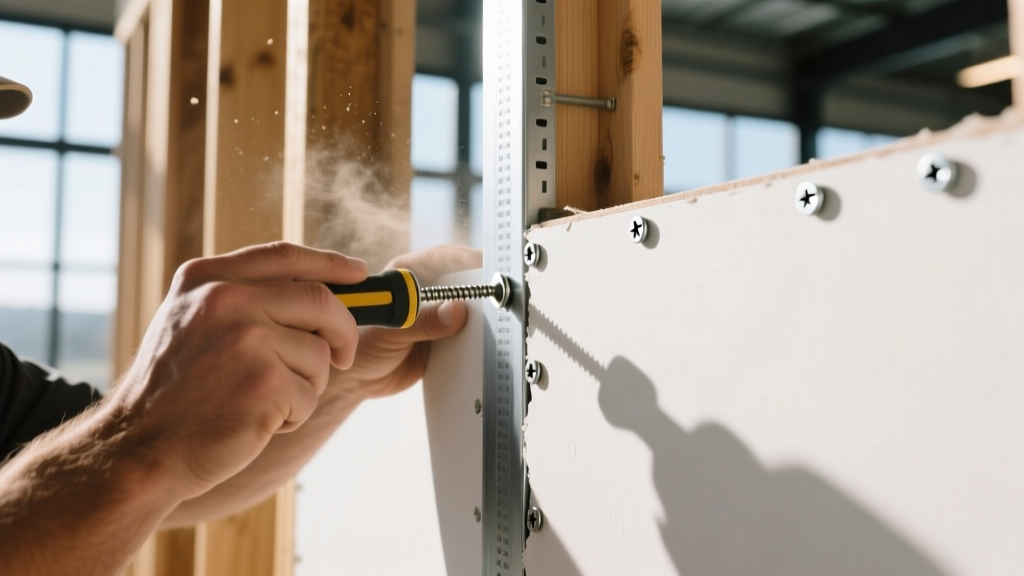
- Fastener Spacing: For 1-hour rated walls, screws must be spaced a maximum of 7 inches on center (o.c.) at the edges and 12 inches o.c. in the field. Over-driving screws (breaking the paper face) compromises the holding power and voids the fire rating.
- Joint Compound: Standard drying-type joint compound shrinks as it cures and can crack under thermal stress. Fire-rated assemblies require setting-type compounds (e.g., 45-minute or 90-minute chemical-set mud) reinforced with paper tape to maintain joint integrity during the ASTM E119 test curve.
Integrating Intumescent Coatings for Structural Steel
Unprotected structural steel loses approximately 50% of its yield strength at 1,100°F (593°C), a temperature easily reached within 10 minutes of a standard commercial flashover. When architectural designs require exposed steel, spray-applied fire-resistive materials (SFRM) or intumescent coatings are mandatory.
Modern thin-film intumescents (such as Sherwin-Williams FIRETEX or Nullifire SC902) expand up to 50 times their original thickness when heated past 392°F (200°C), forming a dense, carbonaceous char that insulates the steel. Application requires strict environmental controls: ambient temperature must remain above 50°F (10°C), and relative humidity must stay below 85% during application and curing to prevent solvent entrapment, which causes blistering and catastrophic delamination during a fire event.
Penetration Seals and Firestopping: The Weak Link
A 2-hour rated wall assembly is rendered useless if a 4-inch HVAC duct or electrical conduit penetrates it without a tested firestop system. The International Building Code (IBC) mandates that all penetrations in fire-resistance-rated assemblies must be protected by an approved through-penetration firestop system tested to ASTM E814 or UL 1479.
Effective firestopping relies on a combination of materials designed to manage both combustible and non-combustible penetrations:
- Mineral Wool Packing: High-density (minimum 8 pcf) mineral wool is compressed into the annular space to provide a rigid, non-combustible backing. Fiberglass batts are strictly prohibited in firestop applications as they melt at roughly 1,200°F.
- Intumescent Sealants: Products like Hilti CP 606 or 3M Fire Barrier Sealant FD 150 are applied over the mineral wool. When exposed to heat, these elastomeric sealants expand (intumesce) to crush melting PVC pipes or seal the gaps left by burned-away combustible insulation.
- Firestop Putty/Pillows: For temporary or frequently changed cable trays, intumescent putty pads or compression pillows allow for easy cable additions without breaking a cured chemical seal.
Code Compliance and Exterior Wall Testing
While interior assemblies focus on compartmentalization, exterior walls in multi-story buildings face the risk of vertical fire spread via leapfrogging flames from broken windows. This is governed by NFPA 285, the Standard Fire Test Method for Evaluation of Fire Propagation Characteristics of Exterior Wall Assemblies Containing Combustible Components.
If an exterior wall assembly incorporates combustible elements—such as rigid polyisocyanurate foam insulation, weather-resistive barriers (WRBs), or composite metal panels (MCM)—and the building exceeds 40 feet in height (under IBC Type I or II construction), the entire assembled wall must pass the NFPA 285 two-story burn test. Substituting a specified WRB for a different brand on the job site, even if it carries an identical flame-spread index, automatically voids the NFPA 285 compliance because the test evaluates the specific chemical interaction of the exact assembled components. Always verify the specific manufacturer's tested assembly manuals before approving material submittals on the site.
'Fire resistance is an assembly property, not a material property. A single product does not possess a fire rating; the tested configuration of studs, fasteners, insulation, and board layers dictates the legal rating of the structure.'
Written by
Priya KapoorPriya Kapoor is a real estate market analyst and construction economics researcher with expertise in housing affordability, development feasibility, and infrastructure investment. She holds a Master of Regional Planning from Cornell University and previously worked as a senior analyst at CBRE's Investment Properties group, where she modeled returns for $4B in mixed-use development pipelines. Priya now runs an independent research practice advising developers, municipalities, and REITs on construction cost forecasting and market timing. She publishes the quarterly "BuildMat Market Pulse" report tracking material price indices across 12 commodity categories. Based in Austin, TX, Priya serves on the board of Habitat for Humanity Austin and is a marathon runner.
More from Priya Kapoor
View all
Construction Cost
Cost to Build a 1600 Sq Ft Home in 2026: Full Breakdown
Accurate 2026 cost to build a 1600 sq ft home—material, labor, and regional pricing breakdowns included. Plan your budget with real-time estimates.
Aug 11, 2026

Wood & Lumber
Name the Types of Wood for Pressure Treatment and Preservation
Learn how to name the types of wood best suited for pressure treatment. Compare species treatability, chemical retention levels, and 2026 preservation costs.
Aug 4, 2026

Stone & Masonry
Stone Veneer Suppliers Lindenhurst: 2026 Cost Analysis
Analyze 2026 stone veneer costs in Lindenhurst, NY. Compare local supplier pricing, delivery fees, and Suffolk County installation labor rates.
Aug 4, 2026