How Much Does It Cost to Build a Fire Pit? 2026 Certified Guide
Discover how much it costs to build a fire pit using certified, fire-rated materials in 2026. Compare ASTM standards, refractory costs, and permits.

The True Cost of a Code-Compliant, Fire-Rated Fire Pit
When researching how much does it cost to build a fire pit, most consumer landscaping guides cite $300 to $800 for a basic masonry ring. However, from a fire-safety testing and material certification perspective, these estimates rely on untested, non-refractory materials that frequently fail under thermal cycling. Standard clay bricks and Portland cement mortar spall, crack, and occasionally explode when subjected to the 1,200°F+ temperatures of a concentrated wood fire.
In 2026, building a genuinely safe, code-compliant fire pit using ASTM-certified refractory materials shifts the budget from a simple DIY weekend project to a specialized masonry build. A fully certified, fire-rated residential fire pit typically costs between $1,800 and $4,500, while commercial hospitality builds requiring third-party engineering stamps and UL-listed gas inserts routinely exceed $12,000.
Material Cost Breakdown: Standard vs. Certified Fire-Resistant
The core driver of fire pit costs is the thermal rating of the materials in direct contact with the combustion zone. Certified refractory materials are engineered to withstand rapid temperature changes without structural degradation.
| Component | Standard Material (Non-Certified) | Certified Fire-Resistant Material | Cost Delta (Per Sq. Ft.) |
|---|---|---|---|
| Inner Lining Brick | Standard Red Clay Brick | ASTM C27 Fireclay Brick (Medium Duty) | +$18 - $24 |
| Binding Mortar | Portland Cement / Type N | ASTM C199 Refractory Mortar (HeatStop) | +$12 - $16 |
| Base Foundation | Compacted Gravel / Sand | Insulated Refractory Concrete (Castable) | +$35 - $50 |
| Spark Containment | None / Decorative Wire Mesh | ASTM E2768 Tested Spark Arrestor | +$120 - $250 (Flat Rate) |
Refractory Liners and Firebrick (ASTM C27)
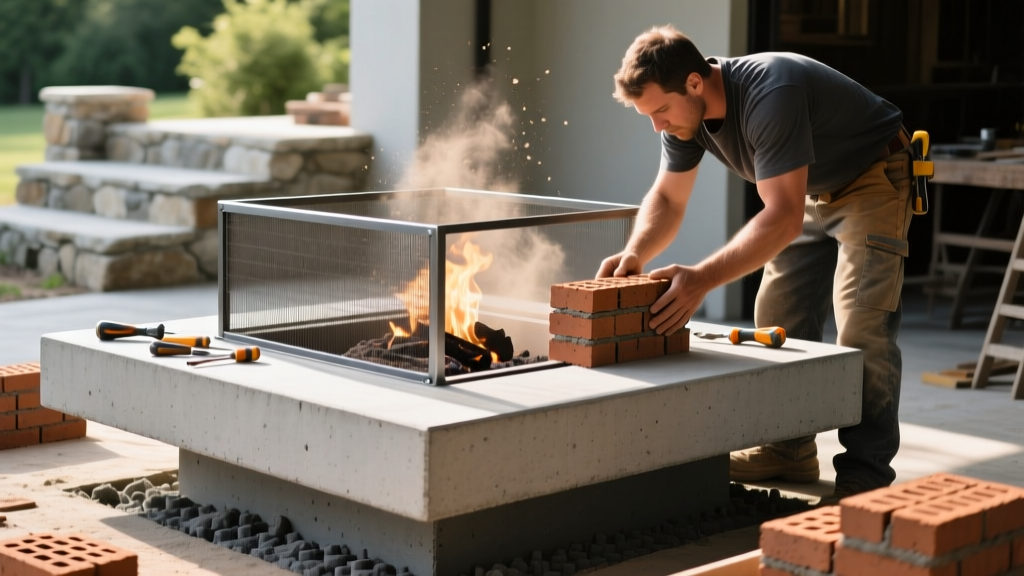
Standard clay bricks contain trapped moisture and air pockets. When heated rapidly, the moisture turns to steam, creating internal pressure that causes the brick to fracture violently. ASTM C27-rated fireclay bricks are fired at extreme temperatures during manufacturing, eliminating trapped moisture and ensuring structural integrity up to 2,460°F. For a standard 4-foot diameter fire pit requiring roughly 60 interior bricks, upgrading to certified firebrick adds approximately $250 to $400 to the material cost, but prevents catastrophic structural failure.
Fire-Rated Mortar and Concrete (ASTM C199)
Traditional mortar loses its adhesive properties at temperatures above 400°F. Certified refractory mortars, such as those meeting ASTM C199 standards, utilize calcium aluminate cements that actually cure and strengthen when exposed to high heat. A 50lb bag of standard mortar costs roughly $15, whereas a 50lb bucket of certified refractory mortar costs $65 to $90.
The Hidden Costs: Testing, Certification, and Inspections
For residential builds, 'certification' usually means passing local municipal fire inspections based on NFPA guidelines and local zoning ordinances. However, for commercial spaces (restaurants, hotels, HOA common areas), the testing and certification costs scale significantly.
If your property is located in a designated WUI zone, local codes mandate strict ember-resistant construction. You will be required to install tested spark arrestors and maintain specific clearance distances from combustible structures. Failing a WUI inspection can result in mandatory teardowns, adding $1,500+ in sunk demolition costs. Always verify your property's WUI status with the local fire marshal before purchasing materials.
Commercial Engineering Stamps and Third-Party Testing
Commercial fire pits must often be stamped by a licensed structural or fire protection engineer to prove they can handle continuous thermal loading without compromising adjacent structural concrete or decking. An engineering review and stamp typically costs between $1,500 and $3,500. If the design utilizes a custom gas burner, the assembly must be tested to ANSI Z21.97 standards for outdoor decorative gas appliances, which requires sending the prototype to a testing lab like UL or CSA Group. Lab certification for a custom gas fire pit assembly ranges from $8,000 to $15,000, which is why most commercial builders opt for pre-certified, UL-listed drop-in gas burner kits instead of custom fabrication.
Gas vs. Wood: Certification Cost Differences
The fuel source dictates the testing framework and the associated compliance costs. Gas fire pits require rigorous leak testing, pressure regulation certification, and wind-resistance testing to prevent unignited gas pooling.
- Wood-Burning Certification: Primarily focuses on structural fire endurance (ASTM E119 for adjacent walls) and spark containment. Testing costs are lower, mostly limited to local fire marshal inspection fees ($150 - $350).
- Gas-Burning Certification: Requires ANSI Z21.97 compliance. A pre-certified, UL-listed outdoor gas burner kit (e.g., a 24-inch stainless steel H-burner with a built-in flame rectification safety sensor) costs $850 to $2,200. This includes the cost of the manufacturer's liability testing, passed on to the consumer. Custom gas lines require a licensed plumber and a secondary pressure inspection ($200 - $450).
Regional Code Variations and Permit Fees
Permit costs and testing requirements vary wildly by jurisdiction. In high-risk fire zones like California or Colorado, the International Wildland-Urban Interface Code (IWUIC) heavily influences local amendments.
| Region / Zone Type | Typical Permit Fee | Specific Testing / Code Requirement |
|---|---|---|
| Standard Suburban (Non-WUI) | $50 - $150 | Basic setback rules (usually 15-25 ft from structures). No material testing required if under 3ft diameter. |
| High-Density Urban | $150 - $300 | Wood-burning often banned. Gas requires certified plumber sign-off and wind-sensor auto-shutoff testing. |
| WUI / Fire Hazard Zone | $250 - $600 | Mandatory spark arrestor testing, non-combustible base extending 10ft radially, ember-resistant zone enforcement. |
Expert Framework: Budgeting for a Zero-Clearance Certified Build
If you are building a fire pit on a combustible surface (like a wooden deck or composite patio) and require a 'zero-clearance' rating, the cost structure changes entirely. You cannot use standard masonry. You must utilize tested, insulated zero-clearance chassis systems.
- The Chassis ($1,200 - $3,000): Purchase a UL-listed, zero-clearance outdoor fire pit chassis. These feature dual-wall stainless steel construction with ceramic fiber insulation (rated to 2,000°F) that keeps the exterior shell below the 160°F combustible touch-point threshold.
- The Surround ($800 - $2,500): Clad the chassis in non-combustible materials. Use calcium silicate boards (like Promat PROMATECT) as a secondary thermal break before attaching stone veneer. Standard cement backer board is not rated for the direct radiant heat of a zero-clearance fire pit and will degrade over time.
- Gas Integration ($600 - $1,200): Hardpipe the gas line using tested, leak-free fittings. Flexible corrugated stainless steel tubing (CSST) must be grounded and bonded to meet modern electrical and fire codes, adding $250 to the electrical contractor's bill.
Frequently Asked Questions
Does a certified fire pit increase home insurance premiums?
Generally, no. In fact, providing documentation that your fire pit was built using ASTM-certified refractory materials and passed local fire marshal inspections can prevent liability disputes in the event of an accidental property fire. Uncertified, DIY wood-burning pits that violate setback codes can lead to claim denials.
How often does refractory mortar need to be replaced?
Properly mixed and cured ASTM C199 refractory mortar should last the lifetime of the fire pit (15-25 years). However, if standard Portland cement was mistakenly used, it will begin to powder and fail within 1 to 2 years of thermal cycling, requiring a complete teardown and rebuild.
Are portable steel fire pits subject to the same testing standards?
Factory-built portable steel fire pits are tested under different consumer product safety standards (like CPSC guidelines) rather than structural masonry codes. However, they must still feature tested spark screens and are subject to the same municipal setback and WUI ember-containment laws as permanent masonry structures.
Written by
David NakamuraDavid Nakamura is a licensed architect (AIA) and construction technology writer focused on sustainable building methods, mass timber engineering, and high-performance building envelopes. He holds a Master of Architecture from the University of Washington and is a certified Passive House Consultant (CPHC). David spent eight years at the Seattle firm Mithun, where he led the design of three LEED Platinum projects, before founding his own practice specializing in net-zero residential design. He serves on the editorial advisory board of GreenBuilder Magazine and has authored peer-reviewed papers on cross-laminated timber (CLT) connections for the Journal of Structural Engineering. In his spare time, David teaches woodworking at Pratt Fine Arts Center and kayaks the Puget Sound.
More from David Nakamura
View all
Construction Cost
Labor Cost to Build a Deck Per Sq Ft: 2026 Installation Guide
Discover the exact labor cost to build a deck per sq ft in 2026. This installation guide breaks down contractor rates, complexity factors, and hidden fees.
Aug 4, 2026

Construction Cost
How Much Does It Cost to Build a 3 Bedroom House? Financing Guide
Learn exactly how much it costs to build a 3 bedroom house and explore 2026 financing options, construction loan types, and budget frameworks for your build.
Aug 4, 2026

Construction Cost
Cost to Build a Tennis Court: 2026 Guide
How much does it cost to build a tennis court in 2026? Breakdowns for asphalt, concrete, and synthetic surfaces plus fencing and lighting.
Jul 30, 2026