How Much Does It Cost to Build an Outdoor Fireplace? 2026 Guide
Learn how much it costs to build an outdoor fireplace in 2026. We break down masonry vs. prefab pricing, fire code compliance, and material requirements.

The True Cost of Code-Compliant Outdoor Fireplaces
When homeowners ask, 'how much does it cost to build an outdoor fireplace,' the answers they find online often range from $3,000 to $15,000. However, these estimates frequently ignore the single largest variable in modern construction: fire code compliance. In 2026, building an outdoor fireplace is not simply about stacking stone and lighting a fire; it requires strict adherence to the International Residential Code (IRC) Chapter 10 and NFPA 211 standards. Failing to budget for code-mandated fire-resistant materials, structural clearances, and permitting will result in failed inspections, torn-down masonry, and ballooning costs.
For a fully permitted, code-compliant custom masonry outdoor fireplace, expect to pay between $8,500 and $14,500 in 2026. Prefabricated outdoor fireboxes installed with compliant non-combustible surrounds offer a lower entry point, typically ranging from $4,200 to $7,800. Below, we break down exactly where your budget goes and how fire safety codes dictate your material selection.
2026 Baseline Cost Breakdown: Masonry vs. Prefabricated
The divergence in cost primarily stems from the labor intensity of masonry work and the specific fire-rated materials required by local building departments. The table below outlines the average national costs for a standard 4-foot wide outdoor fireplace installation.
| Cost Category | Custom Masonry Build | Prefabricated (Prefab) Insert |
|---|---|---|
| Firebox Core Materials | $1,800 - $2,500 (Firebrick, refractory mortar) | $1,500 - $3,200 (UL-listed steel unit) |
| Veneer & Surround | $2,500 - $5,000 (Natural stone, stucco) | $1,200 - $2,500 (Cement board, stone veneer) |
| Labor & Masonry | $3,500 - $6,000 (40-60 hours) | $1,200 - $1,800 (15-25 hours) |
| Permits & Inspections | $250 - $600 | $150 - $400 |
| Total Estimated Cost | $8,050 - $14,100 | $4,050 - $7,900 |
The Code Compliance Multiplier: Mandatory Fire-Resistant Materials
According to the International Residential Code (IRC) Section R1001, the firebox of a masonry fireplace must be lined with a material capable of withstanding extreme thermal shock without transferring destructive heat to the surrounding structure. This is where your material budget must be strictly allocated.
1. Firebrick Liners (ASTM C27)
Standard clay bricks will spall, crack, and eventually explode under the repeated thermal cycling of a wood fire. Code requires the use of medium-duty firebrick meeting ASTM C27 specifications.
2026 Cost Impact: Firebricks cost between $1.85 and $2.75 per unit. A standard 4-foot firebox requires approximately 150 to 200 bricks, adding $275 to $550 purely for the inner lining.
2. Refractory Mortar (ASTM C199)
Standard Type N or Type S masonry mortar contains Portland cement, which degrades rapidly at temperatures exceeding 1,000°F. The joints in your firebox must be laid with refractory mortar (meeting ASTM C199), which utilizes fireclay and calcium aluminate.
2026 Cost Impact: A 50 lb. bucket of premixed refractory mortar costs roughly $45 to $65. You will need 4 to 6 buckets for a standard firebox, adding $180 to $390 to the budget.
Many DIY builders forget the structural lintel above the fireplace opening. The IRC mandates a non-combustible lintel (typically a 3.5-inch x 3.5-inch x 1/4-inch steel angle iron) to support the masonry above the firebox opening. Custom-cut, galvanized steel lintels add $120 to $250 to the material cost but are an automatic inspection failure if omitted.
Clearance to Combustibles: The Most Expensive Code Trap
The most common reason outdoor fireplace projects fail inspection or require costly rebuilding is the violation of clearance to combustibles. If your outdoor fireplace is integrated into a covered patio, pergola, or attached to a wood-framed house, IRC R1001.11 dictates strict spatial rules.
- The 2-Inch Air Space Rule: All combustible framing (wood posts, roof joists) must maintain a minimum 2-inch air space from the exterior of the masonry chimney and firebox. This air space cannot be filled with insulation or mortar.
- The 12-Inch Masonry Rule: If an air space is not maintained, the masonry wall separating the firebox from the combustible structure must be a minimum of 12 inches thick (nominally a double-wythe brick wall).
Budget Impact: Designing a double-wythe masonry wall or engineering a steel-framed, non-combustible pergola attachment to maintain the 2-inch clearance can add $1,500 to $3,000 in structural engineering and specialized labor costs.
Hearth Extensions and Spark Arrestors
Outdoor fireplaces are subject to the same embers and radiant heat hazards as indoor units. The Brick Industry Association Technical Notes and the IRC outline two mandatory safety features that directly impact your final invoice.
Non-Combustible Hearth Extensions (IRC R1001.9)
You cannot place a wood deck directly against the firebox opening. The code requires a non-combustible hearth extension extending at least 16 inches in front of the opening and 8 inches on each side (for openings under 6 square feet).
Material Solution: Poured concrete slabs, natural flagstone set in mortar, or heavy-duty pavers. Budget an additional $400 to $900 for hearth extension materials and substrate preparation.
Spark Arrestors (IRC R1003.9)
In wildfire-prone regions (such as California's WUI zones) and many standard municipalities, a spark arrestor is legally required on the chimney flue. The mesh must be made of corrosion-resistant steel with openings no smaller than 1/2 inch and no larger than 5/8 inch.
Cost: A stainless steel, code-compliant spark arrestor cap costs between $150 and $350, plus installation labor.
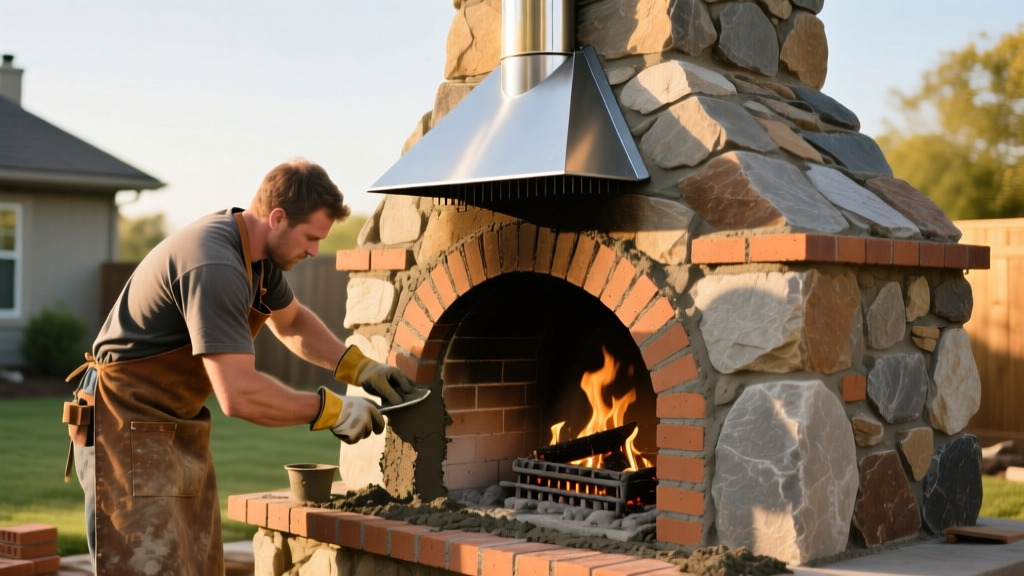
Decision Matrix: Wood-Burning vs. Gas Outdoor Fireplaces
When determining how much it costs to build an outdoor fireplace, the fuel source drastically alters the code pathway and the final price. Gas fireplaces bypass many of the heavy masonry requirements of wood-burning units, provided you use a listed outdoor gas firebox.
| Feature | Wood-Burning Masonry | Direct-Vent Gas Insert |
|---|---|---|
| Governing Code | IRC Chapter 10 / NFPA 211 | ANSI Z21.89 / IRC Chapter 24 |
| Firebox Material | ASTM C27 Firebrick & Refractory Mortar | UL-Listed Stainless Steel Prefab Unit |
| Chimney Requirements | Class A insulated pipe or masonry flue tile | Co-axial direct vent pipe (can vent horizontally) |
| Hearth Extension | Mandatory (16" front / 8" sides) | Often waived by manufacturer specs (check listing) |
| Average 2026 Cost | $8,500 - $14,500 | $5,500 - $9,500 (includes gas line trenching) |
The Permitting and Inspection Sequence
Budgeting for the physical materials is only half the equation. To ensure your outdoor fireplace is legal and insurable, you must navigate the local building department. Expect to pay $150 to $500 in permit fees, depending on your municipality. The inspection process generally follows three mandatory phases:
- Footing and Rebar Inspection: Before any masonry is laid, the inspector must verify that the concrete footing extends below the local frost line (typically 12 to 36 inches) and contains the required #4 or #5 rebar grid to prevent settling and structural cracking.
- Firebox and Flue Liner Inspection: The inspector will check the firebrick layout, refractory mortar joints, and the installation of the clay flue liner or Class A chimney pipe before the exterior stone veneer is applied.
- Final Clearance and Cap Inspection: Once the veneer is complete, the inspector measures the clearance to any nearby patio covers, verifies the hearth extension dimensions, and ensures the spark arrestor is securely fastened.
Expert Checklist for First-Pass Inspection Approval
To avoid the catastrophic costs of tearing down a finished stone veneer because of a hidden code violation, verify these specific details with your masonry contractor before signing the contract:
- Ash Dump Cleanouts: If your design includes an ash dump, the exterior cleanout door must be made of ferrous metal (steel or iron) and fitted with a tight-sealing latch to prevent wind from blowing ashes into the yard.
- Expansion Joints: The clay flue liner must not be mortared tightly to the surrounding masonry. It requires a 1/2-inch expansion joint filled with ceramic fiber rope to allow the liner to expand independently of the brickwork during heating.
- Smoke Chamber Parging: The area just above the damper (the smoke chamber) must be parged smooth with refractory mortar to prevent creosote buildup and ensure proper draft. Rough, stepped brickwork in this zone is an immediate red flag for inspectors.
Understanding how much it costs to build an outdoor fireplace requires looking past the aesthetic stone veneer and budgeting for the fire-resistant engineering beneath it. By allocating your budget toward ASTM-rated firebricks, proper structural clearances, and mandatory safety caps, you ensure your outdoor living space is both a stunning focal point and a legally compliant, safe investment.
Written by
David NakamuraDavid Nakamura is a licensed architect (AIA) and construction technology writer focused on sustainable building methods, mass timber engineering, and high-performance building envelopes. He holds a Master of Architecture from the University of Washington and is a certified Passive House Consultant (CPHC). David spent eight years at the Seattle firm Mithun, where he led the design of three LEED Platinum projects, before founding his own practice specializing in net-zero residential design. He serves on the editorial advisory board of GreenBuilder Magazine and has authored peer-reviewed papers on cross-laminated timber (CLT) connections for the Journal of Structural Engineering. In his spare time, David teaches woodworking at Pratt Fine Arts Center and kayaks the Puget Sound.
More from David Nakamura
View all
Construction Cost
Labor Cost to Build a Deck Per Sq Ft: 2026 Installation Guide
Discover the exact labor cost to build a deck per sq ft in 2026. This installation guide breaks down contractor rates, complexity factors, and hidden fees.
Aug 4, 2026

Construction Cost
How Much Does It Cost to Build a 3 Bedroom House? Financing Guide
Learn exactly how much it costs to build a 3 bedroom house and explore 2026 financing options, construction loan types, and budget frameworks for your build.
Aug 4, 2026

Construction Cost
Cost to Build a Tennis Court: 2026 Guide
How much does it cost to build a tennis court in 2026? Breakdowns for asphalt, concrete, and synthetic surfaces plus fencing and lighting.
Jul 30, 2026