Selecting Fire Resistance Materials: A Complete Safety Guide
Discover how to select the best fire resistance materials for your build. Learn about ASTM ratings, code compliance, and top products for structural safety.

The Science of Fire Resistance: Beyond the Misnomer of 'Fireproof'
In commercial and multi-family construction, the term 'fireproof' is a dangerous misnomer. No building material is entirely immune to fire indefinitely. Instead, the construction industry relies on fire resistance materials—components and assemblies engineered to contain flames, restrict heat transfer, and maintain structural integrity for a measured duration. Understanding this distinction is the first step in designing code-compliant, life-saving structures.
When exposed to a standard building fire, temperatures can reach 1,700°F (927°C) within the first hour and exceed 2,000°F (1,093°C) by the second hour. Fire resistance materials function through three primary mechanisms: ablation (charring or calcining to absorb heat), intumescence (swelling to form an insulating carbon char), and thermal mass (dense materials like concrete that conduct heat slowly).
Decoding Fire Ratings: ASTM E119 and the Hose-Stream Test
To legally specify fire resistance materials, architects and contractors must rely on standardized testing protocols. The gold standard in North America is ASTM E119 (Standard Test Methods for Fire Tests of Building Construction and Materials), which is virtually identical to UL 263.
Under ASTM E119, a wall, floor, or structural column assembly is subjected to a controlled furnace fire that follows a strict time-temperature curve. However, surviving the furnace is only half the battle. To achieve a certified fire rating, the assembly must also pass the hose-stream test. Immediately after the furnace exposure, the superheated assembly is blasted with water from a fire hose at a specific pressure. This simulates the thermal shock and physical impact of actual firefighting operations. If the material shatters, delaminates, or allows water to pass through, it fails the rating.
| Rating | Furnace Temp at Failure | Typical IBC Application | Common Assembly |
|---|---|---|---|
| 1-Hour | 1,700°F (927°C) | Corridor walls, tenant separations | One layer 5/8" Type X gypsum per side |
| 2-Hour | 1,850°F (1,010°C) | Stairwell enclosures, shaft walls | Two layers 5/8" Type X gypsum per side |
| 3-Hour | 1,925°F (1,052°C) | High-rise structural columns | Multiple layers Type C gypsum or concrete encasement |
| 4-Hour | 2,000°F (1,093°C) | Property line walls, vaults | Masonry, concrete, or specialized calcium silicate |
Top Fire Resistance Materials for Structural and Interior Applications
Selecting the right material depends on the substrate (steel, wood, or concrete), the required hourly rating, and aesthetic requirements. Below is a technical breakdown of the most reliable fire resistance materials used in modern construction.
1. Type X and Type C Gypsum Board
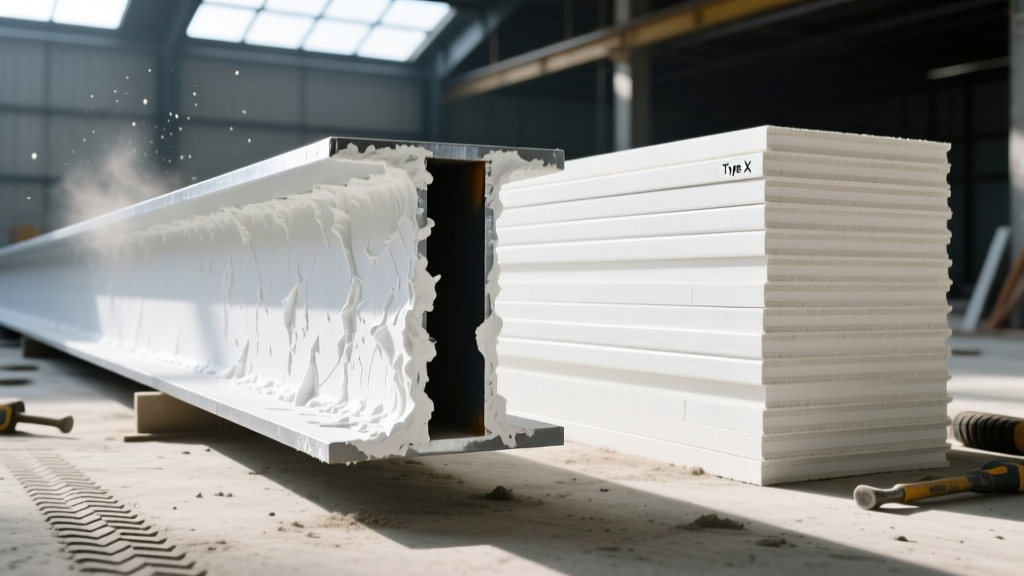
Standard gypsum board contains chemically combined water (calcium sulfate dihydrate). When exposed to fire, this water calcines, releasing steam that actively cools the wall cavity. According to the Gypsum Association, Type X gypsum (typically 5/8-inch thick) includes glass fibers and other additives to reinforce the core after the water is driven off, preventing the board from crumbling during the hose-stream test. Type C (or Enhanced Type X) features a denser core with a higher concentration of glass fibers and vermiculite, allowing for fewer layers to achieve 2-hour and 3-hour ratings. Products like USG Sheetrock Firecode X remain the industry baseline for interior fire separations.
2. Intumescent Coatings for Structural Steel
Unprotected structural steel loses 50% of its load-bearing capacity at roughly 1,100°F (593°C), which can occur in just 5 to 10 minutes of a standard fire. Intumescent paints provide a solution without adding the massive weight of concrete encasement. When heated above 392°F (200°C), the coating undergoes a chemical reaction, expanding 20 to 50 times its original thickness to form a rigid, carbonaceous char. This char insulates the steel. For a 2-hour rating on a W12x26 steel beam, a product like Nullifire SC902 requires a precise Dry Film Thickness (DFT) of roughly 35 to 45 mils, verified via ultrasonic testing during application.
3. Calcium Silicate Boards
For environments where gypsum is too fragile or susceptible to moisture, calcium silicate boards (such as Promat PROMATECT or Skamol) offer extreme durability. These boards can withstand continuous temperatures up to 1,200°C (2,192°F) without structural degradation. They are heavily utilized for fireproofing elevator shafts, encasing structural steel in parking garages, and protecting HVAC ductwork to prevent fire migration between floors.
4. Mineral Wool and Firestop Sealants
Fire resistance is only as strong as the weakest penetration. Mineral wool insulation (e.g., Rockwool Safe'n'Sound) has a melting point exceeding 2,150°F (1,176°C) and is used to pack wall cavities and floor penetrations. However, mineral wool must be paired with tested firestop sealants. When PVC pipes or electrical cables melt in a fire, the resulting hole must be sealed by an expanding, ablative sealant like 3M Fire Barrier Sealant CP 25WB+ to maintain the wall's ASTM E119 rating.
Code Compliance: Navigating the International Building Code (IBC)
Material selection must align with Chapter 7 of the International Building Code (IBC), which dictates fire-resistance requirements based on a building's Construction Type (e.g., Type I-A, Type III-B) and Occupancy Group. For example, a Type I-A high-rise requires a 3-hour fire-resistance rating for its primary structural frame and 2-hour ratings for exterior bearing walls. Contractors must ensure that the specific assembly they build matches a tested design listed in the UL Fire Resistance Directory or the Gypsum Association's GA-600 Fire Resistance and Sound Control Design Manual. Substituting a brand of firestop caulk or using a different stud gauge than what is specified in the tested design legally voids the fire rating.
Cost Analysis: Budgeting for Fire-Rated Assemblies
Fire resistance materials carry a premium over standard construction materials, but they are non-negotiable for code compliance. Below is a comparative cost analysis for achieving a 2-hour fire rating across different substrates, reflecting 2026 material and labor averages.
| Material System | Material Cost | Labor Cost | Total Installed | Best Application |
|---|---|---|---|---|
| Double-Layer Type X Gypsum (Wood/Metal Stud) | $1.80 - $2.50 | $2.50 - $3.50 | $4.30 - $6.00 | Interior partition walls, corridor enclosures |
| Thin-Film Intumescent Paint (Structural Steel) | $4.00 - $6.50 | $3.50 - $5.00 | $7.50 - $11.50 | Exposed architectural steel, atriums |
| Calcium Silicate Board Encasement | $3.50 - $5.00 | $4.00 - $6.00 | $7.50 - $11.00 | Exterior columns, damp environments, shafts |
| Spray-Applied Fire Resistive Material (SFRM) | $1.20 - $2.00 | $1.50 - $2.50 | $2.70 - $4.50 | Concealed structural steel, parking garages |
Common Installation Failures and How to Avoid Them
Even the highest-rated fire resistance materials will fail if installed incorrectly. Building forensics reveal three recurring errors that compromise fire assemblies:
- The 'Head-of-Wall' Gap: Leaving a gap between the top of a gypsum partition and the concrete deck above to allow for floor deflection. If this gap is not filled with a tested, compressible firestop material (like mineral wool and an elastomeric firestop sealant), smoke and fire will bypass the 2-hour wall in minutes.
- Over-thinning Intumescent Paint: Applicators sometimes thin intumescent coatings to make spraying easier or to save material. This alters the chemical expansion ratio. The coating will char, but it will not achieve the required thickness to insulate the steel, leading to premature structural collapse.
- Unrated Electrical Boxes: Installing standard plastic electrical boxes back-to-back on opposite sides of a 1-hour rated wall. The plastic melts, creating a direct path for fire. Always use rated electrical boxes equipped with intumescent pads, or stagger the boxes horizontally by at least 24 inches.
Frequently Asked Questions (FAQ)
Can I mix different brands of firestop materials in a single penetration?
No. UL and ASTM fire ratings are granted to specific, tested systems. A tested design might specify 3M mineral wool and 3M CP 25WB+ sealant. Substituting the sealant for a Hilti or Specified Technologies Inc. (STI) product, even if that product is rated for 2 hours on its own, legally voids the assembly because the specific chemical interaction and expansion rates were not tested together.
Does adding more layers of standard drywall equal a fire-rated assembly?
Not necessarily. While multiple layers of standard 1/2-inch gypsum do add mass and delay heat transfer, they lack the glass fibers required to hold the core together after the calcined water evaporates. Without those fibers, standard drywall will crack and fall off the studs during the hose-stream test. You must use specifically manufactured Type X or Type C fire-rated gypsum board to achieve a certified rating.
How do I maintain the fire rating of an intumescent-coated steel beam?
Intumescent coatings are highly sensitive to physical damage and moisture. If the coating is scratched, dented, or exposed to prolonged humidity without a protective topcoat, its ability to expand is compromised. Facility managers must conduct annual visual inspections and repair any damaged areas using the exact same manufacturer's patching compound, verified to the correct mil thickness.
Written by
David NakamuraDavid Nakamura is a licensed architect (AIA) and construction technology writer focused on sustainable building methods, mass timber engineering, and high-performance building envelopes. He holds a Master of Architecture from the University of Washington and is a certified Passive House Consultant (CPHC). David spent eight years at the Seattle firm Mithun, where he led the design of three LEED Platinum projects, before founding his own practice specializing in net-zero residential design. He serves on the editorial advisory board of GreenBuilder Magazine and has authored peer-reviewed papers on cross-laminated timber (CLT) connections for the Journal of Structural Engineering. In his spare time, David teaches woodworking at Pratt Fine Arts Center and kayaks the Puget Sound.
More from David Nakamura
View all
Construction Cost
Labor Cost to Build a Deck Per Sq Ft: 2026 Installation Guide
Discover the exact labor cost to build a deck per sq ft in 2026. This installation guide breaks down contractor rates, complexity factors, and hidden fees.
Aug 4, 2026

Construction Cost
How Much Does It Cost to Build a 3 Bedroom House? Financing Guide
Learn exactly how much it costs to build a 3 bedroom house and explore 2026 financing options, construction loan types, and budget frameworks for your build.
Aug 4, 2026

Construction Cost
Cost to Build a Tennis Court: 2026 Guide
How much does it cost to build a tennis court in 2026? Breakdowns for asphalt, concrete, and synthetic surfaces plus fencing and lighting.
Jul 30, 2026